Understanding Your Paycheck

Understanding Your First Paycheck for College Graduates

If you are anything like me, you may be surprised when you get your first paycheck. Until that moment, I had only worked jobs as an independent contractor, where earning a $1 meant actually receiving a $1. If you’ve accepted a job as a true W2 employee after graduation, you likely negotiated a salary that doesn’t reflect your actual take-home pay. It may not be close at all, leading you to wonder, “I think there is something wrong with my paycheck.” In this blog and the accompanying video, we clarify essential terms for recent college graduates and anyone curious about their paystub, providing a jump start to understanding the United States tax code.

Independent Contractor vs. Employee

First, it’s important to understand the difference between how the person is viewed performing the work for the business. Are you an employee of the company or an independent contractor? Certainly, some companies operate in a grey area when it comes to classifying labor. You may feel like an employee, only to discover after reading this article that you’re actually classified as an independent contractor, which essentially makes you a business owner! For this article, we will set aside the legality of the matter regarding your employer in the eyes of the Department of Labor.

There is nothing inherently good or bad about this, but there is a stark difference in your benefit eligibility, tax responsibility, and ability to make certain deductions. A deduction is something that ultimately lowers your taxable income. To qualify for many deductions, you need to be self-employed to take advantage of them.

For example, a remote worker cannot claim a home office deduction and deduct this expense from their income. However, if other eligibility requirements are met, an independent contractor can use the home office deduction to reduce their taxable income.

Important Paycheck Terms for Employees

There are three (3) general categories of deductions that reduce your gross pay. 

Employee Taxes: Ordinary income tax + Federal Insurance Contributions Act (FICA) tax that funds Social Security and Medicare

  • Federal Income Tax

  • State Income Tax: 3% for Louisiana residents

  • Old Age, Survivors, and Disability Insurance (OASDI or Social Security): 6.2% on a maximum income of $176,100 in 2025. 

  • Medicare: 1.45% + 0.90% on income over $200,000. 

Pre-Tax Deductions: These will vary depending on your employee benefits, but the common ones are:

  • 401k Contributions

  • Health/Dental/Vision Insurance Premiums

  • Flexible or Health Savings Accounts

Post-Tax Deductions: These will also depend on your employee benefits and selections, but the most common ones are:

  • Roth 401k Contributions

  • Some Life and Disability Insurance Premiums

  • Legal Insurance

Sample Paycheck

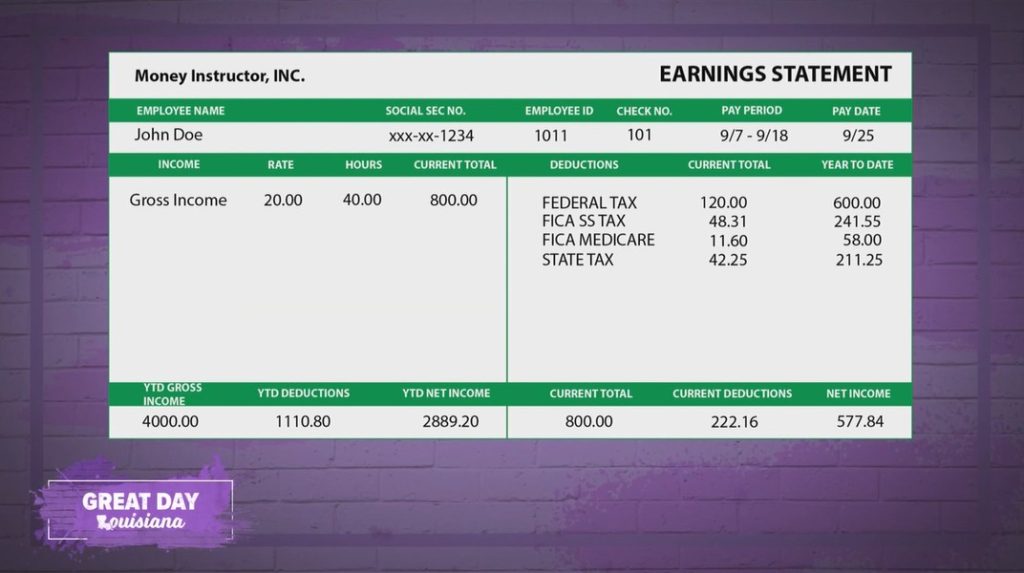
As a basic and common example, here’s what a pay period might look like for an Individual earning $75,000.

Assumptions

  • Tax Filing Status: Single
  • No Dependents
  • Pay Periods: 24 (Semi-Monthly)
  • Pre-Tax 401k Contribution: 4% ($3,000 annual)
  • Roth 401k Contribution: 4% ($3,000 annual)
  • HSA Contribution: $4,300 (2025 Individual Max)
  • Health Insurance Premium: $200/month

In this scenario, the employee’s net pay is 65% of their gross pay. 18% of their income is allocated to taxes, while 17% is earmarked for employee benefits, including health insurance and retirement savings. This leads to the individual having $2,174 less each month to allocate toward their budget for housing, transportation, food, and discretionary expenses. 

If you’re unsure what your net pay might look like, I recommend using 60% as a baseline. This will provide a fair estimate of your actual pay that will reach your checking account before you commit to significant fixed expenses, such as rent or transportation. It also provides an opportunity to begin your journey as a saver or investor, as illustrated in the example above.

Does This Affect Independent Contractors Differently?

As an independent contractor, you’ll be paid, but you won’t get earning statements or paystubs detailing your income. But here’s what you need to understand: you owe taxes!  The United States has a pay-as-you-go tax system. If you have income, you are generally required to make payments as you earn it. As an employee, this occurs through your paystub via mandatory company withholding, as shown above. For independent contractors, you are responsible for estimating what you will owe, setting that money aside, and remitting payment quarterly. If you don’t pay your estimated taxes quarterly, you could face underpayment penalties come the tax deadline (April 15th of the following year). 

Here are the dates you are expected to estimate your quarterly taxes owed and pay by:

  • Q1 January – March: April 15th
  • Q2 April – June: June 15th 
  • Q3 July – September: September 15th
  • Q4 October – December: January 15th

As stated, there are no safeguards in place, like the mandatory withholding for employees. If you haven’t paid any taxes, you’re in for a nightmare when your tax filing software spits out the amount owed. Additionally, you owe not only the employee side of the FICA tax but also the employer side (another 7.65%). We’ll save the nuance of correctly making self-employment deductions for another day! Some individuals may not fit neatly into employee or independent contractor categories; for example, one can be an employee while also running a side hustle. Keep reading…

Is My Company's Withholding For Me 100% Accurate?

At the start of employment, everyone will fill out a W-4 Employee Withholding Certificate to instruct their employer how much money to withhold for taxes. Unless you tell them otherwise, they only account for the money they are paying you, along with the information you provide regarding tax filing status and dependents.

Have a side hustle? 

Your employer will only adjust your withholding if you instruct them to do so on your Form W-4 and accurately complete the form to take your additional income into consideration. Otherwise, you will need to manually calculate the taxes owed for this additional income and make quarterly payments, as mentioned in the section above regarding independent contractors. 

The most accurate way to do this is to go online and use the IRS’s Tax Withholding Calculator.

Negotiating Your Next Salary

Not everything that reduces your gross pay to actual pay is bad. In fact, most are either beneficial or, at the very least, unavoidable, like taxes. In our sample pay stub above, this individual had access to a 401k retirement plan and a Health Savings Account. Although not shown here, most (but not all) employers offer matches for these types of accounts. That’s MORE money paid to you than you bargained for. When reviewing job offers or negotiating your salary, it’s crucial to assess the complete range of compensation and benefits available. The most significant variable beyond any form of equity compensation is always health insurance. How attractive are the plan options in terms of the premium amount, as well as the deductible and out-of-pocket maximum?

If you’re a recent college graduate, this is the first paycheck of (hopefully) many! Set aside time to understand the foundational aspects of it so you can prepare for future earnings.

Tips on negotiating your next salary? We got you!

Tips for selecting benefits during open enrollment season? We also got you!

Fiduciary, fee-only, Certified Financial Planner, Mike Turi

Mike Turi, CFP® APMA™ is the Founder and a Lead Financial Planner at Upbeat Wealth, a fee-only firm based in New Orleans and serving clients virtually across the country. He specializes in providing straightforward financial guidance to ambitious young families as they navigate life’s many milestones.

Do you have questions about what we shared in this post, or anything else in general? Feel free to schedule a free consultation or drop us a line!

Sign up for our newsletter (at the bottom of this page) to stay up to speed on our Upbeat Insight.

Disclaimer: All content in this article is provided for educational, general information, and illustration purposes only. None of the information is intended as investment, tax, accounting, or legal advice. Nor is it a recommendation for purchase or sale of any security, or investment advisory services. We encourage you to consult with a financial planner, accountant, and/or legal professional for advice on your specific situation. Read our full disclaimer here.

Preparing for Movement in the Markets

When Do We Officially Enter a Recession?

Recessions are tough to measure definitively, but as the famous saying goes, you know it when you see it. They are typically defined as two consecutive quarters of negative growth in Gross Domestic Product (GDP), a term used to measure a country’s total output of goods and services. As GDP grows, companies hire to meet demand, productivity increases, and laborers earn more money. As GDP shrinks, we will likely see a spike in unemployment, a decrease in asset values, and a reduction in consumer spending. Let’s face it, though. No one thinks of GDP when considering the threat of a recession. It’s… am I going to lose my job? Will my 401k recover?

Lessons from History on Bear Markets

Bear markets (when the market declines by 20%) often coincide with recessions, but accurately timing the market recovery would require a time machine. If this isn’t an impossible task for you, congratulations! You’re the best investor in the world. The challenge, especially for the general public, is that market recoveries historically happen swiftly and at a moment when consumer sentiment is at an all-time low. Here’s a chart from J.P. Morgan showing sentiment cycle lows and subsequent 12-month S&P 500 returns.

You’ll notice the disconnect between present fear and future returns. Things will never have felt worse right before the market pushes higher.

Historical Performances of Bull + Bear Markets

Bear markets are typically measured in months, while bull markets are measured in years. Since 1957, the S&P 500 Index has returned an annualized 10%, yet there are very few years when the return actually fell between 8% and 12%. In fact, across this 67-year period, it has only happened on 7 occasions. Markets tend to have bigger calendar year swings that, historically, have netted out favorably. Here’s a chart presented by First Trust displaying the importance of staying disciplined as a long-term investor.

And to beat this point with a stick (iykyk), here’s another illustration showing how costly it would be if you were caught up in the negative consumer sentiment, sold to cash, and ended up missing the best days as the market recovered!

Compared to a portfolio that remained fully invested, if you were caught in cash during the best days for returns, you’d be kicking yourself!

Missed the 10 Best Days → 54% Less Money

Missed the 20 Best Days → 73% Less Money

Missed the 30 Best Days → 83% Less Money

And as noted by the above graphic’s pie chart, these best days are likely to occur during a bear market. While the COVID-19 pandemic initiated an economic shutdown that resulted in GDP decline and peak unemployment in line with the Recession of 1937, the losses in the markets were a blip. If you hadn’t logged into your investment accounts for a couple of months, you would have never known it even happened. So, setting COVID-19 aside, we haven’t seen an extended contraction of the economy since the financial crisis of 2008. This means that we have twenty-somethings who were barely aware, along with individuals in their thirties who lack perspective on the mental toll of watching their portfolio decline. We even have people in their 40s who probably weren’t investors yet themselves and were just starting their careers. That’s a significant portion of the investing population entering their peak earning years without any first-hand experience on how to prepare for a recession. 

Prepare for Economic Downturns, But Don’t Panic

If you’re anxious right now, you’re not alone. According to the March results of the Harvard Harris Poll, the two biggest concerns for voters right now are price increases/inflation and the economy/jobs. Inflation continues to be the top issue for voters across party lines. Although we are not currently in a recession, we are nearing the definition of one, along with a bear market. However, we cannot predict what will happen next. We haven’t experienced a global trade war for almost a century. And after an emotionally tolling election and with the 24/7 news cycle, it’s difficult to allow yourself the space to step back from making an emotional decision. But as a local advisor and friend, Jude Boudreaux, would say, respond, don’t react

Now is a time for focus and introspection. What opportunities do you have to save more or spend less, and what are your household’s biggest threats?

I’m Already Struggling to Make Ends Meet, How Will I Prepare For An Economic Downturn?

Households have two options for saving more money in preparation for a financial crisis:

  1. Reducing Expenses

  2. Earning More

If you are already living paycheck to paycheck with limited discretionary income, the possibility of losing your income or the rapidly rising cost of goods is a frightening prospect. Reducing expenses is already a finite solution, and if you’re living paycheck to paycheck, your ability to do so is severely diminished. 

Additionally, if your household’s income comes from a single source, you are at greater risk of needing to withdraw from your savings or rely on credit if the economy experiences a downturn. Income preservation, similar to asset protection, is most effective through diversification. It’s easier said than done, but do you have a path toward increasing or diversifying your income? Can you pivot and further your education on a clearly defined path that leads to career advancement? Can you add extra income to, at the very least, build an emergency fund, perhaps through seasonal employment or gig work? While recessions are undeniably bad, opportunities can emerge. Be realistic about your current situation and how it will project into the future. Don’t be afraid to invest in yourself or leverage your connections toward a brighter future. Nothing worth doing is easy.

Reducing Discretionary Expenses

There’s no time like the present to reevaluate your discretionary spending habits. It’s better to act before a crisis takes hold, but you certainly would not be alone if you delayed this difficult internal evaluation upon reaching an inflection point. As a financial planning note, we hope that you completely avoid being between a rock and a hard place by practicing what we preach regarding cash flow flexibility:

Building a proper Emergency Fund (discussed in the February 2025 Newsletter)

Keeping fixed expenses like home and auto at a conservative percentage of household income, rather than borrowing the maximum a lender permits. (discussed on Great Day Louisiana)

Successfully benchmarking your salary and negotiating a raise (discussed in the March 2025 Newsletter and on Great Day Louisiana)

However, if those opportunities have passed, we also have a great guide on taking control of your cash flow.

To quickly reduce spending, here are four key categories to explore for opportunities to make immediate adjustments. 

Dining Out: Meal prep at home is always cheaper than dining out and healthier. 

Travel: Experiences can add up quickly if you’re not careful. 

Impulse Purchases: Create some framework around necessities vs. nice-to-haves. 

On-Demand Services: Are you paying a hefty surcharge for convenience services such as same-day shipping, meal delivery, and rideshares?

The Moral Of The Story

As of this writing, we aren’t in a recession or a bear market, and attempting to predict one or how long it will last isn’t worth your energy. I would even go so far as to say that if you have a financial advisor who is making market timing predictions with your money, you may want to reevaluate that service or at least question the methodology of when their crystal ball indicates to reenter the market. Especially considering what you know now about consumer sentiment and diminished returns from missing the best days. 

History is a cycle. On a timeline long enough, we wouldn’t be surprised by much. Unfortunately, our moment happens in a blink of the universe’s eye. It’s difficult to stay disciplined when times are uncertain. In today’s world, it’s crucial to uphold your values and what matters to YOU, rather than succumbing to peer influence or the blatant deception found on social media. Life is too short to confine oneself to someone else’s definition of success.

Fiduciary, fee-only, Certified Financial Planner, Mike Turi

Mike Turi, CFP® APMA™ is the Founder and a Lead Financial Planner at Upbeat Wealth, a fee-only firm based in New Orleans and serving clients virtually across the country. He specializes in providing straightforward financial guidance to ambitious young families as they navigate life’s many milestones.

Do you have questions about what we shared in this post, or anything else in general? Feel free to schedule a free consultation or drop us a line!

Sign up for our newsletter (at the bottom of this page) to stay up to speed on our Upbeat Insight.

Disclaimer: All content in this article is provided for educational, general information, and illustration purposes only. None of the information is intended as investment, tax, accounting, or legal advice. Nor is it a recommendation for purchase or sale of any security, or investment advisory services. We encourage you to consult with a financial planner, accountant, and/or legal professional for advice on your specific situation. Read our full disclaimer here.

Declutter Your Finances: Spring into Action

Spring Is Here, And It's Time to Declutter Your Finances!

We all know how the end of the year goes—dreaming about the year ahead. Perhaps making some grand declarations about new beginnings to a room full of friends and family—but tonight, they are really just fellow Chappell Roan fans. Dry January officially starts in five minutes, but having a drink after midnight doesn’t truly count. Who’s keeping track anyway?

And so it begins… by the time spring arrives, the ball, figuratively and literally, dropped long ago. What happened? We focused on the result, not the process. We aim to “get healthier,” but we haven’t actually established a framework to achieve it. We strive to “be more present,” but we haven’t clearly defined what that even means. Sometimes our biggest role as financial planners is to hold families accountable for the goals they set and the positive behavior changes they seek, or to help them clearly define those goals in the first place.

Ultimately, the most effective way to create change or drive positive impact is through small, sustainable actions. So, for today’s blog, we will help you *spring* into action to declutter your finances with a boring ass checklist to prevent costly mistakes. These steps offer a quick and dirty way to help you move closer to healthier financial habits without sacrificing your presence with loved ones, especially during festival season here in New Orleans.

credit score, cash flow, cybersecurity

Prioritize Obtaining Your FREE Credit Reports

Wondering where to start checking off boxes on your spring to-do list? Start by reviewing your credit reports for free once a year at AnnualCreditReport.com

THE ONLY INFORMATION YOU NEED:

  • Name
  • Birthday
  • Social Security Number
  • Current US Address

From there, you’ll be able to see reports from Experian, TransUnion, and Equifax. What *really* is a credit bureau and how do they work? Check out this helpful Investopedia article. For the purpose of this blog, these are the three bureaus that lenders will depend on to evaluate your creditworthiness. Your creditworthiness directly influences the amount you qualify to borrow and the interest rate offered. The higher your credit score or creditworthiness, the better your lending terms will be.

WHAT THE CREDIT REPORTS WILL SHOW YOU:

  • Opened/Closed Credit Cards
  • Mortgage Balances
  • Installment Loan Balances (i.e. Auto or Student Loans) 
  • Lender Requests for your credit history
  • Debts sent to a collection agency
  • Public Records such as bankruptcy

One thing it won’t show you for free is your credit score, but that is merely a numerical representation of an accurate credit history. If you’d like to check your credit score, most major credit card companies permit you to view it online at no cost as a perk. 

While a temporary government program permits you to check your credit reports weekly, we suggest reviewing them at least once a year and additionally a few months prior to making a major purchase. This provides you time to dispute any inaccuracies with the major credit bureaus and repair your credit history if needed, for instance, if you’ve been a victim of identity theft or incorrect reporting. Most importantly, periodic reviews of your credit reports can help minimize financial damage from someone attempting to defraud you by catching it early. Can’t imagine this will ever happen to you? A 2021 report from the Bureau of Justice Statistics found that 1 in 5 people had experienced identity theft in their lifetime.

Feeling Unsecure? How To Protect Account Information

In reality, we know most busy young people don’t log into their financial accounts all that much. And when it comes to checking investment balances, that’s not a bad strategy to minimize mixing emotions with investing. However, just because you might not use your login information frequently doesn’t mean someone else isn’t attempting to access it. Do yourself a favor: while wiping off the dust from your financial account logins to gather tax documents for your filing, refresh those passwords!

Additionally, ensure that your current address is accurately listed so your secure information isn’t sent to a previous address where it could fall into the wrong hands. This goes for financial accounts, utility service companies, and insurance providers. Heck, you might even unknowingly have an overdue bill that you’re missing because the notices are going to an old address. Then all of a sudden, you have a collections agency calling you… not good! 

The next important piece of account information to review… your beneficiaries! Confirm they are correct. We often see these left incomplete, or even worse, the selections no longer reflect your wishes. 

Popular Accounts for Beneficiary Designations:

  • 401(k) or other Employer-sponsored Retirement Plans
  • IRAs
  • Bank Accounts (most states allow a Transfer on Death)
  • 529 Plans (Successor Custodian)
  • Life Insurance Policies

Setting your beneficiary designations correctly is an important first step in creating a proper estate plan. These designations at the account level will supersede your Last Will and Testament.

Don’t Kill My Momentum—I am Springing into Action

As previously mentioned, those New Year’s resolutions are likely far behind us. However, when it comes to your cash flow, now is an excellent time to review all of your memberships and subscriptions. As planners, we often discover bigger opportunities to assist families in increasing their cash flow through proper tax planning, intentional savings, student loan management, and much more. However, I believe that reviewing your subscriptions annually is a healthy practice. While your $20 Netflix subscription may not be the primary obstacle, if you’re not using it, it’s still money being wasted.

Individually, these subscriptions might not seem costly, but collectively, they can build up and eat away at your discretionary budget. Let’s be honest: the primary business model of these companies falls into one of two categories. They initially offered their services essentially for free but have raised the price each year since then, hoping you have become too dependent on the service to resist paying whatever they charge. Or you might have entirely forgotten that you were subscribed to the service in the first place.

Hence, our easy three-step guide to evaluate your memberships & subscriptions:

  1. List them all out with their current pricing to see the cumulative monthly total. Don’t forget the annual subscriptions either! 

  2. Have any promotional offers that originally drew you in as a customer expired, or has the service’s price significantly increased from inception? 

  3. Have you used the service you’re paying for since the start of the year? 

When in doubt, consider tearing it all down. What’s likely to happen is they will offer you a discount to stay with it. Or if you really do cancel and end up genuinely missing that service, you’re likely only a few clicks away from reactivating it as needed!

Fiduciary, fee-only, Certified Financial Planner, Mike Turi

Mike Turi, CFP® APMA™ is the Founder and a Lead Financial Planner at Upbeat Wealth, a fee-only firm based in New Orleans and serving clients virtually across the country. He specializes in providing straightforward financial guidance to ambitious young families as they navigate life’s many milestones.

Do you have questions about what we shared in this post, or anything else in general? Feel free to schedule a free consultation or drop us a line!

Sign up for our newsletter (at the bottom of this page) to stay up to speed on our Upbeat Insight.

Disclaimer: All content in this article is provided for educational, general information, and illustration purposes only. None of the information is intended as investment, tax, accounting, or legal advice. Nor is it a recommendation for purchase or sale of any security, or investment advisory services. We encourage you to consult with a financial planner, accountant, and/or legal professional for advice on your specific situation. Read our full disclaimer here.

Term Life Insurance: Protecting Loved Ones and Avoiding Mistakes

Term Life Insurance, Group Life Insurance, Avoid Costly Insurance Mistakes

What is the Greatest Risk to My Family or Loved Ones?

For us in New Orleans, we are intimately familiar with homeowners, flood, and auto insurance. Perhaps “intimately familiar with” isn’t the best way to phrase it. Let’s say “tortured by.” Yeah, that’s better. It’s easy to understand the need. If you own a home that would cost $500,000 to rebuild and owe $400,000 on your mortgage, you’ll likely carry homeowners and flood insurance, regardless of how painful the premiums may be. You don’t want to lose your home while still being responsible for your mortgage payments 25 years from now. 

You purchased that home because you were confident you would earn enough money to live there until you decided to move on someday.

But what if you lost your ability to earn because of death or disability? If someone relies on your income and that income ceases to exist, your loved ones may lose their sense of autonomy regarding housing, transportation, education, and quality of life. Financial goals and objectives that previously seemed attainable may now appear out of reach. 

Here’s the deal: if someone depends on your income, both now and in the future, it’s worth protecting. Please do not leave your ability to financially support your loved ones to chance or a GoFundMe.

And if you’re in your early 20s with no dependents, you likely don’t need to worry about life insurance. It would have to be quite a unique situation otherwise. Therefore, you can tell your friend at—just making up a name—Northwestern Mutual that you’re all set.

Buy Insurance? Surely, There are Other Forms of Risk Protection!

Insurance just feels gross. You pay all this money with the goal of never needing it. So, let’s explore other forms of risk protection to see if there’s an alternative. 

Risk Mitigation: Minimize your risk exposure by avoiding it entirely or implementing protective measures. Easy enough! Kid on the way? Maybe leave the motorcycles, helicopters, skydiving, and deep-sea diving to Tom Cruise. 

Self-insuring: Personally accepting the financial consequences of a risk occurring. Self-insuring can be effective for everyday risks or those that are relatively minor and low risk. For instance, you might not buy travel insurance every time you fly. Or you might build up, say, an emergency fund to protect against losing your job and a temporary loss of income. 

While living a safer, healthier lifestyle sounds great – shit happens. And unfortunately, I’ve participated in far too many of those *shit happened* conversations since starting in this business 14 years ago. You *might* be able to self-insure it, but the odds are low if you’re at the beginning of your career and haven’t had a chance to build up your assets.

Enter Insurance: a Basic Explainer

And here comes the Upbeat Wealth disclaimer: we do NOT sell insurance, so this isn’t a sales pitch. We take pride in our fee-only approach to financial planning, which strives to remove conflicts of interest. This helps us (and you) remain objective, knowing that we are always a fiduciary working in your best interest. This is more of a heart pitch to take care of your loved ones. 

Purchasing Insurance: Transferring the financial consequences of a risk to a third party in exchange for premiums paid. Insurance is usually comprised of these four (4) components: 

Premium: The amount you pay to keep the policy active, typically on an annual basis.

Coverage: The type of risk you are protecting against. 

Benefit: The pool of money left to you or your beneficiaries in the event of a claim.

Term: The duration of time that coverage is provided to the insured.

Term Life Insurance → This is The Way

As you enter your family-building years, Term Life insurance policies are typically affordable, straightforward, and offer substantial benefits to help replace income, which can pay off your family’s mortgage and fund your children’s educational goals. 

If you’re seeking financial stability for your household in case you’re no longer around, term life insurance is the primary option to consider. Using the components of insurance above, here’s how that would translate to a Term Life Insurance policy:

Premium: Annual amount required to maintain the policy. Although there are different types of term life insurance policies, the most popular is the “fixed premium” term life policy, meaning your annual premium will stay the same throughout the duration of the policy. According to NerdWallet, the average rate for a 30-year-old woman to obtain a 20-year, $1,000,000 policy is $374 per year. 

Coverage: Transferring the risk of your premature death to a third party (the insurance company), effectively protecting your future income that you have not yet earned. Later in this article, we’ll discuss more about choosing a coverage amount. 

Benefit: Should you pass away unexpectedly with coverage, your beneficiary(ies) will receive a sum of money equal to the policy’s face value, tax-free! 

Term: The policy will provide coverage for a set amount of time as long as you pay the fixed annual premium. In the example of buying a policy because you have young kids, we aim to align the policy term with the birds leaving the nest. There is also no cancellation policy. So if you experience a sudden money event, such as your company stock soaring or selling your business, thereby accumulating significant assets that your family could comfortably draw from, you could stop paying your premiums and allow the policy to lapse.

Calculating Term Life Insurance Coverage is Part Art, Part Science

When calculating suggested coverage amounts and term lengths, we aim to align the timing of when dependents will be out of the home with the necessary amount to protect after-tax earnings, pay off debts, and fund education. While I believe you should think carefully about the amount of coverage you ultimately obtain, this is one area where I wouldn’t let analysis paralysis consume you. Anything is better than nothing. 

And while having no earned income and applying for a $5M Term Life Policy may raise some red flags, there generally aren’t many restrictions on the amount of coverage you can reasonably obtain. Therefore, the best answer is to go secure the bag at a number where you sleep well at night. For those seeking a more strategic approach to selecting the ideal policy, here’s how we guide households through the process. 

Case Study: 

Muses and Thoth are 35 years old, married, and have one child, who is 2 years old, with another on the way this year. They have a household income of $300,000 comprised of Muses ($225,000) and Thoth ($75,000). They recently purchased a $900,000 home and have $700,000 left on their mortgage. In addition to their mortgage, they have a $30,000 car loan. Muses also has $200,000 in Federal Student Loan Debt. Based on their savings rate, they project to achieve work flexibility by Age 57. 

In this scenario, if we were reviewing Muses’s Life Insurance Need, we would use the following inputs:

term life insurance, group life insurance

Income-Earning Years Remaining: We aim to protect Muses’s net income for her estimated 22 years of earnings. 

Annual Income to Protect: We excluded $40,000 in “personal expenses,” representing the household’s annual savings. The payout from the life insurance policy would effectively replace their need to keep saving. An effective tax rate for a household in Louisiana with an income of $300,000 is approximately 19% federal and 3% state. Since term life insurance benefits are tax-free, we only need to account for the net cash flow to the household rather than the gross amount of income. 

Adjustments: While the S&P 500 Index has returned approximately 10% annually over the past century, we will use a more conservative estimate of 6% for projected investment growth. After considering tax drag (taxes on capital gains, dividends, interest) as well as inflation (the rising cost of goods and services), we arrive at a real rate of return of 2%. 

Current Resources: Muses has employer-provided life insurance of 1x salary ($225,000) through work. However, we will disregard this. Muses doesn’t expect to stay in this job forever, and this policy is not portable. Therefore, when leaving this position, coverage will no longer be available. However, their household currently has $300,000 in investable assets that would be used to help replace unearned wages due to death. We’ll deduct this amount from their Total Life Insurance Need

Liabilities + Final Expenses: Canvas ready? Here comes the art of determining your unique needs. Yes, by successfully replacing Muses’s net income, they could reasonably expect to pay off their mortgage according to the original payment schedule. However, Muses expressed, “F that! We just bought this place, and I never want my family to risk losing it.” Muses incorporated this into the death benefit so Thoth could pay off the mortgage and significantly reduce their housing costs. They also decide it’s in their best interest to use the proceeds to pay off the car and cover any funeral expenses. 

Education: Muses and Thoth want to intentionally save enough money to cover the tuition costs of a public four-year in-state college. Using the current tuition cost growing at a 6% inflation rate, they have a present educational need of $166,386. Assuming the funds earmarked for college tuition increase by 8% annually, they will satisfy educational goals for both children. 

Current Remaining Life Insurance Need (today): $3,037,012. 

20-Yr Annual Premium Cost (Preferred Best Health Class): ~$1,200

15-Yr Annual Premium Cost (Preferred Best Health Class): ~$900

From a planner’s perspective, if you’re in good health, that is a small premium to pay to ensure life continues with some semblance of normalcy for your loved ones.

Avoiding Common Life Insurance Mistakes

Don’t rely too heavily on your employer’s group life insurance benefits. Just because you have employer-paid life insurance or access to additional voluntary insurance doesn’t mean you’re fully covered. Group term life insurance policies are typically NOT portable. If your employment status changes, you will lose this coverage. Moreover, your health may change, making qualifying for a preferred rate more difficult than when you were younger and, perhaps, healthier. Securing voluntary coverage through your employer can be beneficial if you have a pre-existing condition that impacts your health class rating, as there is typically a specific amount of voluntary coverage you can obtain without undergoing medical underwriting. However, if you are young and healthy, you will likely pay more for voluntary coverage through your employer than if you purchased a policy privately. 

If expecting a baby, do not wait until the third trimester to apply for term life insurance. Even if you are having a low-risk pregnancy, insurance companies may underwrite you differently as you get further along. This can be a costly mistake throughout the duration of a policy that could have been avoided by merely mistiming the application by a few weeks. 

While we understand that children are dependents, we shouldn’t overlook aging parents. If you’re part of the sandwich generation, they might also rely on you for care. 

Even if one spouse is a stay-at-home parent with no earned income, there is likely still a need for life insurance. Close your eyes and relive the wonder of what single-parenting looks like when your significant other is gone for a weekend. Yeah, you’re probably going to have some additional childcare costs. 

Overinsuring yourself, especially if no one is actually relying on your income. If you don’t need life insurance, don’t purchase life insurance. One unique situation where you might still consider it is if you have a hereditary disease that hasn’t taken hold but is known to be passed down in your family. Perhaps you still plan on having dependents one day, and it makes sense to get ahead of something that might be pre-existing. 

Another area where I see folks overinsuring is with their kids. Losing a child is an unimaginable tragedy, but they don’t require an insurance policy on their life, especially one that combines insurance with investing. Instead, just invest for them. And in a poor attempt to lighten the mood, feel free to ignore this if your little one is in a deep sports gambling hole with a bookie. Sorry…

And finally – be cautious of sales pitches that seem too good to be true, particularly those that combine insurance coverage with retirement investing. This is an article for another time, but just remember that good products are bought while bad products are sold.

Looking for more risk protection tips? Here’s our risk checklist! 

Fiduciary, fee-only, Certified Financial Planner, Mike Turi

Mike Turi, CFP® APMA™ is the Founder and a Lead Financial Planner at Upbeat Wealth, a fee-only firm based in New Orleans and serving clients virtually across the country. He specializes in providing straightforward financial guidance to ambitious young families as they navigate life’s many milestones.

Do you have questions about what we shared in this post, or anything else in general? Feel free to schedule a free consultation or drop us a line!

Sign up for our newsletter (at the bottom of this page) to stay up to speed on our Upbeat Insight.

Disclaimer: All content in this article is provided for educational, general information, and illustration purposes only. None of the information is intended as investment, tax, accounting, or legal advice. Nor is it a recommendation for purchase or sale of any security, or investment advisory services. We encourage you to consult with a financial planner, accountant, and/or legal professional for advice on your specific situation. Read our full disclaimer here.

Presidential Inauguration and Your 401k

Inauguration, 401k, investments

Presidential Elections vs. the Stock Market

New President = New Investment Strategy? Not so fast! 

Historically speaking, there is nothing red or blue about the United States stock market. It’s green (see below). Regardless of who is leading the administration, the stock market and your 401k has consistently moved up and to the right. 

And look, there are many reasons each election can be conceived as the most important in our lifetime. Indeed, the presidential and congressional election winners affect our geopolitical and economic outlook. Our debt is soaring. Instability is rising across the globe. There’s much work to be done on issues surrounding inequality and human rights at home. However, it pays to zoom out when it comes to the stock market and your 401k + investment portfolios.

S&P index, Presidencies, Investment Management

Source: YCHARTS

THE Reason Against Changing Your Investment Strategy. Spoiler Alert: It’s Your Money.

If you had only remained invested when your preferred candidate was in office, you would have missed out on some significant opportunities and cost yourself a fortune. Check out the graphic below created by YCHARTS! Assuming an initial investment of $10,000 starting in January of 1950, here’s how your portfolio would have performed if you had only remained invested under a Democrat or Republican.

  • During Democratic Presidencies Only: $444,760
  • During Republican Presidencies Only: $77,770

And here comes the big BUT. If you had remained invested regardless of who was in the White House, that $10,000 would have grown to $3.49 Million by September of 2024.

Portfolio Performance, Investing, Politics

Source: YCHARTS

Allowing your political beliefs to influence your portfolio can lead to disastrous outcomes.

Attempting to time the market is a fool’s errand! Just turn on the TV. No matter if the market is rising or falling, everyone always has an explanation. Although they may act as if they possess one, there is no crystal ball. Not even when it comes to explaining intraday market swings.

Uncertainty is a certainty, which is why I love this Vanguard article and its principle: TUNING OUT THE NOISE NEEDS TO BE YOUR SUPERPOWER.

Now That I’m Thinking About My Portfolio, Are There Any Practical Adjustments I Can Make?

Risk Capacity: Are your investments appropriately aligned with the level of risk you can afford to take? e.g., Do you already have an emergency fund? Could you experience a loss of income, a medical emergency, car trouble, or a home repair without having to withdraw from your investment accounts at an unfavorable time? Depending on the account type, untimely withdraws could lead to penalties and tax issues in addition to loss of principal. 

Check out the graphic below compiled by Lincoln Financial Group. From 1976 to 2022, in any given 12-month period, your investment in the S&P 500 (the 500 largest companies in America) may have gained 61.2% at the peak or lost 43.3% at the trough. 

Is that a gamble that you want to take if there’s a chance you might need your money in the interim (less than 15 years)? Feel free to check out a quick risk checklist in a previous Upbeat Wealth blog post.

S&P 500 index, Investing, Rolling Returns

Time Horizon: Have you clearly defined your goals and corresponding timelines to achieve them? Are you properly allocated to maximize risk-adjusted returns based on when you expect to need the money? We often receive questions about investment optimization with condensed time horizons. “I want to buy a home in five years; how should I invest the money?” Well, probably not very aggressively. 

Below is our firm’s current general guidance on how to approach short-term time horizon investing, especially given the current high-interest rate environment and the virtually risk-free returns of FDIC-insured high-yield savings accounts and fixed income such as U.S. Treasury bonds, backed by the full faith and credit of the U.S. government. 

One strategy we like to implement with our families is to separate taxable investment accounts into different sleeves or buckets. We assist them in identifying their goals and timelines, and we encourage them to create separate accounts for a clearer allocation and visualization of their objectives for those funds.

investment allocation, equities, fixed income, high-yield savings

Managing Costs: Are you invested in low-cost index funds and effectively tax planning around your contribution and investment strategy? I can’t tell you how often I have reviewed household 401(k) investments and seen selections in the highest-fee mutual funds, which seldom beat their respective benchmarks. 

Rule of thumb: the fancier the name, the higher the fees. If you see a Yellowstone Dutton Ranch New Pioneers Beth is Aggressively Back on The Booze, Psych – She Never Actually Left Portfolio, RUN for the Vanguard or Fidelity Index Funds if they are there, pleeeeease!

Dollar Cost Averaging: Are you already sitting on a heavy concentration of cash or encountering a sudden money event? Consider investing it over time rather than all at once. While it might not be the mathematically preferred approach, taking this route can help minimize your investment timing risk and serve as a portfolio Ambien when it comes to getting your money a better night’s sleep. 

What If This Time is Different?

The U.S. stock market has recently outperformed its average annual returns despite the election, higher interest rates, Russia invading Ukraine, and conflict in the Middle East. When market volatility rears its head, it’s impossible to point to one single factor.

At the beginning of every year, banks and wealth management companies are issuing their annual market forecasts and it’s a whole lot of blah blah blah. Some interesting insights? Maybe. But, ultimately, the themes are indistinguishable and laced with caveats about what the future holds. Because if they knew, they wouldn’t be writing about it. And there are no real consequences because it is all hot air to begin with. Most of the larger well-known wealth management firms conveniently erase their previous year market predictions. Look around, they’re hard to find. That’s because there are no crystal balls, especially during an administration change.

If you make investment decisions solely based on who is in the White House, you might be costing yourself a chance to reach your financial goals. If you’re investing for retirement with 15 years or more ahead of you, embrace a long-term, disciplined strategy. Staying the course now will pay off in the future! It’s important to remember that the market reflects the companies that provide goods and services and drive innovation rather than the actions of any one political party. The only thing we can predict about recessions is that they will occur, but not when. Make sure to have an emergency fund prepared and focus on the things within your control!

“The only president who didn’t complain about the previous administration was George Washington” – like every political speaker or journalist

Fiduciary, fee-only, Certified Financial Planner, Mike Turi

Mike Turi, CFP® APMA™ is the Founder and a Lead Financial Planner at Upbeat Wealth, a fee-only firm based in New Orleans and serving clients virtually across the country. He specializes in providing straightforward financial guidance to ambitious young families as they navigate life’s many milestones.

Do you have questions about what we shared in this post, or anything else in general? Feel free to schedule a free consultation or drop us a line!

Sign up for our newsletter (at the bottom of this page) to stay up to speed on our Upbeat Insight.

Disclaimer: All content in this article is provided for educational, general information, and illustration purposes only. None of the information is intended as investment, tax, accounting, or legal advice. Nor is it a recommendation for purchase or sale of any security, or investment advisory services. We encourage you to consult with a financial planner, accountant, and/or legal professional for advice on your specific situation. Read our full disclaimer here.

Upbeat Wealth on the News: Planning your Christmas Budget

Mike Turi sits down with host Malik Mingo on Great Day Louisiana’s Christmas in July special about planning your end-of-year gift budget.

Great Day Louisiana: Christmas in July

Budgeting for Christmas

First and foremost, you know it’s coming. Don’t spend January stressing over your credit card bill, wondering how you overspent. Christmas falls on 12/25 every year, indefinitely, until we are swallowed up by the sun or whatever.

The recurring theme in all our budgeting discussions is, to be honest with yourself about how much you want to spend and to be intentional about how you save for it.  If it’s important for you to have a certain amount of money to spend on Christmas, divide that number by 12 and start setting aside money for it beginning in January. For larger financial goals, it’s helpful to get into the habit of paying now by saving and then actually buying them later.

Best Savings Vehicle

I’m a big fan of categorizing funds into different buckets or accounts. My mind is already a mosh pit, so I enjoy having my spending goals clearly defined.

What’s more effective: having $10,000 in a general savings account or distributing the money into separately labeled accounts/buckets for specific purposes ($5,000 Emergency Fund, $2,000 Travel, $2,000 Home Improvement, $1,000 Gifts/Celebrations)?

My ultimate advice is to BE SPECIFIC. It’s the key to guilt-free spending. I recommend all my clients use Ally Savings for this very reason. Ally allows you to categorize your goals into buckets under one high-yield account, eliminating the need for multiple bank accounts. All you have to do is start funding them! Once again, you’re paying now and buying later using this method, so it’s much harder to overspend as opposed to buying now and paying later. When you buy now and pay later, you’ve detached receiving a good or service from its affordability. Most importantly, by setting clear goals and aligning your spending, you are beginning to gather empirical data on your priorities and can more thoroughly review your trade-offs.

Struggling with Budgeting?

Regarding our budget, water always tends to find its level. But that level isn’t always healthy. At the most basic level of financial health, your income must exceed your expenses. For instance, I worked with someone recently who had an average credit card debt of $20,000 for over five years. That was their emotional level of being financially “okay.” However, that $20,000 annual credit card balance cost them $5,000 in interest charges. That’s not good.

In general, I think the biggest challenge we all face is the evolution of our needs. “Wants” are subconsciously being converted into “needs” hence the term lifestyle inflation. Need evidence? Reflect on what you considered a “need” 10 years ago or in college. You’ve likely also had a decent raise in income from that time, but your spending might be moving in lockstep.

So what are your options? 

  1. Go all cash. There’s a big difference between clicking a few buttons online and spending $100 and physically handing over a $100 bill. 

  2. Get back to basics. Tear it all down—not your housing costs, daycare expenses, or any other true needs. But maybe you have 1000 subscriptions? Or the convenience of Amazon and online shopping is overpowering. Cancel it all and see what you actually miss. Or set up a specific routine for when online purchases can occur. Take the spontaneity of having anything in the world delivered to you within 48 hours. It’s probably costing you a small fortune.

Alternative Forms of Gift Giving

We are constantly bombarded with advertisements for material goods. It is what it is. It doesn’t mean that’s what’s important. A common observation I’ve made while working with families is that experiences and time spent with loved ones far outweigh consumer products. And that upon deeper reflection upon one’s spending, most consumer products are an expression of such. As in, if you peel back the layers of why someone might want a really nice dining room table, it’s actually because they need one that is big enough to have family meals. So it’s probably not important for it to be fancy – just spacious and sturdy.

Upbeat Wealth on the News: Tips for Parents Saving For College

Upbeat Wealth Founder Mike Turi joins Great Day Louisiana’s Malik Mingo to discuss saving tips for education goals and Louisiana’s START 529 Plan.

Great Day Louisiana: Saving Strategies for College
Budgeting for Higher Education Costs

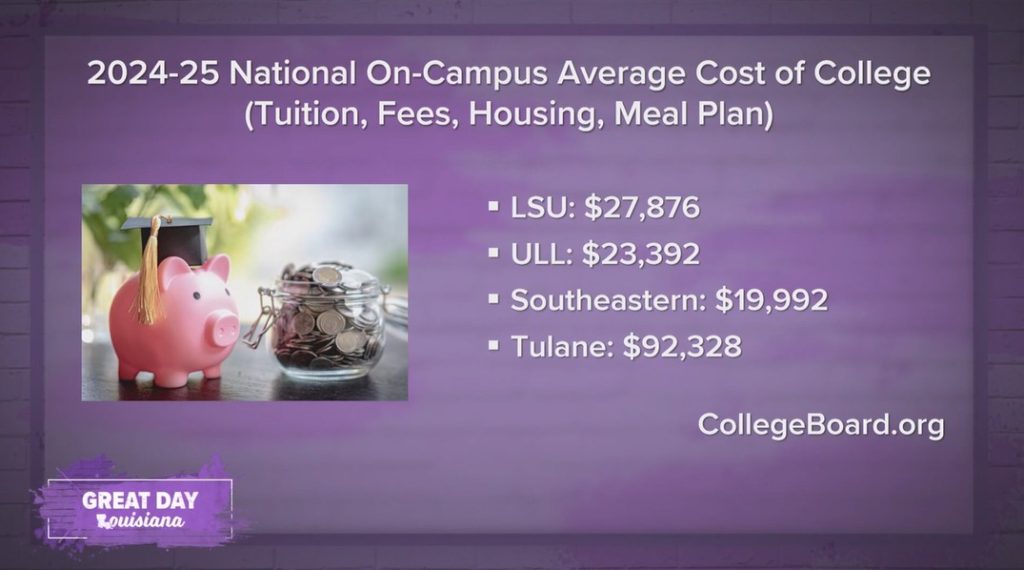
Knowing what it will cost remains the trickiest part of determining how to save for college. You’re simply guessing how much college will cost 10+ years out and how much funding your child will need. Will they go to college? What type of school? Will they receive scholarships and grants? Here’s what the current landscape looks like per CollegeBoard.org: 

2023-24 National On-Campus Average Cost of College (Tuition, Fees, Housing, Food)

  • Public Four-Year In-State: $28,840

  • Public Four-Year Out-of-State: $46,730

  • Private Four-Year: $60,420

Historically, higher education costs have increased faster than other goods and services. If core inflation is running at 2-3%, education inflation is running between 5-8%, depending on what you are measuring. If we adjusted the public four-year in-state tuition of $28,840 for 5% annual inflation over the next 18 years, the cost of college would increase to $69,407. While you will never eliminate sticker shock, this highlights the importance of having an intentional savings + investing plan to keep up with inflation. 

Louisiana’s START 529 Plan

The most tax-efficient college savings vehicle is the 529 plan. In Louisiana, it’s called the START Saving Plan, and there’s a ton of great information on their website, startsaving.la.gov

A 529 plan is a bit like a Roth 401k for higher education costs. Money goes in after-tax, grows tax-free, and is eligible for tax-free withdrawals for qualified expenses such as tuition, fees, books, and room and board. 

Additionally, Louisiana offers the following benefits for residents:

  • State Tax Deduction: Married couples filing jointly may deduct deposits up to $4,800 per year per beneficiary

  • State Match on Contributions: There is an “Earnings Enhancement” based on household income that ranges from 2 – 14%. For example, a household making $70,000 would be eligible for a 6% earnings enhancement. Therefore, if they contributed $10,000 to an LA 529 Plan in 2024, they would receive additional funding of $600. 

  • Low-Cost Investments: Remember to choose your investments when setting up a 529 plan, as LA has a great line-up of low-cost Vanguard funds to choose from, including “age-based” options that will rebalance automatically from aggressive to conservative as your child gets closer to college. 

While I always recommend investing a portion of your savings in a 529 plan for the above reasons, you might consider diversifying your savings toward a boring old taxable brokerage account, especially early on when there is a great certainty of your child’s track. This will allow you added flexibility if there is excess savings relative to your funding needs. 

What happens if my child ends up not needing the money?

Withdrawing funds from a 529 plan for non-qualified educational expenses carries tax consequences and penalties. Generally speaking, you’ll be subject to ordinary income taxes and a 10% withdrawal penalty on the earnings portion. Thankfully, recent legislation has added flexibility to avoid these penalties. To avoid income tax on earnings and penalties, parents have the option to:

  • Change the beneficiary at any time to another child or grandchild for their benefit

  • Rollover funds from a 529 plan to a Roth IRA for a beneficiary. Restrictions apply, such as a minimum holding period, an annual maximum, and a lifetime maximum.

  • Withdraw up to the amount of a tax-free scholarship/grant to avoid penalty but not income tax on the earnings.

Upbeat Wealth on the News: The Truth Behind Credit Cards

Upbeat Wealth Founder Mike Turi joins Great Day Louisiana’s Malik Mingo to discuss the truth behind credit cards. Check out the video and the blog below for the good, the bad and the ugly!

Great Day Louisiana: The Truth Behind Credit Cards

The Biggest Credit Card Myths

  1. Closing a Credit Card Does Irreparable Damage to your Credit Score: Credit history is a small component of your overall score. Yes, be cautious about the timing of closing credit cards if you are actively shopping for a car or home, but do not sweat closing a credit card that charges you an annual fee greater than your benefits.

  2. Making the minimum payment doesn’t result in interest charges: However, unless you have a 0% introductory rate, interest will accrue on the unpaid balance over the minimum payment. To avoid interest charges, pay off your full statement balance on time.

  3. Having more credit cards is a sign of money trouble and overspending: Having multiple credit cards can make it easier to categorize and track spending. Additionally, many consumers have the time and talent to play the points game without sacrificing their financial stewardship.

Common Mistakes

  1. Overspending: You are dangerously treading water if you consistently purchase items on credit that you couldn’t purchase outright. The average interest rate across credit cards is 24%. If you cannot pay your unpaid balance and that interest starts to compound, it’s a very tough situation to get out of.

  2. Foreign transaction fees: Know if your card charges one before traveling internationally or making international purchases.

  3. Chasing rewards: Do not put the cart before the horse. Churning credit cards or inefficiency tracking your expenses may prevent you from having control over your cash flow. For most, it’s better to optimize rather than maximize. Understanding your actual cash flow so you’re spending/saving with intention is more powerful than grabbing every last mile on vacation booking.

How to Use Credit Cards Responsibly

Credit cards aren’t inherently bad. Consumers receive great benefits such as convenience, purchase protection, and rewards! 

  1. Charge what you can afford: Treat your credit card like it’s a debit card or cash. While technically borrowing money from the credit card company, you’re actually just borrowing from your future self if you struggle to pay your entire balance on time.

  2. Building credit: Credit cards are a great way to build up your credit for making bigger purchases that require a secured loan, such as a home or car. Interest rates are correlated with the strength of your credit.

  3. Understand your redemption options: Earning points is easy, but understanding their value and properly redeeming them is rather complicated. 

Finding the Right Credit Card

If you can responsibly use credit, I recommend having a few different credit cards. Assigning spending categories to credit cards makes tracking your spending and maximizing your rewards easier. This is especially helpful if you are trying to limit spending on a specific subcategory. By keeping it on 1 credit card, you can monitor the balance weekly and stay on track. The categories to pursue depend on your household. There’s pretty much a card for everything! For simplicity, I recommend having a general cash-back card for fixed expenses and then specializing from there. Pick two or three categories you allocate the most resources toward and find the best rewards! Often, I encourage clients to separate their discretionary day-to-day expenses, such as dining, entertainment, and shopping, onto a single card, as many are prone to overspend on these categories and lose sight of their budget. Looking for the best deal? There is an abundance of information available on the Internet about the best cards by category and current bonus offers. There are entire communities dedicated to maximizing one-time and ongoing credit card rewards. And it’s not just about miles, points, and cash back. Credit cards often include great perks like airport lounge access, streaming service or rideshare credits, free global entry/TSA precheck, and complimentary hotel services. Ultimately, the best rewards are those you seamlessly take advantage of without introducing too much hassle.

In Credit Card Debt? Here are the Next Steps!

Stop using your credit cards immediately and look for areas where you can cut back. If necessary, you may need to pick up temporary extra work. While the financial ramifications of credit card debt can be incredibly damaging, the behavioral aspect is the tougher cycle to break. 

  1. Contact a licensed credit counselor via the National Foundation for Credit Counseling. Before you can fix the debt, you have to correct the behavior.

  2. Create a plan to eliminate the debt and stick to it! Staying on track and knowing the end game can be motivating. 

  3. Budget seriously and save a sustainable amount toward an emergency fund to reduce your chance of taking on future debt. 

  4. Call your credit card company, explain the situation, and see if they’ll pause interest charges on your card or get you on a mutually beneficial payment plan. 

  5. Determine what motivates you to keep going more between paying the highest interest rate debt vs. the smallest balance.

  6. After successfully correcting the behavior, explore a balance transfer or loan consolidation to save interest as you repay.