The Risk of Holding Too Much Cash & What to Do About It

The risk of holding too much cash

Too Much Cash?!

Yes, it’s possible.

Much like any time I sit down with a spoon and a pint of Ben & Jerry’s, the same holds true with cash… You can, in fact, have too much of a good thing. When it comes to the ice cream, I always do. When it comes to your cash, we want to help you avoid “overindulging”. 

Of course, cash has its benefits:

  • Security
  • Financial flexibility
  • Easy access to your money

Even so, there’s a very real tradeoff. What you gain in safety, you give up in potential growth and progress toward longer-term goals.

Risk #1: Inflation

As we all know too well, stuff gets more expensive over time – except, of course, for the Costco hot dog. One dollar today doesn’t buy what it did 20 years ago. This is the handiwork of inflation. It erodes the real value of money through the years, reducing your “purchasing power”.

The graph below shows year-over-year inflation during the last decade.

12-month percent change in CPI-U over the last 10 years

Even now, with inflation cooling, prices were 2.4% higher in February of this year relative to February 2025. 

If your dollars aren’t growing at a rate that outpaces inflation, you are losing money in terms of actual spending capacity. An account balance of $100k 30 years from now won’t do nearly as much for you as it would today.

In fact, going off inflation data for the last 30 years, it would do about HALF as much! To buy the equivalent amount of goods and services with $100k in 1996, you’d need $211k today (based on this CPI calculator).

Thanks, largely in part, to the post-COVID spike, the average annual inflation rate over the 10-year period between the start of 2016 and end of 2025 was 3.2%. The Federal Reserve has a target inflation rate of 2%. So even in “the best of times” prices are still expected to go up.

Cash vs. Inflation, an Example

Let’s take a look at what inflation would have done to even a relatively favorable cash position over the last 10 years.

The State Street SPDR Bloomberg 1-3 Month T-Bill ETF (BIL), as the name indicates, invests in Treasury bills with maturities of 1-3 months. Because T-bills are issued by the US government, they’re considered to be nearly risk-free and are a “cash alternative”. 

We’ll match that up to the overall US stock market, using the Vanguard Total Stock Market Index ETF (VTI). Specifically, we’ll view the performance of these two funds for the 10-year period from 1/1/2016 to 12/31/2025.

Assuming that dividends were reinvested, the overall return for each of these funds during the stated period was:

  • BIL: 2.04%
  • VTI: 14.25%

Here’s what that looked like:

VTI vs. BIL Nominal

If you were in search of safety for your money, BIL would have done well preserving your capital while earning some interest. $10,000 would have grown to $12,236.59. This is roughly what your cash would have done had it been sitting in a high-yield savings account during that stretch.

However, there’s one (now hopefully obvious) flaw here. The 2.04% overall return is before accounting for inflation. The returns above are what we call “nominal”. When we adjust for inflation, we work with what’s called the “real” return. 

So here’s how those funds compare over the last 10 years with inflation (CPI-U) baked in…

Real Return

  • BIL: -1.12%
  • VTI: 10.71% 
VTI vs. BIL Real Return

In terms of what your money could actually do for you, it would have lost value if left in BIL for 10 years.

If that same $10,000 was collecting dust in a checking account or traditional savings account, earning 0% to 0.05%?? Forget about it.

Risk #2: Longevity

At this juncture, some people out there may wonder, “What’s so bad about losing just ~1% over 10 years? At least my money wasn’t subject to big swings in the market. In the end, I barely lost any purchasing power.”

Well, sure. But it’s a simple fact: the longer you want (or need) your money to support your lifestyle, the more of it you need to have. So the growth rate of your assets over time directly contributes to the length of the runway you build up for yourself.

This isn’t to say you should go full throttle on the most aggressive investments you can get your hands on. There’s a wonderful world that exists between the extremes. But it underscores the importance of taking a risk-appropriate approach to growing your wealth so that you set yourself up for the best chance of success in realizing your ideal future state. 

What is the RIGHT Amount of Cash to Hold?

To determine the “right” amount of cash…

  1. Calculate your Emergency Fund need
  2. Evaluate any short-term goals (new car, vacation, home project, etc.)
  3. Add these together and voila!

We recommend keeping these funds tucked away in a high-yield savings account. To take it one step further, we favor using an option like Ally that allows you to create “buckets” within a single account. That way, you can easily categorize the savings and always know exactly what each dollar is set aside for.

And bear in mind, the point of this cash is NOT to be a growth engine in your plan. Rather, it DOES…

  • Cover you when something inconvenient inevitably occurs
  • Help prevent the need for taking on higher-interest debts (credit card balances)
  • Allow for quick and easy access
  • Avoid market losses

OK, Now What?

Once you’ve established the optimal cash balance to keep on hand, it’s time to create a plan for the rest. One benefit of getting clear on your cash need is that it frees you up to take on more risk (appropriately) with other resources, creating more efficiency all around. Having adequate cash set aside increases your plan’s risk capacity. In other words, with your bases covered, you are in a position to handle greater risk in the accounts geared toward your long-term goals.

In short, that “extra” cash is ready to be invested. 

Similar to what you did above, ask yourself: What is the purpose of these surplus funds? What will they ideally do for you? Additionally, consider the anticipated timeline before you expect to access them.

Addressing these points will guide what type of investment account those resources go into and how much risk you can reasonably take on when they get to work. For example, money tagged to help support your retirement at age 60 makes sense going into a Roth IRA, where it might be allocated to 100% equities. Funds that will be used to help with a down payment 6 years from now are not as well-suited in an IRA, nor should they be invested so aggressively. Those will serve you better in a taxable brokerage account, with a more conservative approach.

Cash plays a critical role in your financial plan. Yet, it pays to understand its limits and what to do if you can identify any excess. 

Frequently Asked Questions for Cash

Q1: How much cash is too much to keep in savings?

You may be holding too much cash if you’ve already set aside enough for your emergency fund and any short-term goals, but still have a large amount sitting in checking or savings with no clear purpose. Cash is useful for flexibility and protection, but too much of it can quietly slow your long-term progress if it isn’t keeping up with inflation.

Q2: Why is holding too much cash a problem?

The biggest issue is that cash often loses purchasing power over time because of inflation. Even if your account balance stays the same, or grows a little, the real value of that money can decline if prices rise faster than your interest rate. Over long periods, that can create a meaningful drag on your financial plan.

Q3: Is cash losing value because of inflation?

Yes. Inflation reduces what your dollars can buy over time. That means money sitting in cash may feel “safe,” but if it isn’t earning enough to outpace rising prices, it is losing real value in the background. This is one of the main reasons excess cash can become costly over the long run.

Q4: Where should I keep my emergency fund?

Your emergency fund should usually stay somewhere safe, liquid, and easy to access—typically a high-yield savings account. The goal is not maximizing return. The goal is making sure the money is available when you need it, without taking market risk.

Q5: Should I invest money instead of leaving it in cash?

If the money is not needed for emergencies or short-term goals, investing may make more sense than leaving it idle in cash. The best place for that money depends on its purpose and timeline. Money needed soon should generally stay conservative, while money for long-term goals like retirement can usually tolerate more investment risk.

Q6: Is a high-yield savings account enough to beat inflation?

Not likely. A high-yield savings account can help reduce inflation drag compared with a traditional checking or savings account, but it won’t consistently outpace inflation over long periods. It can be a great tool for cash reserves, but it usually shouldn’t be your primary strategy for long-term wealth building.

Fiduciary, fee-only, Certified Financial Planner, Eddy Jurgielewicz

Eddy Jurgielewicz, CFP® is a Partner and Lead Financial Planner at Upbeat Wealth, a fee-only firm based in New Orleans and serving clients virtually across the country. He specializes in providing straightforward financial guidance to ambitious young families as they navigate life’s many milestones.

Do you have questions about what we shared in this post, or anything else in general? Feel free to schedule a free consultation or drop us a line!

Sign up for our newsletter (at the bottom of this page) to stay up to speed on our Upbeat Insight.

Disclaimer: All content in this article is provided for educational, general information, and illustration purposes only. None of the information is intended as investment, tax, accounting, or legal advice. Nor is it a recommendation for purchase or sale of any security, or investment advisory services. We encourage you to consult with a financial planner, accountant, and/or legal professional for advice on your specific situation. Read our full disclaimer here.

What is Enough?

What is enough?

What is "enough"?

There’s nothing like a major life milestone to bring on a spell of deep reflection. Since having our daughter a few months ago, I’ve really been chewing on the question of, “What is enough?”

I’ve been asking myself questions such as:

  • What do I need in order to feel fulfilled in my day-to-day life?
  • What are the experiences that fill my cup?
  • How do I want to allocate my time?
  • What is it that I value most?
  • What does this look like today? Next year? 20 years from now?

Sorry, folks, but this one might leave you with more questions than answers (not that I claim to have all that many to start with). Maybe that’s the point?

Enough is elusive

It’s at the core of any real financial planning endeavor. Yet it has a way of eluding many of us. If we are fortunate enough to fully wrap our minds around the concept one day, it’s likely to shapeshift and escape our grasp not long thereafter, leaving us searching once again for an accurate description of what breeds true contentment in our lives.

It’s almost never a simple question to answer. It makes sense, though. Life is far from linear. People evolve. Circumstances change. 

Then there’s the fact that it’s different for everyone. No one can tell me what enough is in my life, just as I can’t tell anyone else what enough is in theirs. Though, as a financial planner, I get to have a lot of fun with gently nudging people to find their answer.

Is enough a number?

I think not.

At least, it’s not the best place to start. Sure, a number is necessary to punch into a financial plan. We need to have that data point as a goal to shoot for, so we know how to build our resources up to it. But what is it that the dollar figure represents? What does it do? What is the significance? What will that money be in service of?

Because the reality is this: a number, alone, is void of any meaning. 

A common “enough” question revolves around the idea of retirement. Most people we work with ask some version of the question, “How much money do I need to stop working for a paycheck one day?” 

I just typed into Google, “How much money do I need to retire?”, and the AI Overview told me:

“A common benchmark is to save 10–12 times your final annual salary or aim for a portfolio that allows you to withdraw 4% annually. For many, this means a total nest egg between $1 million and $1.5 million, though this varies heavily based on location (e.g., $700k–$2.2M+ in the US) and lifestyle.”

Great! In reality, this largely tells me nothing. Obviously, blanket guidance is rarely all that helpful in specific scenarios. But this is a stark example of that. Sure, it’s better to build up $1 million than $0. Nonetheless, the numbers provided are empty. As would be my response if I attempted to answer a person’s “how much do I need” question before doing the real work of learning what truly matters to them.

The point is, I can’t begin to tell someone how much money they need if I don’t yet know what that money is meant to be in service of. Life is not purely numbers. 

This is why, at Upbeat Wealth, our initial planning process includes an entire meeting dedicated to learning about the values of the family we’re working with before we begin offering recommendations.

How do you know when you have enough?

You don’t usually get in the car without knowing where you’re driving to. Unless, of course, you’re an angsty 17-year old Eddy in his ‘96 Crown Vic, blasting The Eagles, windows down, going wherever the road would take him, finding peace in nothing more than the warm southern summer wind and that freedom that only a few bucks of gas can buy… Ok, digression done. You can’t make it to a destination unless you have one to begin with.

Here’s the thing, though: money, on its own, makes a terrible goal. Winning the lottery, getting a big inheritance, landing that promotion, finishing first in your high-stakes fantasy football league… None of those are sufficient if you haven’t done the real work first. You have to first understand what purpose the money will serve in your life.

Ok, now you might be thinking something like, “I’d sure feel like it was enough if I was making triple my current income!” (and not gonna lie, that does sound nice). Still there’s a ton of research out there that remains generally mixed. 

An older study from 2010 by Daniel Kahneman indicated that emotional well-being increased as income rose to $75,000 and then basically flatlined from there. In 2021, Matthew Killngsworth refuted this and determined that well-being did rise with income even as it exceeded the $75k mark. Interestingly, hold the phone, the adversarial dynamic duo later teamed up in 2023 and found a more nuanced result. They saw that, generally, higher incomes were associated with higher levels of well-being for many people. However, for people classified as “unhappy”, higher incomes did little to improve their overall level of happiness.

My takeaway is probably overly simple, but I can’t see a way around it: “Happy” people have figured out how to align their resources with what’s important in their lives. If you’re “unhappy”, more money, alone, is not a magic bullet. And if you’re “happy”, having more money increases your ability to fill your life with even more of what brings you satisfaction.

Someone might earn what’s considered a “good” salary. At the same time, if that income isn’t used intentionally to align with the person’s values, it is essentially worthless. It comes and goes. 

You could have millions set aside. Yet, what is that money really worth if you don’t have a clear definition of what enough is in your life? 

Don’t skip the critical first step: Get clear on what’s important to you and your life. Find your destination.

To answer the question, my best guess for how you really know when you have enough… I wager it’s more of a feeling than anything you can put your finger on.

If your money could talk, what story would you want it to tell?

Here’s a thought exercise I’ve been toying with… I personify money and ask the question: “At the end of my life, what will you have done for me over the years?”

What story would I want Money to tell me in response?

Immediately, I know I wouldn’t want Money’s first words to be anything like: 

  • “I grew to such-and-such balance across all of your accounts”… 
  • Or, “I compounded at an average annual rate of x% over your lifetime”…
  • Or, “Y% of me was allocated to tax-advantaged and tax-free accounts”… 

There’s no emotion in any of that. It sounds a little empty.

Because it’s not about Money. Money is simply a facilitator. It’s the outcome that matters, the life that’s lived.

I would hope to hear something raw. Something with teeth to it. Something that moves me. I’d want Money to tell me a tale that makes me smile. The kind of smile that grows deep inside and extends to every corner of my heart. It’s a story I’d yearn to hear time and time again. That story is beyond the scope of this post…

If you put Money in the hot seat, what would you hope to hear?

So what is enough for me now?

My current version looks something like:

  • Spending time with my wife and daughter
  • Seeing a smile on their faces
  • Supporting my wife’s dreams and ambitions
  • Raising my daughter to see the best in herself and be a positive force in the world
  • Sharing time with our loved ones and friends
  • Experiencing new places, cultures, and ways of life
  • Getting outside into nature on a regular basis
  • Prioritizing my physical and mental health through an active lifestyle
  • Having flexibility in how I distribute energy between my family and my business
  • Serving client families that inspire me
  • Being generous with my time and resources so that I can have a positive impact on others in my community

That list right there. That’s my north star. Or as we call it here at Upbeat Wealth, my Statement of Financial Purpose. It’s an ever-changing work in progress, and that’s ok with me because I want it to always represent what’s most important to me in the moment.

If I’m doing it right, my money – my financial plan – will only ever be enough if it facilitates those things above.

Fiduciary, fee-only, Certified Financial Planner, Eddy Jurgielewicz

Eddy Jurgielewicz, CFP® is a Partner and Lead Financial Planner at Upbeat Wealth, a fee-only firm based in New Orleans and serving clients virtually across the country. He specializes in providing straightforward financial guidance to ambitious young families as they navigate life’s many milestones.

Do you have questions about what we shared in this post, or anything else in general? Feel free to schedule a free consultation or drop us a line!

Sign up for our newsletter (at the bottom of this page) to stay up to speed on our Upbeat Insight.

Disclaimer: All content in this article is provided for educational, general information, and illustration purposes only. None of the information is intended as investment, tax, accounting, or legal advice. Nor is it a recommendation for purchase or sale of any security, or investment advisory services. We encourage you to consult with a financial planner, accountant, and/or legal professional for advice on your specific situation. Read our full disclaimer here.

Understanding Your Paycheck

Understanding Your First Paycheck for College Graduates

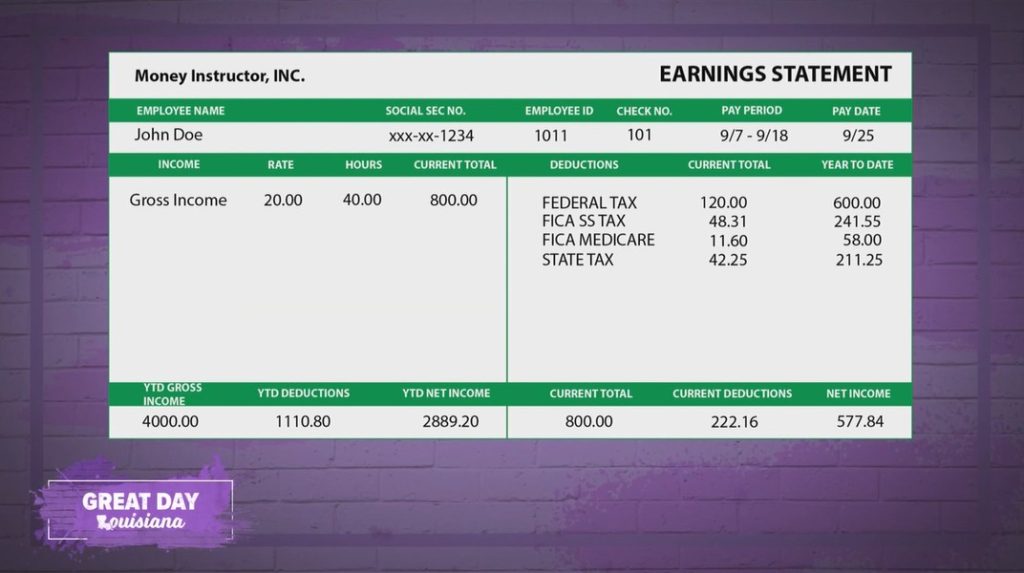
If you are anything like me, you may be surprised when you get your first paycheck. Until that moment, I had only worked jobs as an independent contractor, where earning a $1 meant actually receiving a $1. If you’ve accepted a job as a true W2 employee after graduation, you likely negotiated a salary that doesn’t reflect your actual take-home pay. It may not be close at all, leading you to wonder, “I think there is something wrong with my paycheck.” In this blog and the accompanying video, we clarify essential terms for recent college graduates and anyone curious about their paystub, providing a jump start to understanding the United States tax code.

Independent Contractor vs. Employee

First, it’s important to understand the difference between how the person is viewed performing the work for the business. Are you an employee of the company or an independent contractor? Certainly, some companies operate in a grey area when it comes to classifying labor. You may feel like an employee, only to discover after reading this article that you’re actually classified as an independent contractor, which essentially makes you a business owner! For this article, we will set aside the legality of the matter regarding your employer in the eyes of the Department of Labor.

There is nothing inherently good or bad about this, but there is a stark difference in your benefit eligibility, tax responsibility, and ability to make certain deductions. A deduction is something that ultimately lowers your taxable income. To qualify for many deductions, you need to be self-employed to take advantage of them.

For example, a remote worker cannot claim a home office deduction and deduct this expense from their income. However, if other eligibility requirements are met, an independent contractor can use the home office deduction to reduce their taxable income.

Important Paycheck Terms for Employees

There are three (3) general categories of deductions that reduce your gross pay. 

Employee Taxes: Ordinary income tax + Federal Insurance Contributions Act (FICA) tax that funds Social Security and Medicare

  • Federal Income Tax

  • State Income Tax: 3% for Louisiana residents

  • Old Age, Survivors, and Disability Insurance (OASDI or Social Security): 6.2% on a maximum income of $176,100 in 2025. 

  • Medicare: 1.45% + 0.90% on income over $200,000. 

Pre-Tax Deductions: These will vary depending on your employee benefits, but the common ones are:

  • 401k Contributions

  • Health/Dental/Vision Insurance Premiums

  • Flexible or Health Savings Accounts

Post-Tax Deductions: These will also depend on your employee benefits and selections, but the most common ones are:

  • Roth 401k Contributions

  • Some Life and Disability Insurance Premiums

  • Legal Insurance

Sample Paycheck

As a basic and common example, here’s what a pay period might look like for an Individual earning $75,000.

Assumptions

  • Tax Filing Status: Single
  • No Dependents
  • Pay Periods: 24 (Semi-Monthly)
  • Pre-Tax 401k Contribution: 4% ($3,000 annual)
  • Roth 401k Contribution: 4% ($3,000 annual)
  • HSA Contribution: $4,300 (2025 Individual Max)
  • Health Insurance Premium: $200/month

In this scenario, the employee’s net pay is 65% of their gross pay. 18% of their income is allocated to taxes, while 17% is earmarked for employee benefits, including health insurance and retirement savings. This leads to the individual having $2,174 less each month to allocate toward their budget for housing, transportation, food, and discretionary expenses. 

If you’re unsure what your net pay might look like, I recommend using 60% as a baseline. This will provide a fair estimate of your actual pay that will reach your checking account before you commit to significant fixed expenses, such as rent or transportation. It also provides an opportunity to begin your journey as a saver or investor, as illustrated in the example above.

Does This Affect Independent Contractors Differently?

As an independent contractor, you’ll be paid, but you won’t get earning statements or paystubs detailing your income. But here’s what you need to understand: you owe taxes!  The United States has a pay-as-you-go tax system. If you have income, you are generally required to make payments as you earn it. As an employee, this occurs through your paystub via mandatory company withholding, as shown above. For independent contractors, you are responsible for estimating what you will owe, setting that money aside, and remitting payment quarterly. If you don’t pay your estimated taxes quarterly, you could face underpayment penalties come the tax deadline (April 15th of the following year). 

Here are the dates you are expected to estimate your quarterly taxes owed and pay by:

  • Q1 January – March: April 15th
  • Q2 April – June: June 15th 
  • Q3 July – September: September 15th
  • Q4 October – December: January 15th

As stated, there are no safeguards in place, like the mandatory withholding for employees. If you haven’t paid any taxes, you’re in for a nightmare when your tax filing software spits out the amount owed. Additionally, you owe not only the employee side of the FICA tax but also the employer side (another 7.65%). We’ll save the nuance of correctly making self-employment deductions for another day! Some individuals may not fit neatly into employee or independent contractor categories; for example, one can be an employee while also running a side hustle. Keep reading…

Is My Company's Withholding For Me 100% Accurate?

At the start of employment, everyone will fill out a W-4 Employee Withholding Certificate to instruct their employer how much money to withhold for taxes. Unless you tell them otherwise, they only account for the money they are paying you, along with the information you provide regarding tax filing status and dependents.

Have a side hustle? 

Your employer will only adjust your withholding if you instruct them to do so on your Form W-4 and accurately complete the form to take your additional income into consideration. Otherwise, you will need to manually calculate the taxes owed for this additional income and make quarterly payments, as mentioned in the section above regarding independent contractors. 

The most accurate way to do this is to go online and use the IRS’s Tax Withholding Calculator.

Negotiating Your Next Salary

Not everything that reduces your gross pay to actual pay is bad. In fact, most are either beneficial or, at the very least, unavoidable, like taxes. In our sample pay stub above, this individual had access to a 401k retirement plan and a Health Savings Account. Although not shown here, most (but not all) employers offer matches for these types of accounts. That’s MORE money paid to you than you bargained for. When reviewing job offers or negotiating your salary, it’s crucial to assess the complete range of compensation and benefits available. The most significant variable beyond any form of equity compensation is always health insurance. How attractive are the plan options in terms of the premium amount, as well as the deductible and out-of-pocket maximum?

If you’re a recent college graduate, this is the first paycheck of (hopefully) many! Set aside time to understand the foundational aspects of it so you can prepare for future earnings.

Tips on negotiating your next salary? We got you!

Tips for selecting benefits during open enrollment season? We also got you!

Fiduciary, fee-only, Certified Financial Planner, Mike Turi

Mike Turi, CFP® APMA™ is the Founder and a Lead Financial Planner at Upbeat Wealth, a fee-only firm based in New Orleans and serving clients virtually across the country. He specializes in providing straightforward financial guidance to ambitious young families as they navigate life’s many milestones.

Do you have questions about what we shared in this post, or anything else in general? Feel free to schedule a free consultation or drop us a line!

Sign up for our newsletter (at the bottom of this page) to stay up to speed on our Upbeat Insight.

Disclaimer: All content in this article is provided for educational, general information, and illustration purposes only. None of the information is intended as investment, tax, accounting, or legal advice. Nor is it a recommendation for purchase or sale of any security, or investment advisory services. We encourage you to consult with a financial planner, accountant, and/or legal professional for advice on your specific situation. Read our full disclaimer here.

Term Life Insurance: Protecting Loved Ones and Avoiding Mistakes

Term Life Insurance, Group Life Insurance, Avoid Costly Insurance Mistakes

What is the Greatest Risk to My Family or Loved Ones?

For us in New Orleans, we are intimately familiar with homeowners, flood, and auto insurance. Perhaps “intimately familiar with” isn’t the best way to phrase it. Let’s say “tortured by.” Yeah, that’s better. It’s easy to understand the need. If you own a home that would cost $500,000 to rebuild and owe $400,000 on your mortgage, you’ll likely carry homeowners and flood insurance, regardless of how painful the premiums may be. You don’t want to lose your home while still being responsible for your mortgage payments 25 years from now. 

You purchased that home because you were confident you would earn enough money to live there until you decided to move on someday.

But what if you lost your ability to earn because of death or disability? If someone relies on your income and that income ceases to exist, your loved ones may lose their sense of autonomy regarding housing, transportation, education, and quality of life. Financial goals and objectives that previously seemed attainable may now appear out of reach. 

Here’s the deal: if someone depends on your income, both now and in the future, it’s worth protecting. Please do not leave your ability to financially support your loved ones to chance or a GoFundMe.

And if you’re in your early 20s with no dependents, you likely don’t need to worry about life insurance. It would have to be quite a unique situation otherwise. Therefore, you can tell your friend at—just making up a name—Northwestern Mutual that you’re all set.

Buy Insurance? Surely, There are Other Forms of Risk Protection!

Insurance just feels gross. You pay all this money with the goal of never needing it. So, let’s explore other forms of risk protection to see if there’s an alternative. 

Risk Mitigation: Minimize your risk exposure by avoiding it entirely or implementing protective measures. Easy enough! Kid on the way? Maybe leave the motorcycles, helicopters, skydiving, and deep-sea diving to Tom Cruise. 

Self-insuring: Personally accepting the financial consequences of a risk occurring. Self-insuring can be effective for everyday risks or those that are relatively minor and low risk. For instance, you might not buy travel insurance every time you fly. Or you might build up, say, an emergency fund to protect against losing your job and a temporary loss of income. 

While living a safer, healthier lifestyle sounds great – shit happens. And unfortunately, I’ve participated in far too many of those *shit happened* conversations since starting in this business 14 years ago. You *might* be able to self-insure it, but the odds are low if you’re at the beginning of your career and haven’t had a chance to build up your assets.

Enter Insurance: a Basic Explainer

And here comes the Upbeat Wealth disclaimer: we do NOT sell insurance, so this isn’t a sales pitch. We take pride in our fee-only approach to financial planning, which strives to remove conflicts of interest. This helps us (and you) remain objective, knowing that we are always a fiduciary working in your best interest. This is more of a heart pitch to take care of your loved ones. 

Purchasing Insurance: Transferring the financial consequences of a risk to a third party in exchange for premiums paid. Insurance is usually comprised of these four (4) components: 

Premium: The amount you pay to keep the policy active, typically on an annual basis.

Coverage: The type of risk you are protecting against. 

Benefit: The pool of money left to you or your beneficiaries in the event of a claim.

Term: The duration of time that coverage is provided to the insured.

Term Life Insurance → This is The Way

As you enter your family-building years, Term Life insurance policies are typically affordable, straightforward, and offer substantial benefits to help replace income, which can pay off your family’s mortgage and fund your children’s educational goals. 

If you’re seeking financial stability for your household in case you’re no longer around, term life insurance is the primary option to consider. Using the components of insurance above, here’s how that would translate to a Term Life Insurance policy:

Premium: Annual amount required to maintain the policy. Although there are different types of term life insurance policies, the most popular is the “fixed premium” term life policy, meaning your annual premium will stay the same throughout the duration of the policy. According to NerdWallet, the average rate for a 30-year-old woman to obtain a 20-year, $1,000,000 policy is $374 per year. 

Coverage: Transferring the risk of your premature death to a third party (the insurance company), effectively protecting your future income that you have not yet earned. Later in this article, we’ll discuss more about choosing a coverage amount. 

Benefit: Should you pass away unexpectedly with coverage, your beneficiary(ies) will receive a sum of money equal to the policy’s face value, tax-free! 

Term: The policy will provide coverage for a set amount of time as long as you pay the fixed annual premium. In the example of buying a policy because you have young kids, we aim to align the policy term with the birds leaving the nest. There is also no cancellation policy. So if you experience a sudden money event, such as your company stock soaring or selling your business, thereby accumulating significant assets that your family could comfortably draw from, you could stop paying your premiums and allow the policy to lapse.

Calculating Term Life Insurance Coverage is Part Art, Part Science

When calculating suggested coverage amounts and term lengths, we aim to align the timing of when dependents will be out of the home with the necessary amount to protect after-tax earnings, pay off debts, and fund education. While I believe you should think carefully about the amount of coverage you ultimately obtain, this is one area where I wouldn’t let analysis paralysis consume you. Anything is better than nothing. 

And while having no earned income and applying for a $5M Term Life Policy may raise some red flags, there generally aren’t many restrictions on the amount of coverage you can reasonably obtain. Therefore, the best answer is to go secure the bag at a number where you sleep well at night. For those seeking a more strategic approach to selecting the ideal policy, here’s how we guide households through the process. 

Case Study: 

Muses and Thoth are 35 years old, married, and have one child, who is 2 years old, with another on the way this year. They have a household income of $300,000 comprised of Muses ($225,000) and Thoth ($75,000). They recently purchased a $900,000 home and have $700,000 left on their mortgage. In addition to their mortgage, they have a $30,000 car loan. Muses also has $200,000 in Federal Student Loan Debt. Based on their savings rate, they project to achieve work flexibility by Age 57. 

In this scenario, if we were reviewing Muses’s Life Insurance Need, we would use the following inputs:

term life insurance, group life insurance

Income-Earning Years Remaining: We aim to protect Muses’s net income for her estimated 22 years of earnings. 

Annual Income to Protect: We excluded $40,000 in “personal expenses,” representing the household’s annual savings. The payout from the life insurance policy would effectively replace their need to keep saving. An effective tax rate for a household in Louisiana with an income of $300,000 is approximately 19% federal and 3% state. Since term life insurance benefits are tax-free, we only need to account for the net cash flow to the household rather than the gross amount of income. 

Adjustments: While the S&P 500 Index has returned approximately 10% annually over the past century, we will use a more conservative estimate of 6% for projected investment growth. After considering tax drag (taxes on capital gains, dividends, interest) as well as inflation (the rising cost of goods and services), we arrive at a real rate of return of 2%. 

Current Resources: Muses has employer-provided life insurance of 1x salary ($225,000) through work. However, we will disregard this. Muses doesn’t expect to stay in this job forever, and this policy is not portable. Therefore, when leaving this position, coverage will no longer be available. However, their household currently has $300,000 in investable assets that would be used to help replace unearned wages due to death. We’ll deduct this amount from their Total Life Insurance Need

Liabilities + Final Expenses: Canvas ready? Here comes the art of determining your unique needs. Yes, by successfully replacing Muses’s net income, they could reasonably expect to pay off their mortgage according to the original payment schedule. However, Muses expressed, “F that! We just bought this place, and I never want my family to risk losing it.” Muses incorporated this into the death benefit so Thoth could pay off the mortgage and significantly reduce their housing costs. They also decide it’s in their best interest to use the proceeds to pay off the car and cover any funeral expenses. 

Education: Muses and Thoth want to intentionally save enough money to cover the tuition costs of a public four-year in-state college. Using the current tuition cost growing at a 6% inflation rate, they have a present educational need of $166,386. Assuming the funds earmarked for college tuition increase by 8% annually, they will satisfy educational goals for both children. 

Current Remaining Life Insurance Need (today): $3,037,012. 

20-Yr Annual Premium Cost (Preferred Best Health Class): ~$1,200

15-Yr Annual Premium Cost (Preferred Best Health Class): ~$900

From a planner’s perspective, if you’re in good health, that is a small premium to pay to ensure life continues with some semblance of normalcy for your loved ones.

Avoiding Common Life Insurance Mistakes

Don’t rely too heavily on your employer’s group life insurance benefits. Just because you have employer-paid life insurance or access to additional voluntary insurance doesn’t mean you’re fully covered. Group term life insurance policies are typically NOT portable. If your employment status changes, you will lose this coverage. Moreover, your health may change, making qualifying for a preferred rate more difficult than when you were younger and, perhaps, healthier. Securing voluntary coverage through your employer can be beneficial if you have a pre-existing condition that impacts your health class rating, as there is typically a specific amount of voluntary coverage you can obtain without undergoing medical underwriting. However, if you are young and healthy, you will likely pay more for voluntary coverage through your employer than if you purchased a policy privately. 

If expecting a baby, do not wait until the third trimester to apply for term life insurance. Even if you are having a low-risk pregnancy, insurance companies may underwrite you differently as you get further along. This can be a costly mistake throughout the duration of a policy that could have been avoided by merely mistiming the application by a few weeks. 

While we understand that children are dependents, we shouldn’t overlook aging parents. If you’re part of the sandwich generation, they might also rely on you for care. 

Even if one spouse is a stay-at-home parent with no earned income, there is likely still a need for life insurance. Close your eyes and relive the wonder of what single-parenting looks like when your significant other is gone for a weekend. Yeah, you’re probably going to have some additional childcare costs. 

Overinsuring yourself, especially if no one is actually relying on your income. If you don’t need life insurance, don’t purchase life insurance. One unique situation where you might still consider it is if you have a hereditary disease that hasn’t taken hold but is known to be passed down in your family. Perhaps you still plan on having dependents one day, and it makes sense to get ahead of something that might be pre-existing. 

Another area where I see folks overinsuring is with their kids. Losing a child is an unimaginable tragedy, but they don’t require an insurance policy on their life, especially one that combines insurance with investing. Instead, just invest for them. And in a poor attempt to lighten the mood, feel free to ignore this if your little one is in a deep sports gambling hole with a bookie. Sorry…

And finally – be cautious of sales pitches that seem too good to be true, particularly those that combine insurance coverage with retirement investing. This is an article for another time, but just remember that good products are bought while bad products are sold.

Looking for more risk protection tips? Here’s our risk checklist! 

Fiduciary, fee-only, Certified Financial Planner, Mike Turi

Mike Turi, CFP® APMA™ is the Founder and a Lead Financial Planner at Upbeat Wealth, a fee-only firm based in New Orleans and serving clients virtually across the country. He specializes in providing straightforward financial guidance to ambitious young families as they navigate life’s many milestones.

Do you have questions about what we shared in this post, or anything else in general? Feel free to schedule a free consultation or drop us a line!

Sign up for our newsletter (at the bottom of this page) to stay up to speed on our Upbeat Insight.

Disclaimer: All content in this article is provided for educational, general information, and illustration purposes only. None of the information is intended as investment, tax, accounting, or legal advice. Nor is it a recommendation for purchase or sale of any security, or investment advisory services. We encourage you to consult with a financial planner, accountant, and/or legal professional for advice on your specific situation. Read our full disclaimer here.

The Importance of Open Enrollment Season for Families

open enrollment, workplace benefits, 401k, group insurance

The leaves are changing. Store shelves are overflowing with Halloween candy and holiday decorations. Pumpkin spice lattes and sweaters have made their annual comeback… This can all mean only one thing: Open Enrollment Season is upon us!

That’s right, nothing spells Fall like the chance to adjust your family’s health insurance plan.

In all seriousness, Open Enrollment is an important time of year – something worth paying close attention to. But, with the general craziness of the season in which the window typically falls, it can be an easy thing to push aside. Or it may be something that feels unnecessary if you’ve been at your employer for multiple years already and you believe everything is “set”. 

So I want to share some important considerations and a handful of reasons why it’s a good idea for everyone to perk up during Open Enrollment.

First off, be prepared

First and foremost, you’ll make things easier for yourself if you know ahead of time exactly when your job’s Open Enrollment period begins. The majority of employers do this sometime during October or November, but the exact start date and how long the window lasts can vary. There are also some companies that may conduct theirs at another time during the year. In any case – if you’re not already positive – check with HR to see when your Open Enrollment will take place. Take note and mark your calendar so that you can more readily take action. Many windows may last only a couple of weeks, so it can quickly fly by if you’re not anticipating it.

Coordination is key

For dual-income households, the stakes are higher. It’s especially important to coordinate across BOTH benefits packages to be sure you’re making the most (and saving the most) of what’s available. Having kids in the picture only ups the ante even further. Naturally, your enrollment windows may not overlap, making it even more necessary to be prepared and proactive. 

This coordination for families is most consequential when figuring out health insurance – and we may do a deep dive in a separate post. For now, here are some big considerations (assuming both spouses have benefit plans through their employers):

  • There are essentially 3 ways you could slice it:
    • Put the whole family on one partner’s health insurance
      • Sometimes there may be a clear winner with one partner having far superior health insurance options, at a better cost too. Some employers may have a long list of plans to choose from, while others don’t.
      • Although this is usually the easiest to keep track of – managing one plan for the whole family – it is not always the least expensive. 
    • Split it up – for example, one partner could go with individual coverage and the other partner covers themselves along with any kids
      • Companies tend to cover more of their own employee’s premium than they do for a spouse on the same plan. If both partners have employers who take on a large chunk of the cost, it could be much cheaper to go with separate coverages.
      • This can also make sense if one partner requires a lot of healthcare attention throughout the year. They may be better off going with a more robust low-deductible PPO plan while the other partner and the kids get covered under a high deductible health plan – if they are generally healthy.
    • Dual coverage – this means both partners enroll in separate plans that each cover everyone
      • Given that everyone is covered by two plans, it’s going to be the most costly structure. And it’s important to realize this does NOT mean you have twice the coverage. What it does mean is that you’ll have two levels of insurance – a primary and a secondary. As such, the secondary plan may cover costs that the primary plan doesn’t – though coverage will never exceed 100% of healthcare costs.
      • This method also requires you to take extra steps in coordinating your benefits, which is time consuming and sometimes complicated to navigate.
  • When determining the most optimal setup, we look at multiple factors:
    • What are the associated costs? → Premiums, deductibles, out-of-pocket maximums, copays, and coinsurance
    • Will you be able to access your preferred providers in network?
    • What are the specific medical needs of each family member?
    • Are you anticipating any major medical expenses in the coming year such as a surgery or pregnancy?
    • If available, is one plan structure more beneficial for your needs over another (HMO vs. PPO vs. POS)?
    • Can you benefit from an FSA or HSA (via a high deductible plan)?

Reasons to pay close attention at Open Enrollment time

You started the job this year and in the flurry of onboarding didn’t fully get your benefits squared away

If you started at a new employer this year, you already had the opportunity to select benefits as part of the onboarding process. But with how stressful and dizzying it can be to get going with a whole new job, it’s very possible to miss or overlook something concerning benefits. Open Enrollment presents a time to go back through and ensure everything is set up in the most optimal way. 

Your family experienced a big life change and you missed the special enrollment period for the qualifying life change

Did you get married? Did you welcome a new child? Did your spouse go through a job change? Maybe you registered as a domestic partner – like me this year! (CA allows this, but not all states do)?

There are several “qualifying events” that come with the ability to update employee benefits outside of the traditional Open Enrollment window. It’s important to know this and do what you can to make changes as soon as possible during this “special” enrollment period. However, those life changes that qualify also happen to be rather big things… So your mind may be elsewhere as you try to simply focus on that epic wedding and honeymoon, caring for a brand new baby, or whatever it may be. If the craziness of life does what it tends to do, just make sure to get your benefits properly structured when the regular Open Enrollment comes around.

Is now the time to switch to that HDHP/HSA winning combo?

In some cases, you might not have been aware that you had access to a High Deductible Health Plan (HDHP) and the Health Savings Account it comes with. Or this could be the first time your company has offered it. Either way, Open Enrollment is a prime time to consider the benefits of this plan. 

It’s worth doing a thorough analysis and stacking a HDHP up against the other health insurance options. Examine the differences – the premiums, deductibles, out-of-pocket maximums, co-pays, co-insurance, and what’s covered vs. what’s not. Understand that to get the most out of a HDHP, it involves actually contributing to the HSA it comes with. Assess what the impact of the tax savings would do for you and consider the plausibility of maxing it out. Your employer may even contribute some funds to the HSA on your behalf – I’ve seen rather generous cases out there. Often, going the HDHP route and maxing out the HSA will yield better results compared to other health insurance coverage options. 

Let’s look at a case where the switch makes a lot of sense. In the following example, a family has been enrolled under one spouse’s low deductible PPO plan up to this point. They are all generally healthy and don’t expect any extra medical expenses in the coming year. With the current plan, their basic total annual outflow is $20,400 (the monthly premium multiplied by 12). For 2025, they are considering the switch to a HDHP so that they can contribute to an HSA. In that scenario, their annual premium cost would be $13,452. They also have the ability to max out the family HSA with $8,550 in contributions. Since they’re squarely in the 32% Federal tax bracket, they can benefit from tax savings of up to $2,736. As such, their total basic net outflow for the HDHP plus maxing out the HSA is $19,266. 

So, they get the health insurance plan for the family AND they direct $8,550 into a highly tax-advantaged investment vehicle to benefit them down the road.

Key Assumptions

  • Federal Tax Bracket: 32%
  • 2025 HSA Family Contribution Limit: $8,550

PPO Total Annual Outflow

  • Total Premiums: $1,700 x 12 = $20,400

HDHP w/ maxing out HSA Total Annual Outflow

  • Total Premiums: $1,121 x 12 = $13,452
  • Federal Tax Savings of HSA Contribution: $8,550 x 32% = $2,736
  • Total Premiums PLUS Net HSA Contributions: $13,452 + $8,550 – $2,736 = $19,266

Remember: HSA contributions = tax savings + potential for long-term investment growth (in addition to having these pre-tax dollars available for medical expenses if needed). The amount saved in taxes should absolutely be factored in when comparing the total cost of your various health insurance plans.

Are you optimizing your employer-provided life and disability insurance?

Life and disability insurance are often offered in two flavors: basic and voluntary (or some variation of these). For life insurance, the base amount is typically something like $50,000 or an amount equivalent to your annual salary and is sometimes paid for by the employer. However, they may make it relatively easy to get additional voluntary or supplemental coverage if needed – at a cost to you. On the disability insurance side, many companies will provide and pay for coverage that replaces around 50-60% of an employee’s income. In plenty of circumstances, this percentage will be capped at a monthly dollar amount (for example, the policy may replace 60% of an employee’s salary up to $5,000). In these instances, the actual amount of income replacement for higher earners ends up being less than that 50-60% mark. Some employers will then allow you to secure more disability insurance coverage on top of the base amount – again, at a cost to you.

Here’s how we think about the employer life insurance:

  • Beyond whatever is given to you for free, we favor getting any additional needed coverage through a personal policy for two main reasons:
    • If you’re relatively healthy, it will probably cost less over the long term than employee-paid group coverage through your employer.
    • The policy is yours – it doesn’t stay with your employer if you leave as is often the case with those group policies.
  • If needed, voluntary group coverage through your employer CAN be worth going for if you’re someone with certain health issues that may make it difficult to qualify for life insurance.
    • Employer life insurance usually comes with an easier qualification process (underwriting) compared to the much more comprehensive medical questionnaire/exam involved with personal policies.

And here’s our take on the employer disability insurance:

  • You should have 60% of your income protected by disability insurance. If the basic employer coverage doesn’t fully take care of this, supplemental coverage will be necessary.
  • To fill any gap, voluntary supplemental disability coverage through an employer policy is typically more cost-effective than getting it privately. However, the employer policy is often limited in its actual definition of “disability”, making it less likely to pay out in certain situations. 
  • For some, this will be fine and is the recommended route to get fully covered – especially given the lower cost.
  • If you’re in a more specialized field (such as a surgeon), we recommend getting disability coverage with a personal policy – that way it’s totally customized to your specific needs and is portable (goes with you if you switch jobs).

Is there a legal benefit available to help you cost-effectively get estate documents in place?

Estate planning anyone?? If you’re in need of a will and other important estate documents, take a close look at your benefits package. Some employers offer rather cost-effective paths to getting these important documents secured. Since this isn’t as familiar as a 401k or health insurance, I’ve seen many situations where someone didn’t realize this was on the table for them.

Good reminder to double-check beneficiaries

Speaking of estate planning, Open Enrollment is a good time to confirm all of your beneficiaries are listed as intended. Specifically, you’ll want to check on your workplace retirement plan and life insurance. We recommend having a secondary level of beneficiary(ies) in addition to primary.

Are you paying for benefits you don't actually need? (those unnecessary insurances)

I’ve come across multiple instances where someone cast a wide net with their initial enrollment and checked the box for everything. They said, “I’ll have one of everything.” While this is more favorable than signing up for zero benefits, it’s probably not the most optimal setup for you. There are certainly offerings that aren’t necessary for everyone. Reviewing these and trimming any unneeded benefits can help to save money with each paycheck. 

There might be new benefits being offered (or some that are going away)

Employers can change things up from year to year in the form of new offerings or eliminating certain options. As this has a direct impact on your household, it’s important to be aware of such adjustments and update your benefits accordingly.  

Benefit packages are getting more creative

Did you get a new furry friend this year? You might have pet insurance available to you.

Are you hoping to grow your family? Some companies are even offering IVF benefits.

More and more, employers are providing “lifestyle” type benefits to help retain their talent. This could include valuable perks like reimbursements for gym memberships, professional development support, financial wellness assistance, and so on.

Get the Most Benefit from Your Benefits

Here’s what to do:

  • Confirm your enrollment period start and end date
  • Mark your calendar
  • Review the benefits at the start of the window (or earlier), to give yourself time for any adjustments
  • Coordinate with your spouse’s benefits
  • Check with your financial planner to be sure it all makes the most sense
Fiduciary, fee-only, Certified Financial Planner, Eddy Jurgielewicz

Eddy Jurgielewicz, CFP® is a Partner and Lead Financial Planner at Upbeat Wealth, a fee-only firm based in New Orleans and serving clients virtually across the country. He specializes in providing straightforward financial guidance to ambitious young families as they navigate life’s many milestones.

Do you have questions about what we shared in this post, or anything else in general? Feel free to schedule a free consultation or drop us a line!

Sign up for our newsletter (at the bottom of this page) to stay up to speed on our Upbeat Insight.

Disclaimer: All content in this article is provided for educational, general information, and illustration purposes only. None of the information is intended as investment, tax, accounting, or legal advice. Nor is it a recommendation for purchase or sale of any security, or investment advisory services. We encourage you to consult with a financial planner, accountant, and/or legal professional for advice on your specific situation. Read our full disclaimer here.

Upbeat Wealth on the News: Planning your Christmas Budget

Mike Turi sits down with host Malik Mingo on Great Day Louisiana’s Christmas in July special about planning your end-of-year gift budget.

Great Day Louisiana: Christmas in July

Budgeting for Christmas

First and foremost, you know it’s coming. Don’t spend January stressing over your credit card bill, wondering how you overspent. Christmas falls on 12/25 every year, indefinitely, until we are swallowed up by the sun or whatever.

The recurring theme in all our budgeting discussions is, to be honest with yourself about how much you want to spend and to be intentional about how you save for it.  If it’s important for you to have a certain amount of money to spend on Christmas, divide that number by 12 and start setting aside money for it beginning in January. For larger financial goals, it’s helpful to get into the habit of paying now by saving and then actually buying them later.

Best Savings Vehicle

I’m a big fan of categorizing funds into different buckets or accounts. My mind is already a mosh pit, so I enjoy having my spending goals clearly defined.

What’s more effective: having $10,000 in a general savings account or distributing the money into separately labeled accounts/buckets for specific purposes ($5,000 Emergency Fund, $2,000 Travel, $2,000 Home Improvement, $1,000 Gifts/Celebrations)?

My ultimate advice is to BE SPECIFIC. It’s the key to guilt-free spending. I recommend all my clients use Ally Savings for this very reason. Ally allows you to categorize your goals into buckets under one high-yield account, eliminating the need for multiple bank accounts. All you have to do is start funding them! Once again, you’re paying now and buying later using this method, so it’s much harder to overspend as opposed to buying now and paying later. When you buy now and pay later, you’ve detached receiving a good or service from its affordability. Most importantly, by setting clear goals and aligning your spending, you are beginning to gather empirical data on your priorities and can more thoroughly review your trade-offs.

Struggling with Budgeting?

Regarding our budget, water always tends to find its level. But that level isn’t always healthy. At the most basic level of financial health, your income must exceed your expenses. For instance, I worked with someone recently who had an average credit card debt of $20,000 for over five years. That was their emotional level of being financially “okay.” However, that $20,000 annual credit card balance cost them $5,000 in interest charges. That’s not good.

In general, I think the biggest challenge we all face is the evolution of our needs. “Wants” are subconsciously being converted into “needs” hence the term lifestyle inflation. Need evidence? Reflect on what you considered a “need” 10 years ago or in college. You’ve likely also had a decent raise in income from that time, but your spending might be moving in lockstep.

So what are your options? 

  1. Go all cash. There’s a big difference between clicking a few buttons online and spending $100 and physically handing over a $100 bill. 

  2. Get back to basics. Tear it all down—not your housing costs, daycare expenses, or any other true needs. But maybe you have 1000 subscriptions? Or the convenience of Amazon and online shopping is overpowering. Cancel it all and see what you actually miss. Or set up a specific routine for when online purchases can occur. Take the spontaneity of having anything in the world delivered to you within 48 hours. It’s probably costing you a small fortune.

Alternative Forms of Gift Giving

We are constantly bombarded with advertisements for material goods. It is what it is. It doesn’t mean that’s what’s important. A common observation I’ve made while working with families is that experiences and time spent with loved ones far outweigh consumer products. And that upon deeper reflection upon one’s spending, most consumer products are an expression of such. As in, if you peel back the layers of why someone might want a really nice dining room table, it’s actually because they need one that is big enough to have family meals. So it’s probably not important for it to be fancy – just spacious and sturdy.