Education Funding: Strategies for Louisiana Residents Saving For College

The Price of Admission

When it comes to funding higher education for your children, knowing what it will cost remains the trickiest part of determining how to save for college. You’re mostly guestimating the cost of college 10+ years from now and how much funding your child will need. 

Internal Factors:

  • State of Residency and In-State School Cost/Desirability

  • Will they attend college? 

  • Scholarships/Grants/Financial Aid

  • Career Goals, Public Student Loan Forgiveness Eligibility

External Factors:

  • Future of Student Loan Borrowing Terms

  • Educational Cost Inflation

I’m not sure what’s tougher, getting a read on your 4-year-old or your government. So, instead of making predictions, let’s review the current landscape of attendance costs and some rule-of-thumb approaches toward setting educational goals and funding them. 

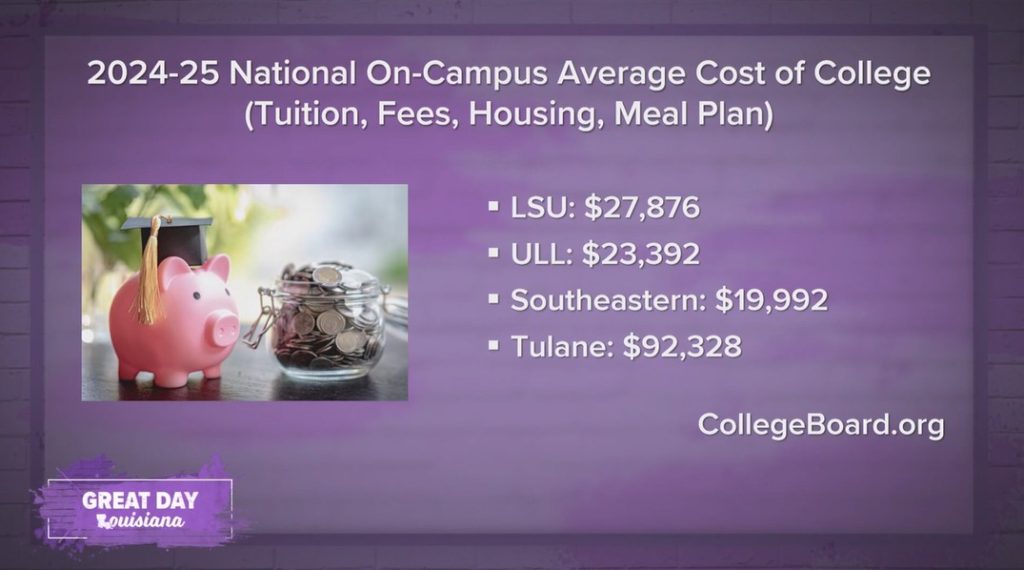
2024-25 National On-Campus Average Cost of College (Tuition, Fees, Housing, Meal Plan)

  • Public Four-Year In-State: $29,910

  • Public Four-Year Out-of-State: $49,080

  • Private Four-Year: $62,990

To bring those numbers closer to home in Louisiana, here is the cost of attendance at the four most widely attended local universities:

  • LSU: $27,876

  • ULL: $23,392

  • Southeastern: $19,992

  • Tulane: $92,328

Education Inflation (Not Terrible Anymore?) and Trends in Financial Aid

We always take a conservative approach at Upbeat Wealth, so our in-house assumption for education inflation is 5%, which reflects the price increases of the last 30 years. The silver lining is that most of the increases happened between 1995 and 2015. From 2015 to 2025, the cost of attendance has moved more in line with the general inflation rate of 3%. Want to learn more about trends in college pricing? Here’s some great data from Collegeboard.org

The other encouraging trend? More students are receiving some form of financial aid – and it’s the good kind! Grants, free money that doesn’t need to be repaid, are increasing as a percentage of total student aid. This has led to a decrease in federal loans, although this data does not include private loans.

Setting an Education Funding Goal

The best metaphor I’ve ever heard for setting an education funding goal for your kids is the same protocol you’re instructed to follow if there’s a drop in cabin pressure on an airplane. When oxygen masks drop in an emergency, put yours on first before assisting others. Another tired analogy would be that there are student loans, but there aren’t retirement loans. It’s important to ensure you are on track for your definition of retirement before funding education goals. If you aren’t careful, you might unintentionally shift the burden of your kids taking out student loans—which can often be managed through forgiveness or paid over time—to supporting your retirement or covering the high costs of end-of-life care.  

If we broadly define “ensuring you are on track for retirement,” it would mean saving at least 10% of your income annually. Obviously, there are about a gazillion other variables that go into this, but I think that’s simple enough for the purposes of this blog. 

Okay, so you’re contributing 10% of your income annually, but also have a couple of kids, so what’s next? 

Here Are Two Goal Funding Frameworks That Households Have Had Success With

Saving Strategy No. 1: Aim to Save Enough to Cover 100% of a Public 4-Year In-State College

Even if you prefer your child not to stay in-state, this offers a generous starting point before they need to consider taking on some financial responsibility and having skin in the game to attend a higher-cost university. E.g., that degree better be worth it. 

To do this, you need to save approximately $685 per month. Here’s an example using our calculator and a few assumptions. 

Saving Strategy No. 2: You Save ⅓ Now, You/Financial Aid Pays ⅓ Then, They Borrow ⅓ to Pay in the Future

I first learned about this strategy from another financial planner, Meg Bartelt with Flow FP. I really like it because it covers a little of everything—about a third, actually! You save a recurring amount that will satisfy a ⅓ of the price of college. Then, during the years your child is in college, you make some trade-offs to cover another ⅓ of the cost from your income, and hopefully, there’s some financial aid involved. Finally, your child covers the remaining ⅓ through student loans, which you can, of course, help them pay off with your future earnings if you wish. 

It’s a great framework to start saving right away and then reevaluate as you get closer. Maybe you’re in good shape for retirement and can contribute more than a third during the enrollment years. Perhaps your child doesn’t even need to know that, and you can laugh at them as they complain about student loans. Or maybe you can act as the lender on the student loans and offer better terms than the federal government, which still believes it’s a good idea to burden our youth with high interest rates as they work to further their education and build a foundation for a fulfilling life. 

It’s just a balanced way of saying, hey yeah, I care. I’ve done something to help you. Perhaps I can do more when I earn more, and I feel confident that I am taken care of. And by the way, it’s your life, take some responsibility for what you hope to get out of this education. 

Here’s another example using the same assumptions as above, but this time to save enough for 33% of a Private 4-Year education. You would need to save about $475 per month now for the first third. If you chose to pay another third at the time of attendance, you’d be looking at approximately $50,000 per year for those 4 years, assuming they didn’t receive any financial aid. 

Where Do I Actually Save The Money For My Child’s Education?

Okay, you’re doing a good job saving for yourself, and now you’ve created an education funding goal. Where the heck does this money go? Here are common options, along with our assessment of each. 

Option 1: Uniform Transfers to Minors Act (UTMA)

This is not much different than setting up a normal brokerage account at a Schwab, Vanguard, or Fidelity. You maintain custodial power over the money inside this account until the beneficiary listed reaches the age of majority, which is now 22 in Louisiana. A quick note: the age of majority varies by state. In Louisiana, it was historically 18. This meant that if you contributed $100,000 to a UTMA account for your child, once they turned 18, they could use the money however they wanted. That makes for a fun first year of college. 

UTMA Pros

  • “Kiddie tax” rules for 2025 allow you to pay no tax on the first $1,350 of earnings annually (dividends, interest, capital gains). The next $1,350 of earnings are taxed at the child’s tax rate, which is likely zero. 

  • The beneficiary can use this account for anything without restrictions. It doesn’t just have to be for educational purposes.

  • More investment options, but that doesn’t necessarily mean *better* options, at least not in Louisiana. 

UTMA Cons

  • Lack of control. The money that you contribute to this account is an irrevocable gift. You can’t just change your mind and reclaim it. Once it’s in there, your only responsibility is to manage it as the custodian for your child’s benefit. 

  • High assessment rate when your child fills out the Free Application for Federal Student Aid (FAFSA). Because this is a child-owned asset, any financial aid they would have otherwise qualified for would be reduced by 20% of the UTMA’s value. 

  • The beneficiary can use this account for anything without restrictions. Once they hit the age of majority in your state, that money is theirs. While 22 is better than 18 in Louisiana, it’s still pretty young to inherit a lump sum of cash. Most 22-year-olds I know don’t stop wanting to spend money after they graduate from school. Usually, they’re making big decisions about the affordability of renting homes and leasing cars. Well, things have just become a whole lot more affordable, and perhaps only temporarily, until the money is gone. 

Our UTMA Assessment: The lack of control, combined with the beneficiary’s early access to the funds, makes this option pretty unattractive. With the recent rule changes increasing the flexibility of the 529 Plan (our next option) beyond college tuition, there is no longer a worthwhile benefit to having an UTMA account. Unless you’re not interested in them using this money for postsecondary education and don’t mind the possibility of giving your child a lump sum at an age when they’re most likely to spend it on something questionable. That’s TRUST. 

Option 2: The 529 Plan

Last year, I filmed a segment for Great Day Louisiana and wrote a blog about the Louisiana START 529 Plan. Since then, with the recent passing of the One Big Beautiful Bill Act (OBBBA), 529 Plans have become even more lenient on how you can use/access the cash beyond college tuition. Here’s a big list of qualified withdrawals. You can contribute up to a lifetime maximum of $35,000 to a beneficiary’s Roth IRA, but there are certain caveats and restrictions. 

Here are some of the main pros and cons of Louisiana’s 529 START Plan. To find out how your state’s 529 plan compares, visit the SavingForCollege website, which outlines the key features of each plan. 

Louisiana START 529 Plan Pros

  • LA State Tax Deduction. $2,400 Single & $4,800 Married Filing Jointly per beneficiary. If you contribute more than the maximum annual deduction amount, the excess carries forward as a deduction in subsequent years. 

  • Earnings Enhancement. Louisiana matches between 2% and 14% of your contributions based on your Adjusted Gross Income. 

  • Tax-Free Growth and Distributions. Money grows tax-free and can be withdrawn tax-free if used for qualifying purposes (see link above re: qualified withdrawals).

  • Maintain Control. The beneficiary is never entitled to the money. You can change beneficiaries on the account as many times as you’d like.

Louisiana START 529 Plan Cons

  • Separate Account Location. Some may find it inconvenient that you have to open up the plan directly through the STARTSaving.LA.gov website. It is technically one more thing that you’ll have to keep track of. 

  • Penalties. While the list of what constitutes a qualified expense continues to grow, if you make an unqualified distribution, you may be subject to paying income tax on the earnings as well as a 10% penalty. 

  • Small Impact on Financial Aid. When owned by a parent, there is a slight reduction in the financial aid your child could qualify for, but this is much less severe than the penalty for an UTMA. 

Our 529 Plan Assessment: The 529 Plan is the premier vehicle for saving for your child’s future education. Workarounds, such as being able to pay for K-12 tuition and possibly contributing a maximum of $35,000 to a Roth account, have made this option more attractive for funding at higher levels in recent years. Our only caveat is that we typically recommend families aim for 33% to 66% of funding through the 529 plan to limit the risk of overfunding. There’s always a possibility that you’ll need that money for other purposes, and current workarounds and increased flexibility for non-penalized withdrawals might still be insufficient. 

Reasons that the percentage would be closer to 66% rather than 33%? You have multiple children, which increases the chances that someone in your family will benefit from the money. Or you have the financial means to the extent that you wouldn’t mind if the money ends up going to your grandchildren. 

Option 3: A Taxable Brokerage Account

You keep the money in your name and just set up a separate account so it’s not commingled with your general investment funds. We strongly advocate using separate accounts, each designated for a specific investment goal, to save money intentionally. When money is mixed together, it’s harder to maintain a clear investment strategy, and you might feel guilty spending it when that goal isn’t predetermined. 

Taxable Brokerage Account Pros

  • Ultimate Control & Flexibility. Money is yours to spend however you see fit. 

Taxable Brokerage Account Cons

  • Taxes, of course! You’ll be taxed along the way on dividends and interest. While there are strategies to reduce capital gains taxes, you’ll likely pay something when you sell appreciated investments to access the money.

Our Taxable Brokerage Assessment: Tax planning is a major part of our work. We believe it’s one of the most important ways we deliver value to our households. However, this is one of those cases where I think that maintaining control and flexibility to supplement your education savings makes a lot of sense, even if it comes with a higher tax liability. Yes, when you earn money in a taxable account, you owe taxes. But it’s not uncommon for a carefully planned and financially smart strategy to fail and end up costing a household much more just because life threw them a curveball. This is like contributing to a 401k plan without having a proper emergency fund. It might have saved you money initially, but if something happens and you need to withdraw funds from the 401k, you’ll face taxes and penalties, which could end up costing you much more. 

Our Overall Assessment: Ultimately, we believe the 529 Plan and the Brokerage account are a perfect marriage for Louisiana residents seeking to optimize their tax savings, receive a state funding match, maintain flexibility over the funds, and help jumpstart educational and non-educational goals alike. 

Statistically, More Education Is The Best Way To Increase Earning Power

As I speak with more and more families, there is a growing sentiment that college will not be a driving force of personal economic growth for their children. There’s also considerable frustration with the system. These certainly go hand in hand. Of course, college isn’t the be-all and end-all. There are numerous lucrative paths for those who don’t follow the traditional route. Anecdotal examples are everywhere, from Fortune 500 CEOs to your cousin, Bill. However, the chart above from the Bureau of Labor Statistics shows a very clear picture. If you put a ceiling on your education, it becomes tougher, not easier. For now, there still is a real benefit in exchange for the price of admission. 

Fiduciary, fee-only, Certified Financial Planner, Mike Turi

Mike Turi, CFP® APMA™ is the Founder and a Lead Financial Planner at Upbeat Wealth, a fee-only firm based in New Orleans and serving clients virtually across the country. He specializes in providing straightforward financial guidance to ambitious young families as they navigate life’s many milestones.

Do you have questions about what we shared in this post, or anything else in general? Feel free to schedule a free consultation or drop us a line!

Sign up for our newsletter (at the bottom of this page) to stay up to speed on our Upbeat Insight.

Disclaimer: All content in this article is provided for educational, general information, and illustration purposes only. None of the information is intended as investment, tax, accounting, or legal advice. Nor is it a recommendation for purchase or sale of any security, or investment advisory services. We encourage you to consult with a financial planner, accountant, and/or legal professional for advice on your specific situation. Read our full disclaimer here.

OBBBA Student Loan Updates

Creating a Student Loan Repayment Plan

Let me start by saying that the goal of this article is to provide an objective summary of the changes in the student loan world for existing borrowers, helping people make informed decisions moving forward. The purpose isn’t to criticize or pass judgment on the ongoing legislative issues or poor execution. We’ll briefly mention some changes affecting new borrowers but reserve a more detailed explanation for later. If you’re a parent planning to borrow for your child or a student preparing for graduate or professional school, you’ll face the biggest challenges from the upcoming changes if taking out loans after July 1, 2026. Borrowing after July 1, 2026, can also affect how you repay your existing loans. 

Currently, 7.7 million people are on SAVE forbearance. Most people feel frustrated, confused, and uncertain about how they will repay their loans. They are exhausted from being the ball in an endless game of political ping pong. If you’re one of those people, this article is for you.

Student Loan Repayment Options

Need a refresher on student loan repayment options? Here’s a bird’s-eye view from the Department of Education: https://studentaid.gov/manage-loans/repayment/plans

Generally speaking, borrowers have two options to pay back their student loans:

  • Fixed payment: Loans structured for borrowers to pay off their balances in full within a specified time period

  • Income-Driven Repayment (IDR): Monthly payments are calculated using your household income and size. IDR is primarily designed for borrowers seeking some type of student loan forgiveness.  

So, why wouldn’t everyone choose to make payments under an income-driven repayment plan and aim for forgiveness? You have a high income. When your student loan repayment is based on your income, it might cause you to pay off your loans too quickly to qualify for forgiveness or raise the payment above what you’re comfortable paying. Or the opposite, you might actually want to pay off your loans quickly but prefer not to deal with the hassle of recertifying income annually. Perhaps you’ll refinance to lower your interest rate and pay off your loans as fast as possible. 

Income-Driven Repayment Plans

As mentioned, on an Income-Driven Repayment plan, your total repayment amount is calculated based on your income. The balance and interest of your loan only apply to plans that have “payment caps.” A payment cap puts a ceiling on your total monthly payment, which is equal to what you would pay under the 10-Year Standard Repayment Plan, a fixed repayment plan. Payment caps are applicable to two IDR plans, PAYE and IBR. Payment caps are a valuable feature for borrowers with rising incomes who may still qualify for forgiveness.

There are currently six(ish) IDR Plans: PAYE, Old IBR, New IBR, ICR, SAVE, RAP.

  1. PAYE: Eligible for existing borrowers with loans originated after October 1, 2007 AND a Direct Loan after October 1, 2011 until July 1, 2028

  2. Old IBR (2009): Eligible for existing borrowers with loans originated before July 1, 2014

  3. New IBR (2014): Eligible for existing borrowers with loans originated after July 1, 2014

  4. ICR: Eligible for existing borrowers until July 1, 2028

  5. SAVE: No longer eligible for enrollment

  6. RAP: Created by the One Big Beautiful Bill Act (OBBBA), but not yet available for enrollment

IBR is technically “one plan,’ but we are treating it as two separate plans because changes made in 2014 benefit eligible borrowers by lowering their payments. Since New IBR is notably better than Old IBR, you need to know which plan applies to you.

Common Paths Toward Student Loan Forgiveness

Public Student Loan Forgiveness (PSLF)

The primary goal of using an income-driven repayment plan is to reduce your student loan payments (especially for those with high balances and low incomes) and eventually qualify for forgiveness. Even professionals with high incomes can benefit from forgiveness if their loan balance is substantial and they experience a period with a temporarily low income, such as during residency for physicians. 

Although some occupation-specific forgiveness programs exist, the most well-known and widely discussed is the Public Service Loan Forgiveness (PSLF) program, which covers those who work full-time for a not-for-profit or government organization. Popular occupations include healthcare workers, military personnel, law enforcement officers, first responders, teachers, local and federal government employees, social workers, and nonprofit workers. 

Unsure if you qualify for PSLF? There are 4 Key Components:

  1. Have Direct Federal Loans

  2. Make 120 Payments

  3. Work for a Qualifying Employer (including when you submit your final PSLF form)

  4. Make Payments On An Income-Driven Repayment Plan (although the 10-Year Standard Plan also counts toward this)

IDR Forgiveness

Workers in the private sector can also qualify for forgiveness under an IDR plan, but it will take longer than the time available to public servants under PSLF. If you do not qualify for PSLF, you’ll have to repay your loans for 20, 25, or 30 years to get forgiveness, depending on which IDR plan you’re enrolled in. 

  • PAYE: 20 Years

  • New IBR: 20 Years

  • Old IBR: 25 Years

  • ICR: 25 Years

  • RAP: 30 Years

Another key difference is that PSLF forgiveness is not taxable, whereas IDR forgiveness is. This is often referred to as a tax bomb, and it will take effect again starting January 1, 2026. The forgiven balance of your student loans will be counted as income in the year it is forgiven. To clarify, this does not apply to public servants repaying their loans through PSLF, which remains protected as tax-free under federal law.

Current OBBBA Updates for Existing Borrowers

As of July 29th, 2025, many of the “updates” expected to be rolled out by OBBBA have not yet been implemented. Here are some of the changes that are effective immediately or, at the very least, actionable. 

Existing Parent PLUS Loans Now Qualify for IBR

Previously, Parent PLUS borrowers had access only to ICR, the least favorable IDR plan with the highest monthly payments, unless they used a strategy known as the double consolidation loophole. Now, as long as Parent PLUS borrowers consolidate before July 1, 2026, and enroll in an IDR plan before July 1, 2028, they will qualify for plans beyond ICR, which is the least favorable IDR plan. This is good news for parents who have borrowed on behalf of their kids.

SAVE Plan Forbearance

If you are already enrolled in the SAVE plan, you will remain in forbearance until the sooner of a court ruling or July 1, 2028. This should not be confused with the announcement by the Department of Education stating interest will start accruing on August 1, 2025. Interest beginning to accrue again doesn’t mean you have to start making payments. You are protected from defaulting on your loans under SAVE through forbearance. Later, we’ll discuss reasons you may voluntarily move off SAVE, but for right now, you are not required to voluntarily switch or pay.

Future OBBBA Updates for Existing Borrowers

Most of the legislative changes in the OBBBA have not yet taken effect or are scheduled for future dates. Here are a few of the major changes existing borrowers can expect to see in the coming years. 

Some IDR Plans (PAYE, ICR, SAVE) Will Be Eliminated

The following IDR plans will be phased out and eliminated. Existing borrowers will not be grandfathered into these plans and will not be allowed to make payments on them beyond July 1, 2028. It is unclear how the Department of Education will handle the transition, but all borrowers in the plans listed below will be asked to switch before July 1, 2028. 

  • PAYE: July 1, 2028

  • ICR: July 1, 2028

  • SAVE (formerly REPAYE): Sooner of a court ruling or July 1, 2028

Please note that if you were paying under REPAYE, you were automatically moved to SAVE in 2023.

A New IDR Plan (RAP) Will Be Created

A new IDR plan, called the Repayment Assistance Plan (RAP), will be introduced by July 1, 2026. This will leave existing borrowers (those with no loans originated after July 1, 2026) with the following IDR plan options beyond July 1, 2028. 

  • Old IBR (Borrowers Before July 2014)

  • New IBR (Borrowers After July 2014)

  • RAP

Partial Financial Hardship Will Be Removed for PAYE & IBR

Previously, you could only switch to the IBR plans if you had a partial financial hardship, which was defined by your income-driven repayment being less than your 10-year Standard Repayment amount. Lawmakers recognized that this would be problematic for many borrowers who were making payments on IDR plans that will ultimately be eliminated. Therefore, to expand eligibility for PAYE and IBR, they are removing the partial financial hardship requirement for enrollment. Unfortunately, there is no specific timeline for when this change will take effect and be implemented by the loan servicers. So, PAYE/IBR might show as ineligible on your studentaid.gov portal for now, even though you’re eligible to enroll. Frustrating!

Department of Education Confirms “Buyback” Will Continue for PSLF-eligible Borrowers

Borrowers who have 120 months of eligible employment can buy back periods of deferment or forbearance, provided this brings their total to 120 qualifying payments. The Department of Education announced that in the future, borrowers may buy back previous months even if they do not have 120 months of eligible employment. While it is not guaranteed in the future, as of now, you are eligible to buy back every month you’re in SAVE forbearance, assuming you work for a qualified employer. You still cannot buy back months spent not on an IDR plan or working for a nonqualified employer. 

Changes for Borrowers Taking Out Loans on or After July 1, 2026

The biggest impact of the OBBBA is for borrowers who need to continue borrowing on or after July 1, 2026, as repayment options will become very limited. New borrowers on or after July 1, 2026, and those who consolidate after that date will only have access to two plans. 

  1. An Updated Standard Repayment Plan: the repayment term depends on your loan balance.

  2. The Repayment Assistance Plan (RAP): the only IDR plan option

The situation is even worse for new Parent Plus borrowers; they will only have access to the Standard Repayment Plan, and these loans will no longer qualify for forgiveness.

Borrowers taking out loans on or after July 1, 2026, will face new loan limits for graduate and professional schools as well as for Parent PLUS loans. 

There are changes in procedures for exiting default on loans, qualifying for economic hardship, and entering forbearance, none of which are favorable compared to the current rules.

Is the New IDR Plan (RAP) Any Good?

The RAP Plan is the Republican response to President Biden’s SAVE Plan. While the SAVE Plan was very generous for many borrowers, the RAP Plan is not as kind. The SAVE plan effectively lowered payments for many borrowers compared to other IDR plans. RAP, unfortunately, does mostly the opposite. However, there are small pockets of borrowers who will benefit from a lower payment under RAP compared to New IBR, specifically those with balances between $30,000 and $80,000. 

In line with Income-Driven Repayment Plans, your payment is based on income, although it’s calculated differently than previous IDR plans. Instead of explaining how the income is calculated, I will show you an illustration of how the monthly payments compare across plans. Here are some example monthly payment calculations for RAP vs. Old IBR vs. New IBR. 

Illustration notes: New IBR and PAYE payments are the same. Additionally, this doesn’t consider the monthly payment cap borrowers qualify for under IBR/PAYE, where your payment is limited to the 10-year standard repayment amount. Therefore, the IBR payments shown may actually be lower in your personal situation depending on your loan balance and interest rate. 

RAP Plan Pros

  1. RAP upholds a popular student loan strategy where borrowers can file their taxes separately and pay based on their individual income instead of the household’s income. This is especially useful when the borrowing spouse earns less or is currently unemployed. 

  2. Similar to the SAVE plan, if your monthly payment does not cover the interest, the government will waive it and pick up the tab. It will not be added to the loan. 

  3. In addition to waiving interest, the government will contribute up to $50 toward your loan so your principal actually goes down. 

RAP Plan Cons

  1. Lowest-income borrowers will still need to pay at least $10 per month. There is no option to have a $0 student loan payment. 

  2. If you don’t qualify for PSLF or other forgiveness programs, you need to make 30 years of payments to get IDR forgiveness with RAP. That’s 10 years longer than what is required by New IBR & PAYE.

  3. Other IDR plans determine the amount you can pay based on your “discretionary income,” which is calculated by subtracting a percentage of the Federal Poverty Level (FPL) for your household size. The FPL increases each year to account for inflation, allowing you to exclude a larger amount of income from your household income when calculating your monthly repayment. The RAP plan bucks this trend, so inflation will not help reduce your payment. 

  4. RAP will cost households where both partners have student loan debt. Unlike other IDR plans, there is no prorata calculation used to determine each spouse’s student loan payment based on household income. Instead, as we understand it now, RAP requires each borrower to pay the full calculated amount for their individual loans and does not lower that payment unless you file your taxes married filing separately to exclude your partner’s income.

  5. There is no payment cap relative to the 10-Year Standard Repayment amount.

If I’m In The SAVE Forbearance, What’s My Move?

Giving specific student loan advice is a tall order, so that’s not the goal for the rest of this blog. Ultimately, many variables affect your situation: the type of loans, eligible plans, PSLF or IDR credits, your income, your spouse’s income, projected career path, and household size. And then there’s the total uncertainty of future policy changes. HOWEVER, here’s what I would generally consider in some common scenarios. 

When Staying in SAVE Might Make Sense:

You have made or will make 120 payments, including the SAVE forbearance period, and are currently awaiting the Department of Education’s review of your PSLF Reconsideration request for buyback. 

You have higher-interest loans that you’re working on paying back, like credit card debt. Your money is probably better spent paying down higher-interest loans. 

You are not a public servant, and it’s not clear whether IDR forgiveness or paying off your loans completely is the better financial choice. Additionally, until the partial financial hardship requirement for PAYE or IBR is removed, you’re stuck with the least favorable plan, ICR, as your only option. You might just let the interest on your loans accrue until that partial hardship is removed. 

You expect your income to decrease in the future, making your payments toward forgiveness cheaper than they are now. 

You don’t want to remove yourself voluntarily from SAVE until it’s official that interest will truly accrue.

You already filed your 2024 taxes as married filing jointly, but ideally, you might benefit from filing married filing separately and using only your income to determine the monthly payment. 

When Switching from SAVE to PAYE Might Make Sense:

Your income is similar to your last recertification, and you’re ready to start making payments again to earn credit toward IDR forgiveness or PSLF. 

Once the partial hardship is removed, you can switch and still be limited to the 10-Year Standard Repayment, which allows you to balance the option of continuing earning forgiveness credits with paying back your loans in full.

You took out loans before July 1, 2014, and now only qualify for Old IBR. PAYE is a more affordable plan in any situation compared to the Old IBR. Yes, you’ll need to leave PAYE by July 1, 2028, but at least you’ll get a few years of lower payments before that. 

You’re far from forgiveness and have a career path with increasing income. You might want to start earning guaranteed PSLF/IDR credits now at a lower amount, avoiding the need to buy back later. It’s also possible that the buyback amount will be the same as your PAYE payment today. 

When Switching From SAVE to Old IBR Might Make Sense:

You only need to make a few more payments to reach 120 credits and want to avoid waiting for PSLF buyback, or you need to act quickly on PSLF because you’re leaving a qualifying employer. Remember, you must be actively employed at a qualified employer when submitting your PSLF forgiveness application. 

When Switching From SAVE to New IBR Might Make Sense:

The advantages of switching to New IBR and PAYE are 99% similar. However, you can go directly to New IBR if you prefer not to switch off PAYE when it becomes obsolete in 2028. The New IBR will continue to exist, and the payments for New IBR and PAYE are exactly the same. The only downside of New IBR compared to PAYE is that if you ever need to switch off New IBR, your interest will capitalize. So, if a more attractive IDR plan is introduced in the future, any unpaid interest will be added to the loan principal. This only becomes a problem if you need to pay off your loans in full later. 

Private Refinancing Might Make Sense:

You will definitely pay off your student loans, and refinancing with a private lender can lower your student loan interest rate by over 2%. I mention 2% because you should carefully consider this option, as a private takeover of your federal loans is irreversible and can also remove some protections. Additionally, it could exclude you from any future relief resulting from policy changes by a different administration. 

The Biggest Variable is Future Policy Uncertainty Beyond This Administration

Student loan policy may become a single-issue concern for voters in the future. There will be considerable frustration due to the fallout from OBBBA. And contrary to belief, this isn’t just coastal liberal arts professionals who will suffer. Doctors and lawyers are also taking a big hit. Furthermore, the downsizing of the federal government eliminated the possibility of PSLF for many public servants. Our teachers, first responders, and soldiers, who are already struggling to make ends meet, may now face higher payments. This is pure speculation, but I believe the Democrats will try to capitalize on this, and if they successfully regain unified control, we could see another major shift in policy.

Our Biggest Recommendation

If you’re confused, hire a knowledgeable expert in student loan repayment and forgiveness. Several reputable companies offer one-time consultations for $400 to $700. Student loan strategies can be complicated, and choosing the right one could save you tens of thousands of dollars. That’s a potentially huge return on your money. And whatever you do, ignore anyone in the media *lecturing* you about how you should pay back your student loans dollar for dollar. Ignore their tired ass complaints about how people used to honor their debts in the past. If you are eligible for a path toward forgiveness and will spend less getting there than paying back your student loans in full, it is your American right by law to pursue it!

Fiduciary, fee-only, Certified Financial Planner, Mike Turi

Mike Turi, CFP® APMA™ is the Founder and a Lead Financial Planner at Upbeat Wealth, a fee-only firm based in New Orleans and serving clients virtually across the country. He specializes in providing straightforward financial guidance to ambitious young families as they navigate life’s many milestones.

Do you have questions about what we shared in this post, or anything else in general? Feel free to schedule a free consultation or drop us a line!

Sign up for our newsletter (at the bottom of this page) to stay up to speed on our Upbeat Insight.

Disclaimer: All content in this article is provided for educational, general information, and illustration purposes only. None of the information is intended as investment, tax, accounting, or legal advice. Nor is it a recommendation for purchase or sale of any security, or investment advisory services. We encourage you to consult with a financial planner, accountant, and/or legal professional for advice on your specific situation. Read our full disclaimer here.

Upbeat Wealth on the News: Tips for Parents Saving For College

Upbeat Wealth Founder Mike Turi joins Great Day Louisiana’s Malik Mingo to discuss saving tips for education goals and Louisiana’s START 529 Plan.

Great Day Louisiana: Saving Strategies for College
Budgeting for Higher Education Costs

Knowing what it will cost remains the trickiest part of determining how to save for college. You’re simply guessing how much college will cost 10+ years out and how much funding your child will need. Will they go to college? What type of school? Will they receive scholarships and grants? Here’s what the current landscape looks like per CollegeBoard.org: 

2023-24 National On-Campus Average Cost of College (Tuition, Fees, Housing, Food)

  • Public Four-Year In-State: $28,840

  • Public Four-Year Out-of-State: $46,730

  • Private Four-Year: $60,420

Historically, higher education costs have increased faster than other goods and services. If core inflation is running at 2-3%, education inflation is running between 5-8%, depending on what you are measuring. If we adjusted the public four-year in-state tuition of $28,840 for 5% annual inflation over the next 18 years, the cost of college would increase to $69,407. While you will never eliminate sticker shock, this highlights the importance of having an intentional savings + investing plan to keep up with inflation. 

Louisiana’s START 529 Plan

The most tax-efficient college savings vehicle is the 529 plan. In Louisiana, it’s called the START Saving Plan, and there’s a ton of great information on their website, startsaving.la.gov

A 529 plan is a bit like a Roth 401k for higher education costs. Money goes in after-tax, grows tax-free, and is eligible for tax-free withdrawals for qualified expenses such as tuition, fees, books, and room and board. 

Additionally, Louisiana offers the following benefits for residents:

  • State Tax Deduction: Married couples filing jointly may deduct deposits up to $4,800 per year per beneficiary

  • State Match on Contributions: There is an “Earnings Enhancement” based on household income that ranges from 2 – 14%. For example, a household making $70,000 would be eligible for a 6% earnings enhancement. Therefore, if they contributed $10,000 to an LA 529 Plan in 2024, they would receive additional funding of $600. 

  • Low-Cost Investments: Remember to choose your investments when setting up a 529 plan, as LA has a great line-up of low-cost Vanguard funds to choose from, including “age-based” options that will rebalance automatically from aggressive to conservative as your child gets closer to college. 

While I always recommend investing a portion of your savings in a 529 plan for the above reasons, you might consider diversifying your savings toward a boring old taxable brokerage account, especially early on when there is a great certainty of your child’s track. This will allow you added flexibility if there is excess savings relative to your funding needs. 

What happens if my child ends up not needing the money?

Withdrawing funds from a 529 plan for non-qualified educational expenses carries tax consequences and penalties. Generally speaking, you’ll be subject to ordinary income taxes and a 10% withdrawal penalty on the earnings portion. Thankfully, recent legislation has added flexibility to avoid these penalties. To avoid income tax on earnings and penalties, parents have the option to:

  • Change the beneficiary at any time to another child or grandchild for their benefit

  • Rollover funds from a 529 plan to a Roth IRA for a beneficiary. Restrictions apply, such as a minimum holding period, an annual maximum, and a lifetime maximum.

  • Withdraw up to the amount of a tax-free scholarship/grant to avoid penalty but not income tax on the earnings.