
Why Variable Income Requires a Different Cash Flow Strategy
Even with a steady paycheck, cash flow planning is frustrating. “Budgeting” is a word soaked in evil. Ugh, do I really have to think about whether I’ll have enough for housing, transportation, taxes, insurance, savings goals, and retirement before I purchase ANYTHING?! Even with predictable income, household expenses often don’t match perfectly. You may get 24 or 26 paychecks, but some expenses arise unexpectedly or at irregular intervals.
Now add the complexity of matching variable income to your chaotic expense calendar. How you manage it can make all the difference between feeling wealthy or feeling like you’ll never have enough money. A properly structured cash flow system shovels money in the right bucket, no matter the timing. By filling your buckets ahead of time, you shift from a buy-now, pay-later mentality to a pay-now, buy-later mentality. No more living paycheck-to-paycheck. Big ticket items like retirement savings and life goals BEFORE you spend it all on daily discretionary expenses. Which, in return, helps you actually spend guilt-free on daily discretionary items because, well, you already handled the bigger, more importanish stuff.
Irregular Income is Pretty Regular
Most of the households we work with receive some form of variable pay. This doesn’t necessarily mean their take-home pay is unpredictable or seasonal; they might have secondary income that is infrequent, uncertain, or tied to company profits or stock.
Law firm partners may receive irregular draws followed by an annual profit-sharing distribution.
Healthcare workers may receive substantial bonuses based on production.
Tech workers may receive substantial cash bonuses or equity compensation based on incentive programs.
Business owners might take sporadic owner distributions or draws depending on profitability.
Common Types of Variable Income
- Self-employment Income
- Commissions
- Bonuses
- Tips
- Overtime
- Performance-based Compensation
- Shareholder Distributions
- Seasonal Income
- Employee Stock Purchase Plan
- Restricted Stock Units
When receiving any form of uneven compensation, households must plan not only for income variability but also for timing variability.
Income Variability: How much income you might receive and the possible range of outcomes.
Timing Variability: When you expect to actually receive that income.
How to Create a Predictable Income Stream
Dollar in, dollar out? Not so fast! When your income comes in waves, you need to smooth the tides so you can meet your needs, wants, and savings goals – not just in that moment, but across the entire year.
Priority #1: Set Aside Money for Taxes
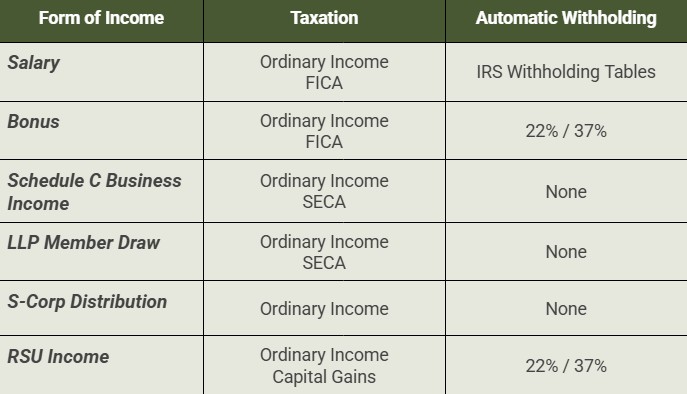
Different forms of compensation are subject to different levels of taxation: Ordinary Income tax, FICA tax, Self-Employment tax (SECA), and Capital Gains tax. To add to the chaos, withholding can be automatically deducted from your paycheck at the same rate, a different rate, or not deducted at all. And that’s not all. Even when withholding is handled automatically, it’s likely inaccurate.
For example, the IRS requires employers to apply a standard withholding percentage for bonus income. It’s 22% for supplemental wages less than $1,000,000 and 37% for supplemental wages over $1,000,000. The withholding rate doesn’t reveal your true tax liability from that income. Furthermore, salary withholding is handled differently, using IRS withholding tables based on your annualized income from that employer and further instructions from your W-4.
Here’s a chart with some more examples.
When creating your tax plan, you’re looking to avoid two things: penalties and surprises.
The simplest way to avoid a penalty is to satisfy one of the following IRS Safe Harbor rules by using normal W-2 withholding and, if applicable, making estimated quarterly payments.
Current Year 90% Rule: Withhold 90% or more of your current year tax liability.
Prior Year 100% / 110% Rule: If prior year income is less than $150,000, withhold 100% of your prior year tax liability. If prior year income is greater than $150,000, withhold 110% of your prior year tax liability.
De Minimis Exception: Owe less than $1,000 when you file.
The easiest way to avoid a tax penalty is to use the prior year formula. For example, if your income greatly exceeds $150,000 and your tax liability is $200,000, you can avoid penalties by paying quarterly estimated taxes of $55,000. Simple and straightforward.
But what about surprises? Business owners, law partners, tech workers, and highly paid executives might only have a rough idea of their overall compensation. Total annual compensation could be significantly higher than the previous year’s. Alternatively, a business may experience bigger write-offs that reduce taxable profit. Or my favorite: if you receive shareholder distributions as a partner or owner of your firm, that isn’t considered taxable income. You are taxed on your proportional share of the firm’s profits. This distributive income flows through to your return based on your ownership percentage. So if the firm retains some earnings and doesn’t distribute them, you still owe taxes on those profits, whether or not you received the money.
Tax Planning Strategies for Variable Income
The level of planning necessary depends on the variability, trendline, and form of compensation. But here’s a good starting point.
If your income is steady and increasing slowly, satisfy the prior year safe harbor rule through regular salary withholding or estimated quarterly payments. To avoid a tax surprise, add 1-3% to each payment.
If your income is volatile throughout the year but generally on par with the prior year, satisfy the safe harbor rule- or- calculate out the effective tax rate of your prior year distributions. Say you received $750,000 in distributions and paid $250,000 in federal taxes in the prior year; that’s an effective federal tax rate of 33%. Now you know you have to set aside ⅓ of each distribution for federal income taxes. If your business income is uneven throughout the year, it’s also helpful to have a CPA in your corner to complete Form 2210, which allows you to enter when you actually received money throughout the year and match your estimated tax payments accordingly.
If you have a young business and profitability is TBD, set aside a conservative baseline percentage, such as 25%, for federal taxes, then adjust as you establish a year-over-year trend.
Regardless of your approach, the key is to distance these funds from your personal or business spending accounts. It’s not really yours to begin with, and the IRS expects you to settle up with them, at most, on a quarterly basis for any earned income. We are a pay-as-you-go tax system, after all. So remove this money from your purview along with the temptation to spend it. That is a surefire way to leave you scrambling at the tax filing deadline and facing a big tax bill.
Priority #2: Fund Life Goals and Irregular Expenses
While it requires careful planning, receiving a large share of your total pay as a one-time bonus is a wonderful way to boost your savings. Let’s face it, routine income from a salary tends to get absorbed into our lifestyles. The creep is there, and it’s real. But if extra money hits you all at once, you have a unique savings opportunity to fund bigger goals like education costs, major purchases, home improvement, retirement, etc. Since this money isn’t regularly deposited into your checking account, you’re used to living with less. Combine that with the instant gratification of filling savings buckets all at once instead of incrementally each week or pay period.
How to Use a Bonus to Fund Your Financial Goals
Here’s an example of how an annual bonus may get disbursed across several goals & obligations.
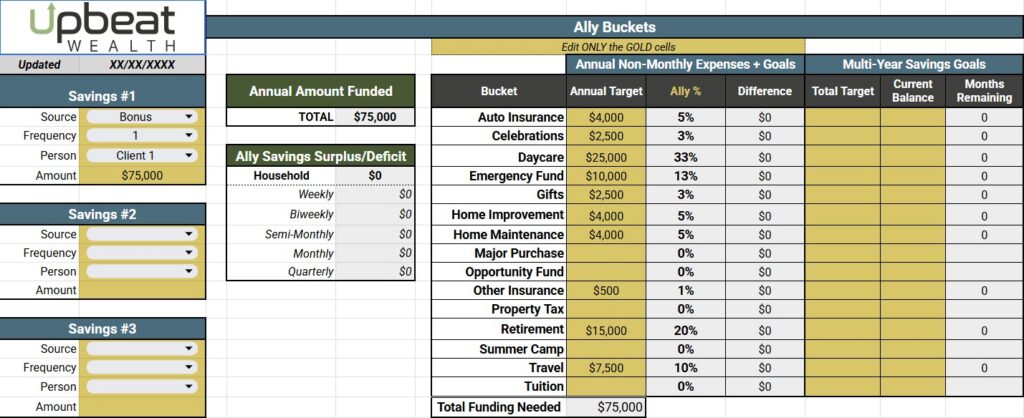
This annual bonus was used to cover this household’s auto insurance premium, celebration budget, daycare costs, emergency fund contribution, gift-giving plan, home improvement projects, home maintenance reserve, umbrella insurance policy, and travel goals. That’s a lot to accomplish with one supplemental paycheck.
Using Your Semi-Monthly Pay Periods To Fund Your Financial Goals
Here’s another example of how these same goals & obligations would be funded via semi-monthly pay periods.
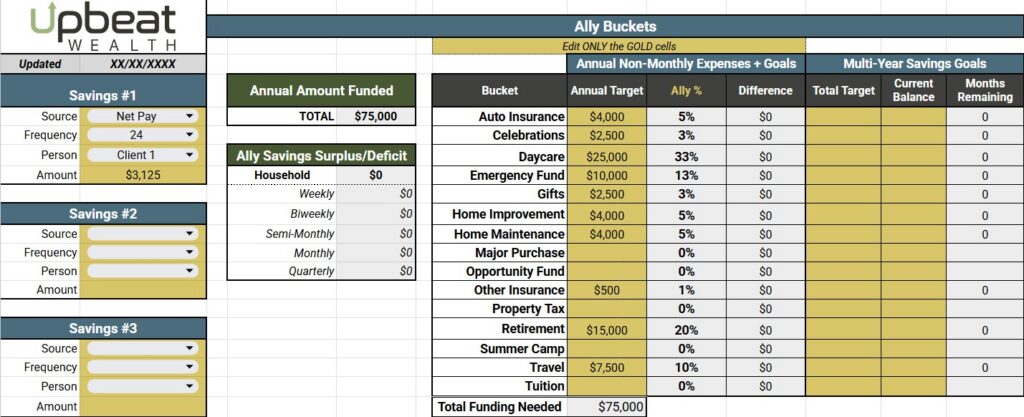
They would have to save $3,125 twice a month to cover the same $75,000 Annual Savings Goal. Mathematically, this isn’t an issue. The end result is the same. Psychologically, I’d be surprised if the household didn’t suffer from some lifestyle creep that resulted in fewer savings. The best way to save is to automate the decision and remove the money from sight, which is easier with a lump sum than when it’s spread across 24 pay periods. You don’t have to exercise the same willpower when you watch a chunk of your paycheck repeatedly go toward things you know are important, even if you don’t face the expense every day.
Establishing A Bucket System
Want to create your own bucket system? Start by using a table like the one above. Itemize the not-so-fun obligations, such as auto insurance, home maintenance, school tuition, and an emergency fund. Then determine what you can afford for irregular discretionary spending, such as gifts, celebrations, home improvements, and travel. A good rule of thumb is to save 10% of your income for the fun stuff – bigger goals that deliver deep value and improve your quality of life.
Priority #3: Save for Retirement
Should saving for retirement be considered priority #3? It’s verrrry close to #1 and #2. Ah, that pesky future self. Why are they always asking for money anyway? I’ll only remind you that you may lose the desire or the physical ability to continue working as you age. And in the event that either of those things happens, Social Security alone will likely not be enough to maintain your current pre-retirement lifestyle. But ultimately, it’s hard to secure your future if you lack control over your present day obligations.
Typically, we recommend allocating 10-20% of household income to retirement savings. Of course, that varies from person to person and household to household. All ships are built differently, with unique destinations in mind. Sometimes that’s easy to do through payroll deductions into a low-cost employer-sponsored retirement plan with employer matching. Really, the unheralded superpower of a 401k plan is that it lets you automate your savings and investment plan without the money ever touching your checking account. It’s just coded as a deduction on your pay stub. It’s entirely out of the picture. You don’t get a chance to spend it. You probably don’t even notice it. It’s a number you might only look at once a year for an update.
But sometimes, you need to allocate funds elsewhere if you don’t have an employer-sponsored retirement plan or if another option better suits your personal circumstances. In that case, you should still treat it like a 401k and work to remove it from your net pay before it’s commingled with your checking account. That could be as simple as setting up a net pay allocation of 10-20% to a brokerage account.
Priority #4: Create A Household Operating Account
After you’ve set aside money for taxes, life goals & obligations, and retirement, what’s left? It’s your day-to-day money. It must cover your monthly fixed expenses (like mortgage/rent) and your flexible spending (like lifestyle). We’ve written previous cash flow pieces about goal prioritization and how to take control of your cash flow. But ultimately, if you’re overspending your household operating account, you either need to increase income, work longer, or cut back on funding other life goals. No matter your level of wealth, there are always tradeoffs to consider.
The household operating account is your primary checking account. It’s the source of payment for your daily financial obligations.
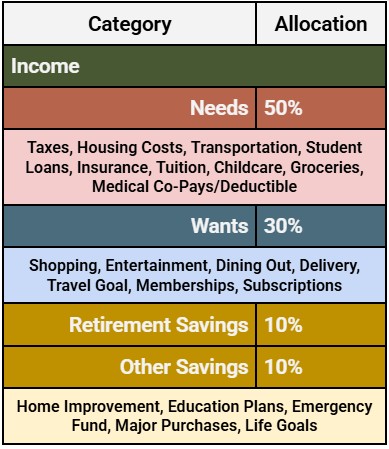
At the end of the day, if you aren’t saving it, you’re very literally spending it. So you could back into this number fairly easily. As mentioned above, it’s whatever is left after you’ve met all your life goals and obligations. But I’d recommend comparing this with your actual fixed expenses to confirm your lifestyle is aligned with your finances. By addressing priority #2, you’ve already pinpointed all expenses that are due less frequently than monthly – such as annually, biannually, or quarterly. Next, list your regular monthly expenses. These are expenses that are consistently the same amount or are set to autopay. Now, consider your “flex” expenses – these are variable costs that fluctuate daily or weekly. You don’t need to list each one separately; just keep track and make sure they stay within your cash flow limits. A healthy cash flow should look something like this using the 50/30/20 Rule:
Here’s an example using cash flow from someone who receives variable pay throughout the year and *buckets* every single dollar.
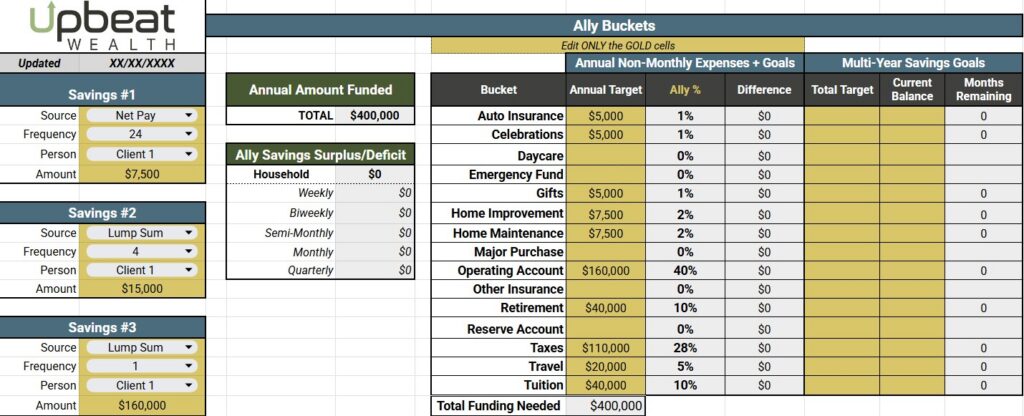
Their total income is $400,000, but they must allocate funds for auto insurance, celebrations, gifts, home improvements, maintenance, retirement, taxes, travel, and tuition. As part of their overall plan, they created an “Operating Account” bucket to pay themselves a salary into their checking account. In this example, they receive $160,000 annually, which breaks down to $13,333 per month, as a distribution from their Savings Account to their General Checking Account. This amount covers fixed monthly costs from their “Needs” and “Wants” categories. Any remaining funds from their manufactured salary can be freely spent on discretionary items such as shopping, entertainment, and dining out.
In the example above, the timing of their income is highly variable, with 40% of their total compensation ($400,000) received as an annual lump sum ($160,000). But what if income occurs even less frequently or isn’t guaranteed at all? Law firm partners often have no income for the first 1-3 months until billables catch up. Similarly, a business owner might have seasonally adjusted income or experience fluctuating profits. This brings us to priority #5: maintain a reserve account.
Priority #5: Build an Income Reserve
An income reserve account can protect you from overspending during high-income times, preventing the need to significantly cut back on your lifestyle during lower-income periods. The goal is to stabilize your spending and make it predictable so you don’t constantly run out of cash, which can cause stress, drastic behavior shifts, and high borrowing costs.
An income reserve helps balance your income by storing surplus funds from good months to support the weaker ones. There are a couple of ways to do this, but first you need to calculate a target for your income reserve.
How Much Should You Keep in an Income Reserve?
- A Percentage of Business Cash Flow/Revenue
- 1 – 6 Months of Business or Household Operating Expenses
- A Percentage Reduction of Your Operating Account
Below is a variation of our most recent example. Instead of having $160,000 in an “Operating Account,” the individual allocates 3 months’ worth of expenses to cover weaker months and saves $40,000 in a “Reserve Account.”
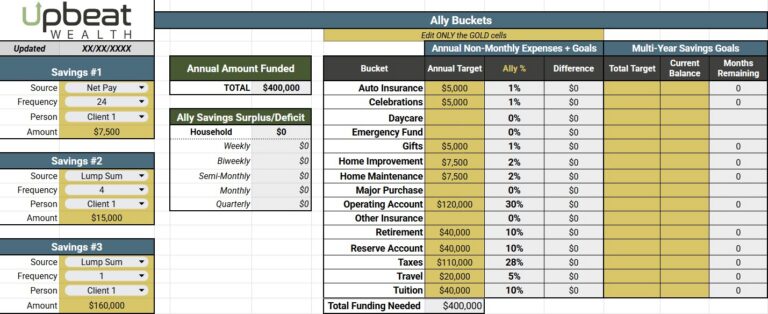
They are currently allocating $120,000 each year, which amounts to a monthly deposit of $10,000 into their checking account as a salary. They also now have a Reserve Account that represents 25% of their total allocated capital ($160,000 in total between the Operating Account and the Reserve Account). This could cover the remaining $3,333 monthly to reach the full $13,333 monthly in the prior example, or a larger chunk if the operating accounts hit $0.
Alternatively, the household can live on the $10,000/mo and use the reserve account as an extra layer of security if their income is highly variable.
At the end of the day, we always recommend erring on the side of caution. It’s much harder to reduce spending than to increase it. But ultimately, a well-structured cash plan, no matter how variable your income is, could not only help you spend money you didn’t realize you had but also stop you from feeling like you’re constantly running your accounts to zero each month or counting the days until your next check.
Frequently Asked Questions About Variable Income
Q1: How do you budget when your income is variable?
A1: The best way to budget variable income is to separate the timing of your income from the timing of your spending. Set aside money for taxes, savings, retirement, and irregular expenses when income arrives, then transfer a consistent amount into your household operating account for monthly spending. An income reserve can provide additional support during lower-income months.
Q2: How much should I save from variable income?
A2: The amount you should save depends on your income, expenses, taxes, and financial goals. A practical approach is to allocate variable income toward taxes first, then fund upcoming obligations, retirement, and other savings goals. The remaining amount can be used to support your regular household spending and income reserve.
Q3: What is an income reserve?
A3: An income reserve is a separate pool of money designed to help smooth out variable income. You can build the reserve during higher-income months and use it during months when your income is lower. A common starting point is one to six months of business or household operating expenses, depending on how unpredictable your income is.
Q4: How do you budget an annual bonus?
A4: Instead of treating an annual bonus as extra spending money, use it to fund expenses and financial goals that occur throughout the year. A bonus can be allocated toward taxes, retirement, an emergency fund, insurance premiums, education, home improvements, travel, gifts, or other irregular expenses. This allows your regular paycheck to support your ongoing monthly lifestyle.
Q5: How can I make variable income more predictable?
A5: Create separate accounts or financial buckets for taxes, savings goals, retirement, household spending, and your income reserve. Rather than spending based on how much money happens to be in your checking account, determine how much you can consistently afford to transfer into your operating account each month. This creates a more predictable spending system even when your income changes from month to month.

Mike Turi, CFP® APMA™ is the Founder and a Lead Financial Planner at Upbeat Wealth, a fee-only firm based in New Orleans and serving clients virtually across the country. He specializes in providing straightforward financial guidance to ambitious young families as they navigate life’s many milestones.
Do you have questions about what we shared in this post, or anything else in general? Feel free to schedule a free consultation or drop us a line!
Sign up for our newsletter (at the bottom of this page) to stay up to speed on our Upbeat Insight.