

Do you ever feel like you’re giving everything you have to balance it all? As if you’re sitting 8 feet high on a unicycle… with a stack of dishes towering on top of your head… taller and taller… more and more getting tossed your way… the stakes getting higher… all eyes on you just watching to see if you can keep it together…
If that hits home, you’re like me and so many others out there navigating life as a growing family.
You might also be Red Panda during a halftime show.
Why Prioritizing Financial Goals Matters
As the years come at us, we’re faced with an ever-growing list of competing responsibilities, tasks, and goals – many of them financial and all of them seemingly important. The most effective way to not only maintain sanity, but give ourselves a solid chance to thrive, is to prioritize everything.
Doing so is sure to deliver some calm to the chaos. It’s also quite necessary given we don’t have access to unlimited resources. By triaging our goals, we set ourselves up to more accurately distribute the finite resources at our disposal, thus sticking to a course in line with what we actually hope to get out of life.
The idea is obvious enough. Making it happen is another story. To help you overcome the hurdle, here’s how I suggest going about prioritizing your financial goals when so many are making a strong case to consume your bandwidth…
Step 1: Put Every Financial Goal on Paper
Our brains operate more efficiently when we free up real estate by writing things down. We think of more, forget less, and reduce unnecessary mental load that gets in the way of the task at hand.
Flush out all of the financial goals you can think of with a brain dump. Create a list, make a mind map… However you like, write out your hopes and dreams. Big, small, serious, silly, and otherwise. When you think it’s complete, ask yourself, “What else?” Then again. Order doesn’t matter at this point. The idea is simply to get them all out.
A helpful prompt to push the exercise along is the first of George Kinder’s 3 Questions:
- Imagine you are completely financially secure. You have more than enough money to take care of your needs, now and in the future. How would you live your life? Let yourself go. Don’t hold back your dreams. Describe a life that is complete, that is richly yours.
Step 2: Clarify Your Values Before Setting Priorities
Once you have everything written out, you could ask ChatGPT or Google how to properly order your list of financial objectives. There’s no shortage of AI, people, finfluencers, and even advisors who will readily tell you the “right way” to go about it without knowing the first thing about you. It’s mostly noise. Odds are you won’t feel anything when you look at the output because it lacks the most consequential variable.
Your plan should be aligned with your values.
Before you attempt to order your goals, set them aside and commit time to deeply exploring your values. Chew on what really matters to you.
It’s a heavy lift. The second and third of Kinder’s 3 Questions push you deeper here:
- Imagine you visit the doctor who tells you that you only have 5 to 10 years left to live. You won’t ever feel sick, but you will have no notice of the moment of your death. What will you do in the time you have remaining? Will you change your life, and how will you do it? (considering your current health & financial situation)
- Now, imagine your doctor shocks you with the news that you only have 24 hours to live. Notice what feelings arise as you confront your very real mortality… Ask yourself: What did I miss? Who did I not get to be? What did I not get to do? What dreams will be left unfulfilled?
Here are a few other prompts to get the juices flowing:
- What does “enough” mean to you?
- What is it about money, as a tool, that’s important to you?
- If you were told to go buy “happiness”, what would you buy? How much would you spend?
Step 3: Rank Your Financial Goals by Importance
After all that pondering, it’s time to go back to the list of goals.
Start With a Reality Check
Allow me to qualify what I said in Step 2 a tad… Understanding your values, then weaving them directly into the content and order of your goals, is essential. Yet, we cannot ignore some basic financial planning principles when ordering them from most important to least important. Let’s be real, some things objectively take precedence over others.
To illustrate: If you’re sitting on a hefty credit card balance and also have your sights set on a kitchen remodel, it’s smart to take care of that high-interest debt before picking out your new cabinets. Married with young kids? Putting an estate plan and adequate life insurance in place should absolutely be near-term tasks. Lacking in Emergency Reserves? Don’t go racing to max out your retirement accounts just yet.
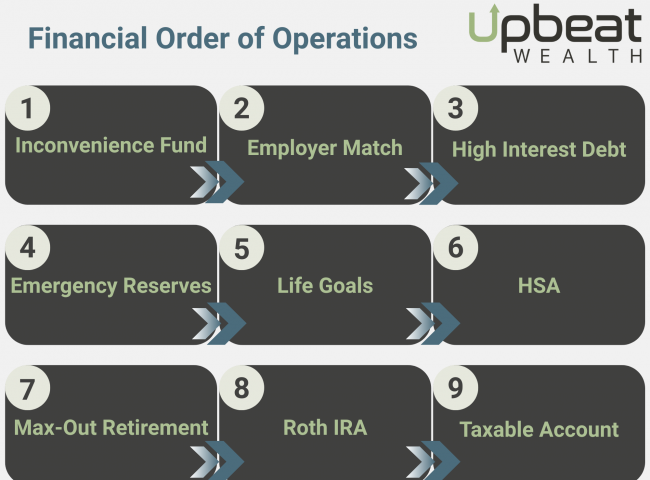
Surprise, surprise… incorporating a healthy dose of prudence is advisable. When it comes to putting your money to work, there tend to be some moves that make sense to prioritize. Here’s a how we generally structure a financial order of operations:
Account for Timing
Then there’s the timeline factor. Expecting a baby? In need of childcare? Have RSUs vesting soon? Approaching a liquidity event? There are plenty of instances where one objective will be more urgent than others purely based on when life throws certain milestones your way. Respect the timing of events accordingly. The sooner it falls on the calendar, the higher a priority it will need to be.
Evaluate Trade-Offs with Your Values in Mind
Life is full of trade-offs. Thoroughly weighing them is vital to further organizing your goals.
- If we pay for our child’s college education, it means we may have to work a few years longer in order to still have enough for our own financial needs.
- If I want to put together a down payment in the next few years, I may have to pull back on spending for travel.
- If I plan to exercise ISOs with cash on hand, it will reduce what I’m able to invest in my brokerage account.
- In order to pay for daycare, we’ll have less that we can put away for retirement over the next few years.
Equipped with a values-driven lens, the scale should tip more easily for each decision. Additionally, the result should be feeling less like you’re giving something up and more like you’re focusing your efforts on what matters more.
For so many young families out there, that “Life Goals” step in the graphic above becomes all too familiar, especially as children first come into the picture. So keep in mind, it’s ok to make trade-offs (the money for childcare has to come from somewhere), as long as you understand the implications and adjust the rest of your plan accordingly. Such moves are often temporary.
Step 4: Assess Where You Stand today
You have to know where you are before you can map out how to get where you want to go.
If you haven't already, refine your goals further so you have a target amount to shoot for
To properly assess your plan, you’ll need as much clarity and detail as possible. For example, if paying for college is an objective, it’s helpful to define what that cost will be: based on the type of institution, how many years you plan to cover, what level of the total cost you’d like to pay for, how you expect scholarships or other support will factor in, and so on. Yes, it’s (and most things are) a moving target. But specific and tangible numbers, to the extent possible, are your friends in this endeavor.
Similarly, it doesn’t do much to say “I want to buy a house in 2 years.” Sure, it’s a goal. But without the needed amount, there’s not a whole lot to work with there. However, you can absolutely work with “For the type of home I’m interested in, I’ll need $180,000 for a down payment and other upfront costs in 2 years.”
Running the Diagnostic
This step uncovers the answers to two types of questions:
- First, “Am I currently on track to _____?”
- Then, “What does it take to achieve _____?”
In other words, if you don’t change a thing, what kind of progress are you already making? If it’s not enough, what more do you need to do? Alternatively, if you’re ahead in one area, what does that free up to be distributed elsewhere?
A financial planning software, like what we use when working with our households, comes in handy here. In lieu of that, you can get a good idea of where you stand in relation to various goals by piecing it together with online calculators, such as this one for retirement, education cost, or general investing goals.
You may discover that you’re already well on pace for some things, while others demand only minor tweaking, and there may be those that are well out of reach without major shifts to the plan.
In the end, you want to land on how much you need to direct toward “x, y, z, etc.” all at once or on a recurring basis.
Step 5: Create a Framework for Allocating Resources
With a working number of what it would take to hit your financial objectives, you can now create a framework to put the plan into motion.
Starting with Priority #1, the flow looks like this:
- What amount (either as a single lump sum or recurring contribution) do you need to direct toward this goal?
- Do you already have enough surplus assets or cash flow to direct here?
- If so, great! Make it happen and move on to Priority #2.
- If not, it’s time to make some decisions…
- Can you decrease expenses or increase income to create more available resources?
- Can you delay this goal?
- Can you decrease the amount needed?
- Is there an alternative to this particular goal that’s still aligned with you values?
- How important is it?
- Do you already have enough surplus assets or cash flow to direct here?
If there resources left over after allocating toward Priority #1, move on to Priority #2 and work through the same framework.
Some Priorities Will Require Only Time, Not Money
By the way, plenty of high-impact action items rely on time as the main resource. Some examples are:
- Moving the cash for your emergency fund from a checking account (earning basically 0%) into a high-yield savings account (earning over 3% interest).
- Selling RSUs as they vest and directing the proceeds into a diversified investment portfolio.
- Adjusting your charitable giving strategy to donate highly-appreciated stock rather than cash.
The point is, prioritizing your goals and allocating resources will also encompass putting certain things on the calendar and setting aside time, not cash flow or assets.
Upon completing this step, you’ll have fully created a plan to allocate your resources (time and money) to your highest priority targets. All that’s left is to take action.
Step 6: Revisit Your Priorities Regularly
Life isn’t static. So your list of priorities won’t be either. Make sure you’re regularly revisiting Steps 1 – 5 above. A good cadence is to do so at least once/year, or as you encounter bigger life changes.
This is an abridged overview of the financial planning process. It’s what we guide our families through in the work we do together. So if you’re in search of support beyond what this post offers, feel free to reach out!
Frequently Asked Questions About Prioritizing Financial Goals
Q1: What is the best way to prioritize financial goals?
The best way to prioritize financial goals is to first identify all of your goals, clarify your values, account for timing and urgency, evaluate trade-offs, and then allocate your resources according to what matters most. A good financial plan balances personal values with sound financial planning principles.
Q2: Which financial goals should come first?
High-priority goals often include building an emergency fund, paying off high-interest debt, maintaining adequate insurance coverage, and saving for retirement. However, the right order depends on your personal values, family situation, and financial circumstances.
Q3: How do I balance multiple financial goals at the same time?
Many financial goals can be pursued simultaneously by dividing available cash flow among priorities. The key is determining how much each goal requires and assigning resources based on importance, timing, and long-term impact.
Q4: How often should I revisit my financial goals?
Reviewing your financial goals at least annually is a good practice. Major life events such as marriage, having children, changing jobs, receiving stock compensation, or approaching retirement may warrant more frequent reviews.

Eddy Jurgielewicz, CFP® is a Partner and Lead Financial Planner at Upbeat Wealth, a fee-only firm based in New Orleans and serving clients virtually across the country. He specializes in providing straightforward financial guidance to ambitious young families as they navigate life’s many milestones.
Do you have questions about what we shared in this post, or anything else in general? Feel free to schedule a free consultation or drop us a line!
Sign up for our newsletter (at the bottom of this page) to stay up to speed on our Upbeat Insight.