

It doesn’t matter if you pass everything off to a CPA, punch your way through a tax prep software, or put pen to physical paper and self-complete your tax return by hand (for some wild reason I can’t understand, my mom does this)… it pays to know the moves that minimize what the IRS collects from you.
One of the key decisions every taxpayer has to make on their personal return is whether to take the standard deduction or itemize their deductions.
The unfortunate reality with tax filing is that, even if you pay a person or software to bear the brunt of the work for you, it’s still on you to feed them the right information. There may be prompts or questionnaires to fill out, but if you miss something, it could cost you.
At Upbeat Wealth, we review our clients’ tax returns each year. I’ve seen the wrong deduction be taken, despite the use of a well-known tax software. I hope this equips you with a working understanding of the standard vs. itemized deductions so you not only know which is the right one for you, but also how to ensure it’s accurately reflected on your return.
First, a Crash Course on Tax Deductions
What is a tax deduction?
Here’s Johnny Rose desperately attempting to help David understand the concept.
Also known as “write-offs”, there are different types (personal, business, above-the-line, below-the-line, etc.), but they all accomplish the same thing: they reduce taxable income. The lower your taxable income, the less you’ll pay in taxes.
It is NOT a Dollar-for-Dollar Benefit
A detail that regularly gets muddled is that a tax deduction is NOT a dollar-for-dollar reduction in taxes owed. Just because you have a “deductible expense”, it doesn’t mean the cost entirely disappears… an unwelcome surprise to David Rose. Again, it simply serves to decrease the amount of income the IRS uses to calculate your tax bill.
Let’s look at a watered-down example:
- A married couple filing jointly has a total income of $500,000 for 2026
- They don’t have any above-the-line deductions, so their adjusted gross income is also $500,000
- They then have a total below-the-line deduction amount of $40,000 (because they itemized their deductions, but more on that soon!)
- This means their taxable income now becomes $460,000
- That $40,000 they deducted fully falls within the 32% bracket
- By reducing their taxable income from $500,000 to $460,000, they’ve saved $12,800 in taxes (40,000 x 0.32 = 12,800)
In other words, the $40,000 of deductible expenses yielded a tax benefit of $12,800 – but they still had a net expense of $27,200.
For Context, a Quick Comparison to Tax Credits
A tax credit does more for you than a deduction… They’re both nice, but not the same.
It IS a Dollar-for-Dollar Benefit
A tax credit reduces your tax owed, or even potentially increases your refund received, on a dollar-for-dollar basis. A likely familiar example is the Child Tax Credit, which is worth up to $2,200 per qualifying child in 2026.
Credits are further categorized into “refundable” and “nonrefundable”, but we won’t get into all the mechanics of credits in this post.
Standard vs. Itemized Deductions
Back to deductions! When filing personal taxes with the IRS, one of the most impactful moves for households comes down to deciding between the standard deduction or itemized deductions. You can only choose one…
2026 Numbers to Know
Standard Deduction Amounts:
- Single: $16,100
- Married Filing Jointly: $32,200
- Head of Household: $24,150
Additional Standard Deduction Amounts for Those Age 65+ or Blind:
- Single: $2,050
- Married Filing Jointly: $1,650 (per qualifying spouse)
So if you and your spouse (filing MFJ) are ages 34 and 37, and you elect the standard deduction in 2026, you get to reduce your taxable income for the year by $32,200.
Itemized Deductions
Instead of choosing the standard deduction, your other option is to add up certain expenses that apply to your situation and use this amount to arrive at your taxable income. These “approved expenses” are known as itemized deductions. This requires more work on your part, but could be time well spent if it results in a higher deduction vs. the standard.
Schedule A is used to report your itemized deductions and guides you through calculating the total amount.
Some of the More Common Deductions Are:
- Certain taxes paid, such as state/local income taxes and property taxes
- Interest paid, such as on a mortgage (up to a certain amount of the loan based on when you took out the mortgage)
- Gifts made to charity (the portion that exceeds 0.5% of your AGI – new for 2026)
- Unreimbursed medical/dental/vision expenses (the portion that exceeds 7.5% of your AGI)
You can find the full list of expenses eligible to be itemized here, along with the fine print. As with all things in the world of taxes, there are thresholds, floors, limits, and more… plenty of rules to pay close attention to. Some of these are new as of the OBBBA, which was signed into law in summer 2025, so things can change over time.
Choosing Between the Standard vs. Itemized Deductions
So which one should you take?
It’s as easy as going for the higher number, whichever one will reduce your taxable income the most.
Who is Most Likely to benefit from itemizing?
You could probably guess from the list of common deductions above. Still, if any of the following apply to you (especially if more than one applies), then there’s a good chance itemizing will reduce your tax bill more than the standard deduction:
- You live in a state with high income taxes – hello California and New York
- You have a mortgage, particularly in the earlier years of the loan where the majority of the monthly payment is interest
- You give a sizeable amount to charity (could be cash, investments, or other property)
- You experienced a year with unusually high medical bills
Even if you’re not sure, it pays to check.
The SALT adjustment you need to know
This is a major update that changed the math for several households. Prior to 2025, the most you could deduct for state and local taxes (SALT) was $10,000 ($5k for MFS). Because of this, many taxpayers hit that cap and thus didn’t have total itemized deductions in excess of the standard deduction. But starting in 2025, the cap was raised to $40,000 ($20k for MFS)! It is now $40,400 for 2026 and will increase by 1% each year until 2029, after which it will go back down to previous levels.
So even if nothing about your financial landscape changed, a higher SALT cap could very well push you into a realm where itemzing makes a ton of sense! Note that the deduction does begin to phase out for higher income earners once modified adjusted gross income exceeds $505,000 ($252,500 MFS).
How do you actually itemize your deductions?
#1: Gather the Right Information
The very first step is collecting the necessary supporting information. The IRS isn’t cool with you guesstimating. Turns out, they prefer that you provide accurate numbers. And you get these from a variety of sources depending on the deduction. If you work with a financial planner, they can be a good resource to tap into since they hopefully have a 360° view of your financial landscape. For example, we provide a Tax Letter to our households each year listing out all the supporting documents and information they should collect for their tax preparer.
Here is a non-exhaustive list of itemized deductions, along with where you’d potentially source the information needed (not all may apply to you) to report the correct amounts on your tax return:
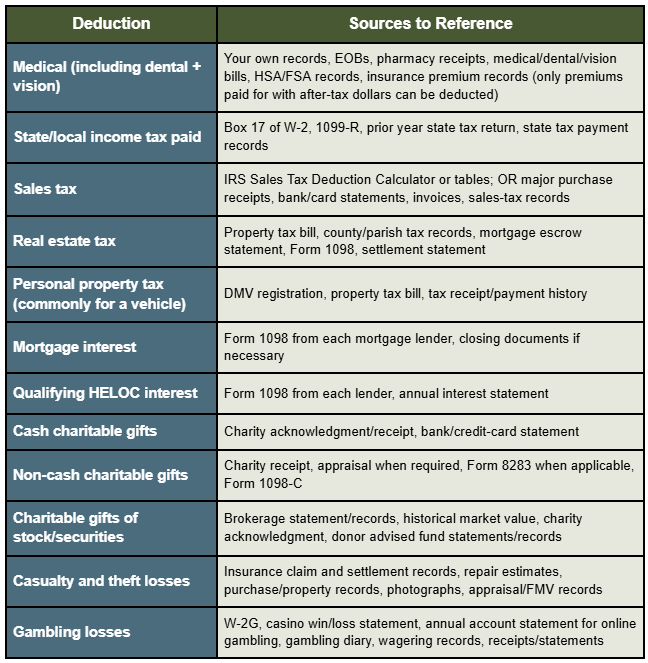
Refer to the instructions for Schedule A to get the comprehensive list of deductions and full guidelines for each.
#2: Get the Information to the Right Place
If you are working with a CPA or using an online filing software, you won’t actually be filling in Schedule A yourself. Instead, you’ll be answering prompts or simply sending the supporting documents in so that they can do the work for you. Regardless, you’ll need to get all the right information submitted. Just make sure they get it! Their inputs will only be as good as what you give them.
Your preparer or software will then fill out Schedule A of the tax return for you with all of the necessary information.
#3: Check the Results
No matter how you go about filing your tax return, the review process is the same for everyone. Upon submitting your return, you’ll be able to access an electronic version of the paperwork that gets sent off to the IRS. Form 1040 is the main document and summarizes all the most important numbers that lead to your final tax owed for the year.
It’s on line 12e that you’ll see the input for either the standard deduction or itemized deduction.
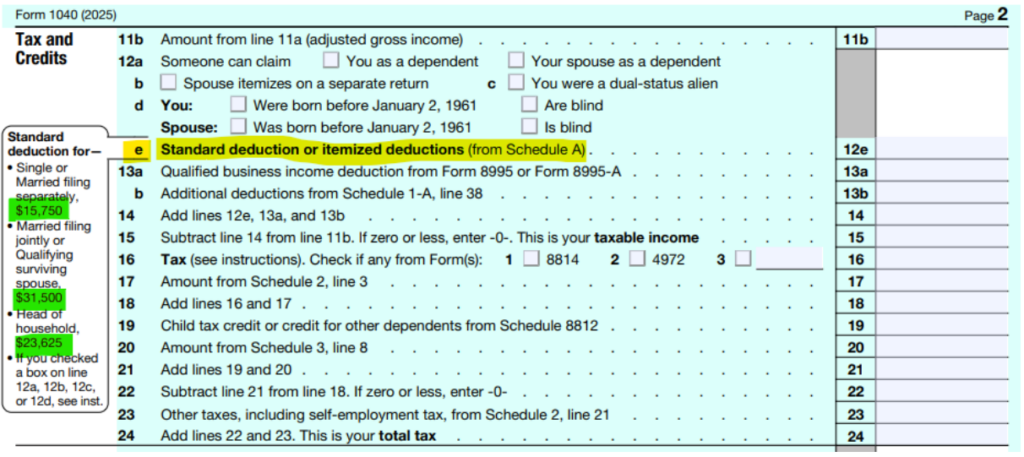
If the value on line 12e is one of the values highlighted in green, based on your filing status, then you’ve taken the standard deduction. If it is anything else, that confirms you’ve itemized your deductions.
If you did itemize, then Schedule A will be included with your return. You can check all the deductions listed out on this page. The total amount will be filled in at the bottom in line 17 and then will match what’s in line 12e on the 1040.
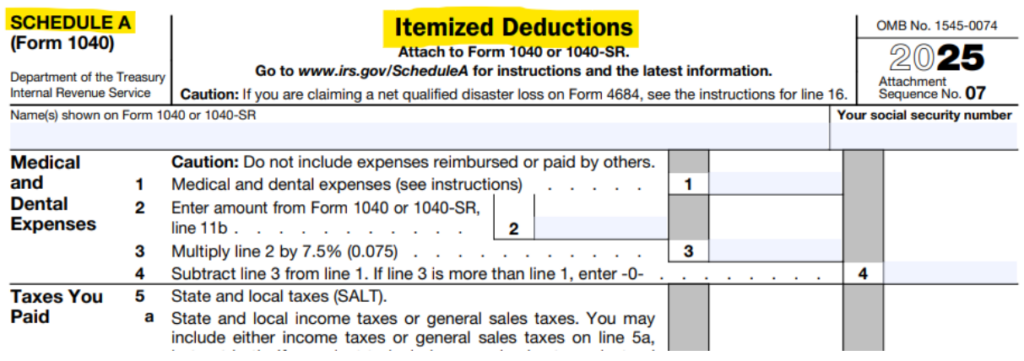
There are lots of reasons to review your tax return, and double-checking the election of the standard vs. itemized deductions is a big one.
How to correct a mistake
If you see that the standard deduction was taken, but you know your itemized deductions would have resulted in a higher figure, you’ll want to get it fixed. Similarly, if you did itemize, but realize some information still didn’t make it onto the return, meaning the deduction amount should still be higher, it’s also worth correcting.
To fix a federal tax return requires filing an “amended” return (Form 1040-X). Now, don’t fret. If you worked with a tax professional or online prep service, they can do this for you. Of course, you will need to let them know what needs to be corrected and provide the supporting documentation, if necessary. Additionally, it will likely involve paying a fee. But as long as the adjustment outweighs the cost, it’s good to get done.
Other Notes to Know
Be Careful with Married Filing Separately
If you and your spouse file your taxes separately, you both are required to take the same type of deduction. One spouse cannot take the standard deduction while the other one itemizes, even if that would lead to a more desirable outcome.
A State Tax Consideration
Some states don’t allow you to itemize on your state tax return unless you also itemize at the federal level. If that’s the case for you, you’ll want to closely examine which combination (standard on federal and state vs. itemized on federal and state) gives you the greatest overall tax benefit. For example, there could be some very edge cases in which you’d elect to itemize on your federal taxes even though it produces a lower deduction amount vs. the standard, so that you can then itemize on your state return and come out ahead overall. Be sure to consult with a tax professional on any special state tax implications.
Bunching
“Bunching” is a tactic where you shift deductible expenses from a future year into the current tax year. The goal is to move your total itemized amount above the standard deduction threshold so that you achieve a better overall tax outcome over multiple years.
Here’s the deal: if you’re in a position where you have some flexibility on the timing of certain deductible expenses, it could be smart to take advantage of this approach. An example might make the point clearer…
Let’s say you’re married filing jointly. That means, for 2026, your standard deduction is $32,200. Your total allowable itemized deductions for the year come to $30,000. This is made up of:
- State and local taxes: $15,000
- Mortgage interest: $5,000
- Property taxes: $5,000
- Charitable donations: $5,000 (this is the amount that exceeds the 0.5% AGI floor)
In this case, it makes sense to simply take the standard deduction since it’s the higher amount.
But here’s what bunching could look like… If you plan to donate $5,000 each year, and you have some extra resources available in the current year, you could “move” next year’s charitable gift of $5,000 into this year. That means…
- 2026 → donate $10,000
- 2027 → donate $0
By doing so, this brings your total 2026 itemized deductions to $35,000.
- State and local taxes: $15,000
- Mortgage interest: $5,000
- Property taxes: $5,000
- Charitable donations: $10,000 (again, for simplicity’s sake we’re assuming $10k is the amount that exceeds the 0.5% AGI floor)
In this scenario, your itemized deductions are now greater than the standard deduction amount for 2026, meaning you’ll get a bigger tax benefit for itemizing this year. Then, you can just take the standard deduction next year as you normally would.
Charitable contributions are one of the primary tools taxpayers will use to bunch deductions. A couple of other examples of expenses some people may have control over (depending on your situation) include:
- Property tax payments
- Medical expenses
Charitable Deductions for Non-Itemizers
A new rule for 2026 is that “non-itemizers” can still take advantage of a deduction for charitable donations. Even if you take the standard deduction, single filers can deduct up to $1,000 of donations and couples filing married filing jointly can deduct up to $2,000. Unlike when itemizing, this deduction is only for cash gifts. It also doesn’t cover contributions to a donor advised fund. This should be taken into account if considering the bunching strategy above.
Frequenty Asked Questions About Standard vs. Itemized Deductions
Q1: Should I take the standard deduction or itemize?
You should generally take whichever gives you the larger allowable deduction. Compare your allowable itemized deductions with the standard deduction for your filing status. The IRS recommends calculating both before deciding.
Q2: What is the standard deduction for 2026?
For 2026, the standard deduction is $16,100 for single filers and married individuals filing separately, $24,150 for heads of household, and $32,200 for married couples filing jointly. Additional amounts are available for taxpayers who are age 65 or older or blind.
Q3: How much do my itemized deductions need to be before I should itemize?
Generally, your allowable itemized deductions should be greater than your standard deduction for your filing status. However, there are less common situations where you may still choose to itemize even if your itemized deductions are lower, such as when doing so produces a larger overall state and federal tax benefit.
Q4: What expenses can I itemize on my federal tax return?
Common itemized deductions include qualifying state and local taxes, real estate taxes, mortgage interest, charitable contributions, certain medical and dental expenses, and certain casualty, theft, and gambling losses. Each category has its own eligibility rules and limitations.
Q5: Can I deduct charitable donations if I take the standard deduction?
Yes. Beginning in 2026, taxpayers who don’t itemize may be able to deduct up to $1,000 of qualifying cash contributions, or $2,000 for married couples filing jointly, subject to the applicable rules.
Q6: Can married couples filing separately choose different deductions?
No. If one spouse itemizes deductions on a married-filing-separately return, the other spouse must also itemize rather than take the standard deduction.
Q7: Can I itemize my federal deductions even if they are less than the standard deduction?
Yes. You may choose to itemize even when your itemized deductions are lower than the standard deduction if doing so provides a better overall tax result, such as a larger state tax benefit.
Q8: What is deduction bunching?
Deduction bunching is a tax-planning strategy that involves concentrating otherwise deductible expenses into one tax year so that your itemized deductions exceed the standard deduction. Charitable contributions are one of the most common expenses used for bunching.
Q9: What should I do if I took the wrong deduction on my tax return?
If you discover that you should have taken a different deduction, you should correct the federal return by filing Form 1040-X, Amended U.S. Individual Income Tax Return. The correction may increase your refund or reduce your tax liability, depending on the circumstances.
Q10: Where can I see whether I took the standard or itemized deduction?
Line 12e on Form 1040 shows the deduction used to calculate taxable income. If you itemized, Schedule A should also be included with the return.

Eddy Jurgielewicz, CFP® is a Partner and Lead Financial Planner at Upbeat Wealth, a fee-only firm based in New Orleans and serving clients virtually across the country. He specializes in providing straightforward financial guidance to ambitious young families as they navigate life’s many milestones.
Do you have questions about what we shared in this post, or anything else in general? Feel free to schedule a free consultation or drop us a line!
Sign up for our newsletter (at the bottom of this page) to stay up to speed on our Upbeat Insight.