
The “B-word”… Not many people out there get all warm and fuzzy inside at the mention of budgeting. In fact, I expect I’ve already lost many readers by throwing it in the first sentence.
But the reality is, most of us stand to benefit (now there’s a nice b-word) from implementing some form of a budget.
Have especially variable or irregular income? Mike wrote a fantastic blog detailing how best to manage uneven cash flow.
A Mental Reframe to Budgeting
Before we discuss a budgeting system that actually works, I think it’s helpful to first revise how we think about the concept of budgeting.
I believe the term carries a negative connotation because it’s primarily viewed through a restrictive lens. It’s so often associated with spending less or not at all. This is a “no” mindset and, to be fair, none of us like to be told “no”.
Now let’s flip it around. What if we adopt a “yes” mindset with budgeting? Here’s what I mean, using a notoriously rogue expense as an example: eating out at restaurants. If this is an area we want to tame, we could go about it a couple of different ways…
Option 1:
A “no” approach to budgeting might simply sound something like: “We need to go out to eat less” (boo)
Option 2:
On the other hand, a “yes” approach would sound like: “Let’s be intentional with how much we eat out, so that we are able to direct more money each month to _____”
A Budget SHOULD be an Unlock
The key to option 2 is that it’s not restricting an activity merely for the sake of spending less, but it’s a thoughtful decision to build toward something else. It ties purpose to the process and highlights the bigger “yes”, rather than focusing only on the “no”. That “____” could be any number of things: a big family vacation, a new home, a dream wedding, a sabbatical, retirement, etc. Something meaningful to you.
At the end of the day, everything boils down to the practice of evaluating trade-offs. This is how it goes for anyone who has a limit to their resources (all of us). More of one thing usually means less of something else. It’s up to you to decide which side of the trade-off you want to focus on. I encourage you to be purposeful with your budgeting and concentrate your energy on what it unlocks.
What is the Flow-Based Budgeting System?
The “Flow-Based Budgeting” framework was pioneered by a fellow financial planner, Natalie Taylor of the Goodland Group – big props!
There’s no one silver bullet that works for everyone. Ultimately, the framework that works for you is the one you’ll actually stick with. That being said, we are fans of this one because it’s particularly sticky.
It works because it…
- Can mostly run in the background.
- Simplifies the flow of money through your household accounts.
- Doesn’t require you to track every single expense that hits your credit cards and bank accounts.
- Leaves room for real life flexibility. There aren’t strict limits for spending across a bunch of “categories”.
- Accounts for irregular expenses that occur at frequencies other than monthly.
- Creates an informative feedback loop.
- Aligns your resources with the “yesses” in your life, proactively directing funds to the things you care about.
How Do You Set Up a Flow-Based Budget?
Step 1: Create Three Categories of Money Flows
- Fixed
- Flex
- Non-Monthly + Goals
“Fixed” – Passive Outflows
These are consistent, recurring monthly expenses or investment account contributions. These flows leave household bank accounts with the transfer out. The amount is the same or about the same each month. Outflows in this category are more passive.
Examples:
- Mortgage
- Rent
- Utilities
- Debt payments
- Insurance premiums
- Tuition
- Donations
- 529 contributions
- Brokerage account contributions
- Etc.
“Flex” – Active Spending
This category encompasses more variable, everyday spending. The amounts fluctuate from day to day or week to week. These expenses tend to be more day-to-day decisions or active in nature.
Examples:
- Groceries
- Restaurants
- Bars
- Babysitter
- Rideshare apps
- Entertainment
- Self-care
- Shopping
- Etc.
“Non-Monthly + Goals” – Irregular Expenses & Cash Savings Goals
This is where you account for expenses that are paid annually, quarterly, or less frequently than monthly. The amounts may fluctuate or be consistent. This also includes cash savings for various goals. The expenses/savings in this category can be both obligations (boring) and discretionary (fun).
Examples:
- Travel
- Summer camp
- Car maintenance
- Vehicle registration
- Insurance premiums
- Holiday/birthday gifts
- Lump-sum retirement/investment account contributions
- Etc.
Step 2: Organize Your Accounts & Cash Flow
In its simplest form, all you need are 2 checking accounts and a savings account:
- Fixed: Checking Account #1
- Flex: Checking Account #2
- Non-Monthly + Goals: High-Yield Savings Account (with buckets/vaults)
Fixed Account: Your Household’s Financial Hub
- This is checking account #1. It serves as the core, the central hub of this entire framework.
- All income is deposited here.
- Any “Fixed” expenses that can be automated are done so and paid from here
- Any “Fixed” investment contributions are automated and set up to be transferred from here.
- A set amount is automatically sent to the “Flex” account each week (more below).
- A set amount is also automatically transferred to the “Non-Monthly + Goals” account (more below).
- It’s a good idea to leave a “floor balance” here, such as 1 month of expenses as a buffer (if that amount is $7,500, the account balance should never go below that $7,500 mark).
- Once this account is set up, it requires very little maintenance or tracking.
Flex Account: Manage Weekly Spending
- This is a separate checking account (#2) that is only used for these expenses. It could also be its own dedicated credit card.
- Payments for expenses from this account cannot be automated.
- Calculate your weekly average maximum spend for “Flex” expenses. Essentially, this is what should be left over on a weekly basis (multiply the monthly amount by 12 and divide by 52) after covering all “Fixed” expenses/savings and the “Non-Monthly” transfer. You will establish an auto transfer for this amount from your “Fixed” account each Friday. Your “weekly spend” starts on Friday, so you can reset in time for the weekend.
- If you use a checking account here, you’ll need to maintain a small buffer (floor balance) to prevent a potential overdraft.
Non-Monthly + Goals: Plan for Irregular Expenses & Savings
- This is a dedicated high-yield savings account.
- Expenses and savings contributions made from this account may or may not be automated.
- Calculate the monthly average for your total annual Non-Monthly expenses/savings (total annual amount divided by 12). This monthly average amount is then set up to be automatically transferred from the “Fixed” account here.
- By doing so, you’re treating these irregular items as regular monthly expenses. It’s a more proactive and comfortable approach to handling those bigger, less frequent expenses. It also frees you up to spend more guilt-free on those fun things like vacation when they come.
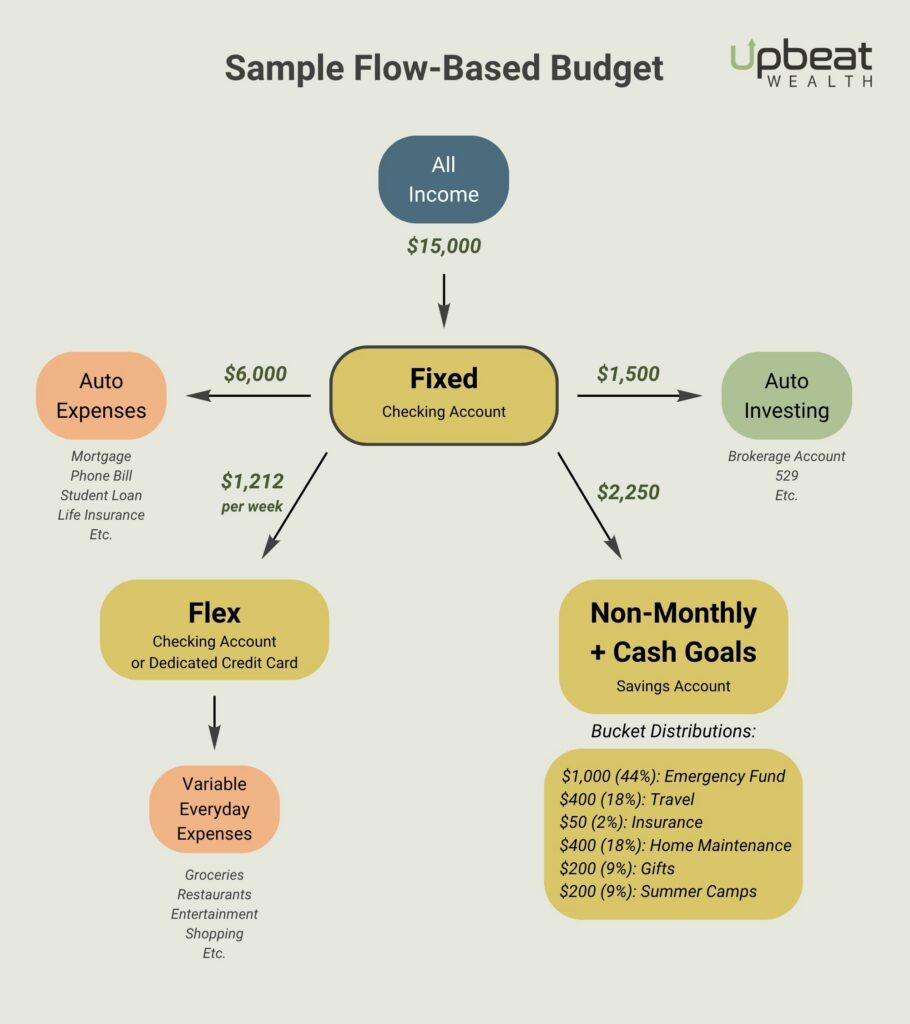
- We recommend using a bank like Ally, so you can take it a step further and have the funds set up to automatically distribute across specific buckets in the account based on a percentage or dollar amount. For example: $2,250 is transferred to this account monthly. Then…
- 44% ($1,000) goes into an “Emergency Fund” bucket
- 18% ($400) goes into a “Travel” bucket
- 2% ($50) goes into an “Insurance” bucket
- 18% ($400) goes into a “Home Maintenance” bucket
- 9% ($200) goes into a “Gift” bucket
- 9% ($200) goes into a “Summer Camps” bucket
- Once you arrange the $2,250/mo auto transfer and the bucket distributions, everything operates on autopilot from there.
- Lastly, it’s helpful to “seed fund” this account from the jump. That way, you’re already prepared when those first infrequent expenses start popping up.
Step 3: Monitor Spending & Adjust as Needed
Granted, there is some effort to set it all up. But once it’s in motion, the majority of this runs on its own.
The “Flex” account becomes the only “active” focus of this framework. If you use up the weekly spend amount too soon, or overspend, you know an adjustment needs to be made the following week. Likewise, if you come in under the weekly amount, you have more room in a following week to work with.
Notably, it doesn’t prescribe exactly how much to spend on specific things. Rather, there’s flexibility within a structured system.
Consistently overspending in the Flex account? Some bigger adjustments in lifestyle or behavior likely need to be addressed.
Consistently coming in under the weekly average max spend amount? Put that surplus to work and direct it to your savings/investing goals!
How to Incorporate Credit Cards into the System
If you want to use credit cards, the easiest thing is to have a dedicated card replace the “Flex” checking account altogether. The tracking and feedback loop work the same.
You could put “Non-Monthly” expenses on the card used for “Flex” expenses too. If you do, simply make sure to immediately pay the balance for those expenses so that the weekly average max spend amount for “Flex” expenses is still easy to monitor.
Implementation for Couples
For households that have combined finances, you’ll use joint bank accounts for the three categories. If you incorporate credit cards, you should both spend from the same credit account in each category, meaning you’ll need to have one person be an authorized user for any cards involved.
Still want to have some fully personal spending? Keep your own individual checking accounts and set up a monthly transfer from the Fixed account as a “household expense” to each of these.
A Tool: Flow-Based Budgeting Spreadsheet
We built this spreadsheet to help organize your expenses and savings, so you can then implement the flow-based budget.
Here's an example of what it might look like with some simple figures:
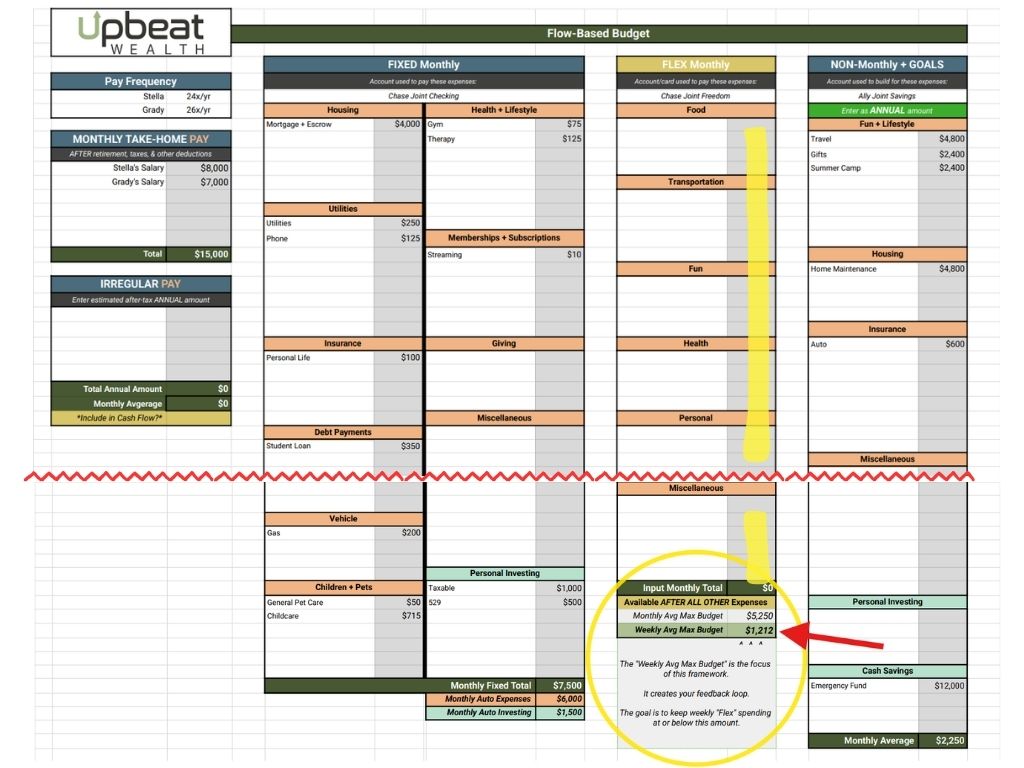
The magic of the spreadsheet is at the bottom of the “Flex Monthly” column. You could actually forego inputting any expenses in the “Flex” column and still get the information you need. As long as you’ve entered “Fixed” and “Non-Monthly + Goals” amounts, the spreadsheet will tell you the target weekly spending threshold for that one checking account/credit card that covers those more variable lifestyle expenditures.
That being said, I do recommend reviewing your expenses over the past few months and filling in the “Flex” column accordingly. That way you get a quick sense of how your current typical spending compares to what’s possible. This will inform any immediate adjustments to consider.
Here's another view of the sample budget (using the numbers in the spreadsheet above).
Frequently Asked Questions About Flow-Based Budgeting
Q1: What is flow-based budgeting?
Flow-based budgeting organizes household cash flow into three categories: fixed expenses, flexible everyday spending, and non-monthly expenses and savings goals. Money is automatically allocated as much as possible. It then highlights a single weekly spending figure for the more variable, lifestyle-type expenses, reducing the need to track every single purchase.
Q2: How do you budget without tracking every expense?
You can budget without tracking every expense by automating recurring bills and savings, transferring a set amount into a dedicated spending account each week, and monitoring that account’s balance. This approach provides a spending limit and feedback without requiring you to categorize every transaction.
Q3: How many bank accounts do you need for flow-based budgeting?
A basic flow-based budget uses three accounts: one checking account for income and fixed expenses, a second checking account for everyday spending, and a high-yield savings account for irregular expenses and savings goals. Some households can adapt the system to incorporate credit cards.
Q4: How do you budget for irregular expenses?
Estimate your total annual irregular expenses, divide that amount by 12, and automatically transfer the monthly amount into a dedicated savings account. This helps you prepare for expenses such as insurance premiums, vehicle registration, holidays, and travel before the bills arrive.
Q5: How does flow-based budgeting work for couples?
Couples can use joint accounts for household income, fixed expenses, everyday spending, and shared savings goals. They can also maintain individual checking accounts and arrange regular transfers for personal spending, allowing them to manage shared finances while retaining some independence.
Q6: Can you use credit cards with a flow-based budget?
Yes. You can use a dedicated credit card for everyday spending instead of a Flex checking account. The key is to account for card purchases consistently, pay the balance in full when possible, and avoid counting both the original purchase and the credit-card payment as separate expenses.
Q7: What is the best way to start a flow-based budget?
Start by reviewing your take-home income, recurring expenses, everyday spending, and annual irregular expenses. Assign each expense to a category, set up your accounts and automatic transfers, and establish a weekly spending allowance. Build an initial savings balance for upcoming irregular expenses when possible, then adjust the system based on your actual spending.

Eddy Jurgielewicz, CFP® is a Partner and Lead Financial Planner at Upbeat Wealth, a fee-only firm based in New Orleans and serving clients virtually across the country. He specializes in providing straightforward financial guidance to ambitious young families as they navigate life’s many milestones.
Do you have questions about what we shared in this post, or anything else in general? Feel free to schedule a free consultation or drop us a line!
Sign up for our newsletter (at the bottom of this page) to stay up to speed on our Upbeat Insight.