Group Term Life Insurance vs. Individual Coverage: What’s the Right Move?

Group Term Life Insurance vs. Individual Coverage: What’s the Right Move?

In our work with young families, one of the first layers of their financial landscape we assess is life insurance. For most people, there are two ways to put this critical protection in place: through your job’s benefits via group term life insurance and/or on your own with an individual term policy

Each avenue differs in a handful of ways. There’s often a clear winner in terms of getting the right mix of protection and value. But it may not always be what you expect… 

In short, your group term life insurance may not offer enough coverage. And even if it provides the needed death benefit, you may be able to save money by getting a policy elsewhere.

So let’s break it down here.

What is Group Term Life Insurance?

Group term life insurance is coverage that is made available to you through your employer, as part of a benefits package. Further, it’s broken into a couple different flavors: basic and supplemental. 

Basic Group Life Insurance

  • It comes at no cost to you, since the employer covers the premium.
  • It is guaranteed-issue (no health screening).
  • Generally, it offers a smaller coverage amount, such as $50k or up to a minimal factor of your salary (like 1.5x salary).
  • The premium amount on the first $50k of coverage paid for by your employer is not treated as taxable income to you. However, any premium amount paid for by your employer on a death benefit in excess of $50k is considered taxable income to you, even though you never receive the cash. This is called “imputed income”.

Here are a couple examples of how this coverage is detailed in a benefits packet:

group term life insurance

Supplemental (Voluntary) Life Insurance Through the Employer

  • You are fully responsible for the premiums on this coverage.
  • The coverage may be guaranteed up to a certain coverage amount.
  • Additional coverage may be available beyond the guaranteed benefit (up to a stated max) contingent on medical underwriting, though the health screening is often “lighter” than when applying for personal coverage.
  • The premium is simply deducted from your paycheck on an after-tax basis.
  • The coverage is issued with “group rates”, meaning the cost is based on a large risk pool.

Again, here are a couple examples of how this may appear in a benefits packet:

group term life insurance

Is Group Life Insurance Enough Coverage?

Maybe. Probably not.

Mike goes into depth on several key aspects of life insurance in this blog post, covering: how much to get, when to get it, what type to get, and mistakes to avoid, among others. So I’ll quickly hit a few high points here.

For starters, if someone depends on your income, both now and in the future, it’s worth protecting. AKA, you need life insurance. As far as how much is enough, we have this life insurance calculator you can use to arrive at a true coverage need based on your wishes.

As with anything, life insurance is a personal decision, one that depends heavily on your unique situation, goals, and values. Generally, families want to provide coverage for some combination of:

  • Income replacement
  • Debt
  • Education expenses

The right coverage means that your family’s desired lifestyle and future goals continue to be a reality, even in a worst-case scenario. In many cases, group life insurance won’t offer a benefit high enough to provide full coverage.

Is Group Term Life Insurance a Good Value?

Maybe. Sometimes no.

Even if you could get enough coverage through your employer, it still pays to thoroughly examine the cost of that policy.

Life insurance premiums are based on two main factors: your age and health. In some cases, your health may even disqualify you from getting coverage altogether, outside of a guaranteed-issue policy.

If You Have Health Conditions

A major benefit of group life insurance through your employer is that some amount of coverage will be issued on a guaranteed basis, requiring no “evidence of insurability”. For those who wouldn’t otherwise qualify for life insurance, this is significant. 

Remember that the “basic” coverage amount will be guaranteed. Then, if supplemental coverage is an option, a portion of that is typically also offered as guaranteed-issue. In the example below, any amount over $700k requires a health screening (evidence of insurability). But that means you could still secure up to $700k in death benefit without answering a single health question.

So if this is your only way to get access to coverage, there’s no way to beat the value of getting something vs. nothing.

group term life insurance

If You Are Healthy

Keep in mind that rates for group coverage are based on a large health pool. Essentially, the “average” person. If you’re in good health, it may behoove you to capitalize on that by applying for coverage through a personal policy. There’s a good chance you’d pay less per amount of coverage compared to a group policy through your job, since you’d land a more favorable health rating.

I almost always see this work out in favor of the healthy individual. If that’s you, your group policy may very well NOT be a good value. Look to get the coverage through a personal policy.

Watch Out for Increasing Premiums

Commonly, the premium for supplemental coverage through an employer will increase over time, based on your age. This could mean a very affordable cost while you’re younger. But that can shift quickly as you get older. Check out an example of this in the screenshot below.

Alternatively, it’s possible to obtain a “level premium” term policy when doing so outside of your employer. This means the cost is set for the duration of the policy. Over the course of 10-30 years, this could mean substantial savings if you qualify for a good health rating with a personal policy, even if the group policy is relatively cheaper at the start.

group term life insurance

In short, if you’re healthy, you’ll likely find more value by securing an individual life insurance policy. If you don’t otherwise qualify for coverage, take advantage of all the guaranteed benefit you can through the employer.

Important! If you are going to replace an existing supplemental group policy with an individual one, be sure you’ve paid for and locked in any new outside coverage before dropping the voluntary policy with your job. It’s best to avoid gaps in coverage.

What Happens to Group Life Insurance If You Leave Your Job?

Oftentimes, group coverage is not “portable”. If you separate from your job for any reason, it may not go with you. That’s a big deal, given that life insurance is a major layer of risk protection for your family. We can’t always predict employment separation, since it could include being laid off or fired. It’s not just a planned retirement or quitting. For that reason, we often recommend excluding any employer-based life insurance coverage amount when calculating your need.

If coverage is portable, it will be the supplemental amount (not basic coverage). You need to check with your employer to determine whether or not the policy is portable. Also, know that the rate would likely be different after leaving.

The Complete Group vs. Personal Coverage Comparison Workflow

Here are the steps you should take to navigate this process:

  1. Take what’s given to you for free through your employer (basic coverage).
  2. Determine your true coverage need.
  3. Compare the cost of getting that coverage between a supplemental group policy vs. an individual policy.
    • Once you know how much benefit you need in place, get quotes for an individual policy through an insurance broker.
    • Apply for a policy through the carrier that offers you the best rate and complete any underwriting requirements. You’ll never know your actual cost until you receive a health rating from the insurance carrier, which requires a completed application.
    • If you are denied coverage, then the guaranteed-issue amount of group supplemental coverage is your only way to get meaningful protection.
    • If you receive a low health rating, the supplemental coverage will likely be a better value for you. Then, you’ll need to assess the cost/benefit of paying a relatively higher premium to secure full coverage beyond what the employer policy provides (paying mind to the portability of group coverage).
    • If you land a strong health rating, you will most certainly be in a position where putting an individual policy in force makes the most sense, with no need to pay for supplemental group term life.

A Final Note on Shopping for Coverage

When you go searching for life insurance coverage, we recommend using a broker, rather than an agent who represents only one insurance company. This way, you can compare quotes across several different carriers and increase your chances of getting the most competitive rate for a policy.

While we don’t sell any products at Upbeat Wealth, we do walk through this entire process with our families. In doing so, we can be an objective sounding board to ensure the most appropriate coverage for their unique situation is acquired. No decisions are made alone.

Frequently Asked Questions About Group Term vs. Individual Life Insurance

Q1: Is group term life insurance enough coverage?

In most cases, no. Employer-provided group life insurance typically offers limited coverage (often 1–2x salary), which is usually not sufficient to fully replace income, cover debts, and fund long-term goals like education.

Q2: What is the difference between group and individual life insurance?

Group life insurance is provided through an employer and often has limited coverage and flexibility. A portion of it may be fully paid for by the employer (basic), with the option to purchase more coverage (supplemental). Individual life insurance is a personal policy that you own, totally separate from your employer, with customizable coverage and typically level premiums.

Q3: Is supplemental life insurance through an employer worth it?

It depends on your health and alternatives. If you have health conditions, supplemental coverage can be valuable due to a certain benefit amount being guaranteed issue. If you’re healthy, an individual policy is often more cost-effective over the long-term.

Q4: Do you lose group life insurance when you leave your job?

Sometimes. In many cases, group life insurance is not portable. If it is portable, it’s usually only the supplemental portion and the premiums may change after leaving your employer.

Q5: Why is group life insurance sometimes more expensive over time?

Group policies often have increasing premiums based on age, while individual term policies can lock in a level premium for 10–30 years, making them more predictable and often cheaper long term for healthier individuals.

Fiduciary, fee-only, Certified Financial Planner, Eddy Jurgielewicz

Eddy Jurgielewicz, CFP® is a Partner and Lead Financial Planner at Upbeat Wealth, a fee-only firm based in New Orleans and serving clients virtually across the country. He specializes in providing straightforward financial guidance to ambitious young families as they navigate life’s many milestones.

Do you have questions about what we shared in this post, or anything else in general? Feel free to schedule a free consultation or drop us a line!

Sign up for our newsletter (at the bottom of this page) to stay up to speed on our Upbeat Insight.

Disclaimer: All content in this article is provided for educational, general information, and illustration purposes only. None of the information is intended as investment, tax, accounting, or legal advice. Nor is it a recommendation for purchase or sale of any security, or investment advisory services. We encourage you to consult with a financial planner, accountant, and/or legal professional for advice on your specific situation. Read our full disclaimer here.

Employee Benefits to Take Advantage of When Expecting a Baby

open enrollment pregnancy benefits

Employee Benefits to Take Advantage of When Expecting a Baby

Traditionally, Open Enrollment is synonymous with health care. Assessing employer-sponsored coverage amid rising costs and premiums. In a previous piece, we provided a checklist to help you evaluate your health insurance options during pregnancy and coordinate with your spouse. But if you’re expecting, here are some lesser-known benefits you should be aware of when reviewing your employee benefits booklet. In this blog, we’ll discuss how to save money on labor & delivery, childcare, and estate planning.

Labor & Delivery: How Hospital Indemnity Insurance May Reduce Hospital Costs

What is Hospital Indemnity Insurance?

Hospital Indemnity Insurance provides a lump-sum payment if you are admitted to the hospital, along with daily benefits during your hospitalization. 

Who Is Elgible for Hospital Indemnity Coverage?

Not all hospital indemnity insurance covers childbirth-related hospitalization or any planned inpatient hospital stay. Some employers offer coverage solely to alleviate some of the financial stress associated with having a baby. Others, not so much. It’s not uncommon to see these plans exclude expected inpatient hospital stays, pregnancy, and/or preexisting conditions. Read your summary plan document or speak with someone in HR before opting into this insurance benefit if you’re unsure which hospitalizations are covered. 

Typical Cost and Payout for Hospital Indemnity Plans

Most larger employers offer this benefit with two (2) options:  a “Low Plan” and a “High Plan”. The “Low Plan” being slightly cheaper with a smaller cash benefit. 

The average cost we see is about $30/month, deducted after-tax from your paycheck. 

For “High Plans”, we typically see a lump sum initial hospitalization benefit of $1,000 and a daily benefit of $100/day. 

Hospital Indemnity Example for Labor & Delivery

A couple is 6 months pregnant in November. Through one of their employers, they have access to Hospital Indemnity insurance. The premium is $30/mo deducted from their paycheck. Therefore, they will pay $360 in 2026 for this benefit. Their benefit for the plan is as shown above: a $1,000 lump sum if either participant is hospitalized and a daily benefit of $100/day. In February, they give birth to their child and spend three nights in the hospital. They submit their hospital bill and receive a cash benefit of $1,000 + ($150 x 3), or $1,450. Since they will pay $360 for the year, they come out ahead by $1,090, which they can put toward their health insurance deductible. 

Wait, It Gets Better

If each partner has access to Hospital Indemnity insurance through their respective employers, there may be no condition preventing them from collecting a cash benefit for the same event. 

What To Watch Out For With Hospital Indemnity Insurance

Most require you to pay into it for the whole year. If you choose to opt out during your Qualifying Life Event enrollment period before receiving your cash benefit, you might lose your eligibility to collect it.

How a Dependent Care FSA Lowers Your Tax Bill

What Is a Dependent Care Flexible Spending Account (DCFSA)?

A Dependent Care FSA is a tax-advantaged account where you can set aside pre-tax dollars to pay for dependent care that enables you to work. 

Dependent Care FSA Eligibility Rules for Married Couples

There is a household limit of $7,500 maximum. This is a household limit, not an individual limit. Therefore, it’s irrelevant whether you have multiple children or access to multiple employer-sponsored Dependent Care FSAs; you can only contribute a total of $7,500 annually for your household. Generally speaking, both spouses must be working and have incomes above the contribution amount. There are some exceptions for full-time students and those who are job hunting. 

Most mid-sized to large employers offer these, and it’s also quite common for small employers to offer them. This is exclusively available as an employee benefit, and there is no other way to contribute to a Dependent Care FSA. 

How Much You Can Contribute to a Dependent Care FSA

There isn’t any “pricing”; it’s just money deducted evenly from your paycheck that you can reimburse yourself for later after proof of claim of an eligible expense. 

Dependent Care FSA Tax Savings Example

A couple knows their daycare costs will exceed the $7,500 DCFSA maximum contribution amount and contributes accordingly. $312.50 will be deducted from their semi-monthly paycheck throughout the year. This couple is in the 24% federal marginal tax bracket and the 3% state marginal tax bracket. Contributions are not subject to federal or most state taxes and are also exempt from FICA taxes (Social Security and Medicare), which have a tax rate of 7.65%. As a result, they reduced their taxes by $2,598.75 ($7,500 x (24% + 3% + 7.65%)) by making the full DCFSA contribution and reimbursing themselves for eligible childcare costs. 

Common Dependent Care FSA Mistakes to Avoid

Like all “Flexible Spending Accounts,” these funds are use-it-or-lose-it. You might be able to carry over a small amount to spend in the following year, but it’s better only to contribute what you’re guaranteed to spend in the current year. Furthermore, informal childcare arrangements, such as paying a family member or babysitter in cash, are not eligible for reimbursement. 

Estate Planning Benefits for New Parents

What Is Group Legal Insurance?

Certain plans provide prepaid legal services and coverage for estate documents, along with various other services such as real estate, adoptions, name changes, court proceedings related to reproductive assistance, and debt collection defense. Here’s a recent blog by Eddy breaking down how to create an Estate Plan.

When to Enroll in Group Legal Coverage?

If your employer offers it, there are no eligibility “gotchas.” However, if this benefit can be added through a Qualifying Life Event, such as having a baby, it likely makes sense to wait until then to take advantage of it. 

Availability: Most mid-sized to large employers offer these. 

Cost Comparison: Group Legal vs. Online vs. Local Attorney

Most often, we see pricing for group legal insurance set at the household level, around $10/pay period. That’s about $240/annually. 

The average cost of a DIY online plan is about $750. 

Hiring a local attorney will likely cost $3,000. 

If your situation is fairly straightforward, using your group legal benefit to have an attorney create a basic Estate Plan for you is a great starting point, especially for young families. 

Estate Planning Example for New Parents

A couple welcomes a baby mid-year. One spouse uses their Qualifying Life Event to add legal coverage for $10 per pay period. They begin the process immediately and, after 2-3 review rounds, complete and sign their Estate Plan before year’s end. This couple has just accomplished a vital planning task for only $120! 

Wait, It Gets Better

Some legal programs may put you in touch with a good local attorney, in which case you receive hands-on assistance at a drastically reduced price compared with contacting them directly. 

Limitations of Employer-Sponsored Legal Plans

The quality of group legal coverage can vary significantly. You might not have access to a local attorney or one you would have selected yourself. When relying on their national team of attorneys, the level of service can differ greatly. We suggest asking colleagues about their experiences with the plan.

Frequently Asked Questions About Employee Benefits for Expecting Parents

Q1: Is hospital indemnity insurance worth it if you’re pregnant?
Yes, hospital indemnity insurance can be worth it if your employer’s plan covers childbirth-related hospital stays. A short hospital stay can result in a payout that exceeds the annual premium, helping offset deductibles and out-of-pocket costs.

Q2: Can both parents collect hospital indemnity benefits for the same birth?
In many cases, yes. If each parent has their own employer-sponsored hospital indemnity plan, there may be no restriction preventing both policies from paying benefits for the same hospitalization.

Q3: Do both spouses have to work to use a Dependent Care FSA?
Generally, yes. Both spouses must be working, looking for work, or attending school full-time. Exceptions exist for full-time students and spouses who are unable to care for themselves.

Q4: How much can a family contribute to a Dependent Care FSA?
For 2026, the household contribution limit is $7,500 per year. This is a household cap, regardless of how many employers offer the benefit or how many children you have.

Q5: What childcare expenses are eligible for Dependent Care FSA reimbursement?
Eligible expenses include daycare, preschool, before- and after-school care, and summer day camps. Informal cash payments to relatives or babysitters typically do not qualify.

Q6: Can group legal insurance help new parents with estate planning?
Yes. Many group legal plans cover wills, powers of attorney, and guardianship documents, making them a cost-effective way for new parents to establish a basic estate plan.

Q7: When is the best time to enroll in new benefits if you’re expecting?

Open Enrollment is ideal, but having a baby is a Qualifying Life Event that often allows you to add or change benefits mid-year, including legal coverage and FSAs.

Fiduciary, fee-only, Certified Financial Planner, Mike Turi

Mike Turi, CFP® APMA™ is the Founder and a Lead Financial Planner at Upbeat Wealth, a fee-only firm based in New Orleans and serving clients virtually across the country. He specializes in providing straightforward financial guidance to ambitious young families as they navigate life’s many milestones.

Do you have questions about what we shared in this post, or anything else in general? Feel free to schedule a free consultation or drop us a line!

Sign up for our newsletter (at the bottom of this page) to stay up to speed on our Upbeat Insight.

Disclaimer: All content in this article is provided for educational, general information, and illustration purposes only. None of the information is intended as investment, tax, accounting, or legal advice. Nor is it a recommendation for purchase or sale of any security, or investment advisory services. We encourage you to consult with a financial planner, accountant, and/or legal professional for advice on your specific situation. Read our full disclaimer here.

What to do With an Old 401k

What to do with an old 401k

Millennials have a knack for switching jobs throughout their careers. In our generation’s constant pursuit of workplace fulfillment, many suddenly find themselves one day with a collection of old employer retirement accounts. It’s kind of like unwittingly opening that random kitchen drawer only to discover a bursting assortment of koozies, collected from a couple of particularly busy wedding seasons and that one college alumni event that was somehow confident everyone in attendance would want 12 koozies each. 

Naturally, a frequent question we get working with couples in their 30s and 40s is: “What should I do with my old 401k(s)?” 

Whether you’re sitting on a stockpile and are uncertain of how to move forward (possibly the upcoming open enrollment season has reminded you of benefits past), or you’re preparing to make your first job switch and want to be prepared, this one’s for you!

You have FOUR Options

After separating from an employer, you can do one of four things with your old 401k:

  • Leave the account where it is
  • Roll it into a new employer plan
  • Move it into an IRA
  • Cash it out

Let’s break down each one and when they do (or don’t) make sense…

Option #1: Leave the old 401k where it is – with your former employer

This can be a good idea if…

  • Your next job doesn’t offer a retirement plan, you are implementing (or planning to implement) a backdoor Roth IRA strategy, and the 401k in question contains pre-tax money.
    • If your income is high enough to the point that the IRS says you cannot contribute directly to a Roth IRA, then you have to take the “backdoor” approach in order to put future dollars into a Roth IRA.
    • This means you ALSO need to pay attention to what’s called the “pro rata rule”. In short, if you have any pre-tax dollars in an IRA and then go about doing a Roth conversion, you’ll end up owing some taxes (even if you only convert an amount equal to after-tax contributions). The solution? Keep pre-tax money in employer retirement plans since the pro rata rule excludes those accounts. 
  • The old plan has a great list of investment fund options and low expenses.
    • Each company’s retirement plan has its own unique list of investment options available within the 401k. If the new plan is light on quality fund options and heavy on the fees, it may behoove you to keep that money put.
  • You don’t have the next job lined up yet.
    • There’s no need to rush into doing something with the old 401k. Wait until you have the next job secured to at least see how the new plan compares, so you can make the most informed decision.
  • You want to take advantage of the Rule of 55.
    • The Rule of 55 is a way for you to access retirement funds before age 59 ½ without owing that pesky 10% early withdrawal penalty to the IRS.
    • To do this, you must be 55 or older and have separated from your company. This type of distribution can only be taken from your most recent employer’s 401k (or 403b), not an IRA.
    • It’s important to note that not all 401k plans allow for this. While the IRS gives it the “ok”, the actual plan documents need to give it the green light as well.
    • This method for early retirement money access comes with somewhat more flexibility than the Substantially Equal Periodic Payment (SEPP) route, which can be used with both 401ks and IRAs.

Be mindful that...

  • You’ll be limited in how you can manage the account.
    • You can no longer add new money to the old 401k. However, you WILL still have full control over how the money is invested (within the list of investment options the plan offers).
  • More time and distance between you and a past employer can make it more difficult to access the account when needed.
    • Just how solid is your system for keeping track of usernames and passwords?
    • Your old company might decide to switch 401k providers, making the account more challenging to locate when you go back to hunt for it (“My account used to be held at Empower, but now it’s at Fidelity?? I’ve never even logged into Fidelity…”).
    • If an especially long period of time passes, there’s even a chance the money could be transferred to the state as unclaimed property.
  • If you have a smaller balance in the 401k, the plan administrator could take action on your behalf, without you requesting them to do so.
    • For old 401k balances under $7,000, there’s a chance that the plan automatically does any one of the following:
      • Cash out the balance and mail you a check, creating a taxable distribution (for balances under $1,000).
      • Move the money into an IRA (also for balances under $1,000).
      • Roll the funds into your new employer’s plan (sometimes for balances between $1,000 – $7,000).

Option #2: Roll the old 401k into your new employer’s plan

This can be a good idea if...

  • The new plan has a more robust investment fund lineup and/or lower fees.
    • It may not necessarily make-or-break your ability to one day retire, but better-performing funds and lower internal expenses add up over growing balances and several years. So it could certainly help get you to your target more efficiently.
  • The 401k has pre-tax dollars and you’re up against the pro rata rule.
    • Just like we discussed in the section above, it’s essential to keep pre-tax money in employer retirement plans when you’re utilizing the backdoor Roth IRA strategy. That means either leaving your old 401k where it is, or rolling it over into your new employer’s plan – as long as the money doesn’t go into an IRA.
  • You want to keep things as streamlined as possible.
    • There’s a real benefit to simplicity. Even in the case where the new 401k plan isn’t a clear “winner” over the old one in terms of investment selection and/or expenses – if they’re pretty close – consolidating the accounts will probably make your life easier down the line. 

Be mindful that...

  • We’ll capture some of the things to be aware of here, and with the other options, in the “General questions and considerations” section at the bottom.

Option #3: Roll the old 401k into an IRA

This can be a good idea if…

  • Your income is under the threshold that would prevent you from contributing directly to a Roth IRA.
    • In the case that you have pre-tax dollars in a Traditional 401k, BUT your income is under the IRS limit for making direct Roth IRA contributions, then you’ll be in the clear of that annoying pro rata rule (assuming that a Roth IRA will also be part of your plan) since you’ll be able to simply make future contributions right into the Roth. 
  • Your entire 401k balance is made up of Roth money.
    • If you don’t have any pre-tax funds in the 401k at all, then you don’t have to be cautious of this money sparking the pro rata rule when it gets moved into a Roth IRA. Again, it’s only pre-tax dollars in a Traditional IRA that make things tricky when doing the backdoor Roth IRA strategy down the line. 
    • Though increasingly rare these days, not all 401ks offer a Roth option. If that’s your new plan, then you’d have to go into a Roth IRA if you’re moving the money.
  • You want more investment options and/or lower fees.
    • By transferring the funds into an IRA, you’d then gain access to the full universe of investment options (mutual funds, ETFs, stocks, bonds, etc.). You can invest the money however you like, without being confined to a 401k plan’s set list of funds. This provides for greater control over the internal expenses that come with investments such as mutual funds and ETFs.
    • With an IRA, you can also pick whatever custodian you prefer, and there are plenty that have no management fees. 
  • You are seeking professional investment management.
    • Speaking of fees, professional management may or may not come with additional expenses, and it’s crucial to understand what those would be.
    • However, if you’re the kind of person who values someone with the appropriate level of expertise taking on some of the responsibility with your retirement savings, you might consider an IRA to allow for this level of guidance.
  • You want to do a Roth conversion.
    • If you have pre-tax money in the 401k and you’re in a position where it makes sense to execute a Roth conversion, then this could be an easy time to make it happen. Of course, you’ll need to be prepared for any taxes owed on the conversion. Note that some plans do allow for in-plan Roth conversions, so this could be a possibility with a new 401k as well.
  • You need some additional flexibility for penalty-free access of retirement funds for hardship or other life events.
    • The IRS grants some leniency to early withdrawals from IRAs (over 401ks) under certain circumstances. You get an exception to the 10% early withdrawal penalty in the following scenarios:
      • Up to $10,000 for a first-time home purchase
      • Covering qualified higher education expenses
      • Paying for health insurance while unemployed
    • Still, income tax is owed on anything you take out and you should ideally treat retirement accounts as an absolute last resort for accessing funds earlier in life. Just because this is an option does not mean it is always a good idea.

Be mindful that...

  • Roth money goes into a Roth, IRA and Traditional money goes into a Traditional IRA.
    • If you have both “types” of dollars in your one 401k plan, you’ll have to split the money between two IRAs when it gets rolled over, based on the tax treatment. 
  • A “Rollover IRA” is essentially the same as a “Traditional IRA”.
    • If you roll money from a 401k into an IRA, you will probably see the option to open a “Rollover IRA”. This account has the same tax treatment and contribution limits as a Traditional IRA. The IRS views these accounts through the same lens. You could choose to roll money from an employer plan into either one and you could then make contributions from earned income to either account. For all intents and purposes, the only real distinction is that you might opt for the “Rollover IRA” if you wanted to have some level of compartmentalization between retirement savings accumulated through past employers vs. those built up through your own contributions directly into a Traditional IRA.
    • It’s worth emphasizing here, too, that money in a Rollover IRA is factored into the pro rata rule the same as money in a Traditional IRA!
  • You need to actually invest the money.
    • When the money is sent to your IRA from the 401k, it will come over as cash. It’s then on you to make sure it gets invested. This is a critical step. 
  • In many cases, you should be able to move money from an IRA into a current employer 401k plan if needed in the future.
    • You’ll need to check with your current employer’s 401k plan documents to see if they allow for this “reverse rollover” (not all do).
    • You can only transfer money from an IRA into the 401k of a company where you’re presently working.
    • And why might you consider doing this? The most typical reason I come across is when your income has grown to the point of necessitating the backdoor Roth IRA strategy and we want to be sure you’re staying clear of issues with the pro rata rule. 
  • While the Rule of 55 exists for 401ks, Rule 72(t) (Substantially Equal Periodic Payments) is a way to access funds without the early withdrawal penalty from IRAs (and 401ks too).
    • There’s a little less flexibility with how funds are accessed under this rule, specifically in regards to the amount and timeline of withdrawals.

Option #4: Cash out the 401k

Yes, technically an option… But not one you really want to give any thought to.

In short, don’t do it! By choosing to cash out your old 401k, you’re creating a fully taxable event (if it’s pre-tax money) and potentially exposing yourself to the 10% early withdrawal penalty if you’re below age 59 ½. Not to mention, you’re likely better off keeping those retirement savings invested and working toward your long-term financial security.

General considerations

  • If you have an outstanding 401k loan….
    • Upon separating from your employer, you’ll have a short period of time to pay back the full balance of the loan.
    • If you don’t pay off the loan in the plan’s prescribed timeframe, the remaining amount owed is treated as a taxable distribution (which could also come with a 10% early withdrawal penalty if you’re younger than 59 ½). 
  • Choosing between a direct rollover vs. an indirect rollover…
    • A “direct rollover” is one in which the 401k money is sent straight to the new IRA or 401k institution and never touches your hands. This is the easier and preferred method.
    • With an “indirect rollover”, a check is sent to you. You then have up to 60 days to deposit the money with the new institution before taxes and penalties kick in. We recommend avoiding this type of rollover given the potential for taxes/penalty in the event it’s not handled in time, plus the increased chance of the check not making it to its appropriate destination.
  • Take note of your vested balance…
    • Your “vested” balance is how much of the account you can access or move, whereas the “unvested” balance is forfeited upon separating from your employer. The unvested portion won’t ever be accessible to you, regardless of what you do with the 401k.
  • Understand the tax status of your 401k dollars (Pre-tax vs. Roth)…
    • It’s important that the tax status of any new account you move 401k funds into matches the tax status the dollars had while in your 401k (Traditional → Traditional and Roth → Roth). You risk creating a taxable event if this gets mixed up.
  • Be wary of the “advisor” who tells you that you have to move your old 401k into an IRA…
    • As we’ve laid out here, your only option isn’t to move money from your 401k into an IRA. In fact, it very well may be in your best interest to leave it where it is or roll it into your new employer’s 401k. 
  • If you think you might have an old 401k sitting around somewhere, but aren’t sure…
    • There are resources out there that can help you track down lost employer retirement plans. One such example is the Department of Labor’s Retirement Savings Lost and Found.

As for the koozies, your four options are:

  1. Make a quilt
  2. Develop a daily koozie rotation to justify the obscene number
  3. Decide which friends/organizations you love the most and toss the rest
  4. Dump the whole drawer and move on
Fiduciary, fee-only, Certified Financial Planner, Eddy Jurgielewicz

Eddy Jurgielewicz, CFP® is a Partner and Lead Financial Planner at Upbeat Wealth, a fee-only firm based in New Orleans and serving clients virtually across the country. He specializes in providing straightforward financial guidance to ambitious young families as they navigate life’s many milestones.

Do you have questions about what we shared in this post, or anything else in general? Feel free to schedule a free consultation or drop us a line!

Sign up for our newsletter (at the bottom of this page) to stay up to speed on our Upbeat Insight.

Disclaimer: All content in this article is provided for educational, general information, and illustration purposes only. None of the information is intended as investment, tax, accounting, or legal advice. Nor is it a recommendation for purchase or sale of any security, or investment advisory services. We encourage you to consult with a financial planner, accountant, and/or legal professional for advice on your specific situation. Read our full disclaimer here.

The Importance of Open Enrollment Season for Families

open enrollment, workplace benefits, 401k, group insurance

The leaves are changing. Store shelves are overflowing with Halloween candy and holiday decorations. Pumpkin spice lattes and sweaters have made their annual comeback… This can all mean only one thing: Open Enrollment Season is upon us!

That’s right, nothing spells Fall like the chance to adjust your family’s health insurance plan.

In all seriousness, Open Enrollment is an important time of year – something worth paying close attention to. But, with the general craziness of the season in which the window typically falls, it can be an easy thing to push aside. Or it may be something that feels unnecessary if you’ve been at your employer for multiple years already and you believe everything is “set”. 

So I want to share some important considerations and a handful of reasons why it’s a good idea for everyone to perk up during Open Enrollment.

First off, be prepared

First and foremost, you’ll make things easier for yourself if you know ahead of time exactly when your job’s Open Enrollment period begins. The majority of employers do this sometime during October or November, but the exact start date and how long the window lasts can vary. There are also some companies that may conduct theirs at another time during the year. In any case – if you’re not already positive – check with HR to see when your Open Enrollment will take place. Take note and mark your calendar so that you can more readily take action. Many windows may last only a couple of weeks, so it can quickly fly by if you’re not anticipating it.

Coordination is key

For dual-income households, the stakes are higher. It’s especially important to coordinate across BOTH benefits packages to be sure you’re making the most (and saving the most) of what’s available. Having kids in the picture only ups the ante even further. Naturally, your enrollment windows may not overlap, making it even more necessary to be prepared and proactive. 

This coordination for families is most consequential when figuring out health insurance – and we may do a deep dive in a separate post. For now, here are some big considerations (assuming both spouses have benefit plans through their employers):

  • There are essentially 3 ways you could slice it:
    • Put the whole family on one partner’s health insurance
      • Sometimes there may be a clear winner with one partner having far superior health insurance options, at a better cost too. Some employers may have a long list of plans to choose from, while others don’t.
      • Although this is usually the easiest to keep track of – managing one plan for the whole family – it is not always the least expensive. 
    • Split it up – for example, one partner could go with individual coverage and the other partner covers themselves along with any kids
      • Companies tend to cover more of their own employee’s premium than they do for a spouse on the same plan. If both partners have employers who take on a large chunk of the cost, it could be much cheaper to go with separate coverages.
      • This can also make sense if one partner requires a lot of healthcare attention throughout the year. They may be better off going with a more robust low-deductible PPO plan while the other partner and the kids get covered under a high deductible health plan – if they are generally healthy.
    • Dual coverage – this means both partners enroll in separate plans that each cover everyone
      • Given that everyone is covered by two plans, it’s going to be the most costly structure. And it’s important to realize this does NOT mean you have twice the coverage. What it does mean is that you’ll have two levels of insurance – a primary and a secondary. As such, the secondary plan may cover costs that the primary plan doesn’t – though coverage will never exceed 100% of healthcare costs.
      • This method also requires you to take extra steps in coordinating your benefits, which is time consuming and sometimes complicated to navigate.
  • When determining the most optimal setup, we look at multiple factors:
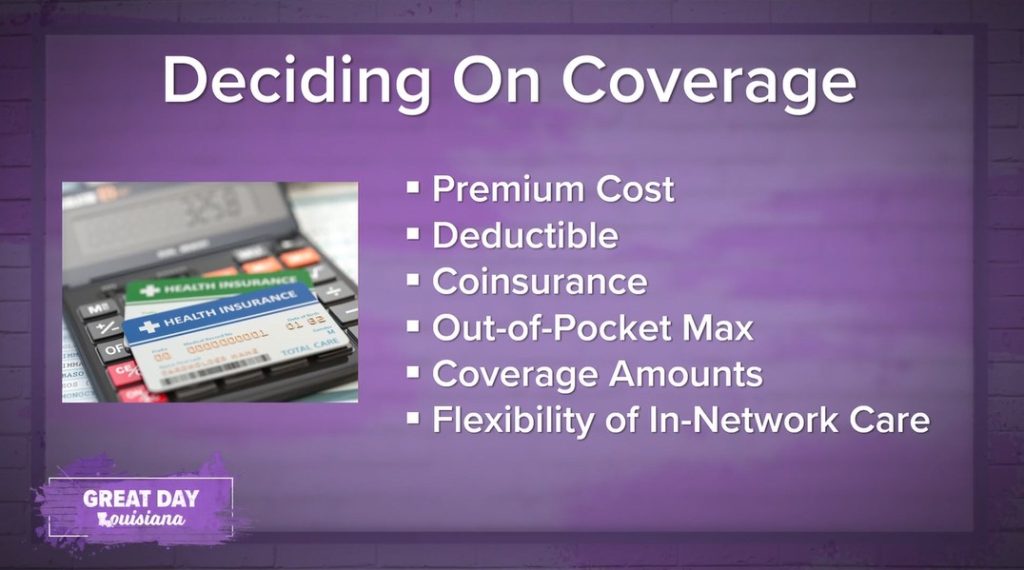
    • What are the associated costs? → Premiums, deductibles, out-of-pocket maximums, copays, and coinsurance
    • Will you be able to access your preferred providers in network?
    • What are the specific medical needs of each family member?
    • Are you anticipating any major medical expenses in the coming year such as a surgery or pregnancy?
    • If available, is one plan structure more beneficial for your needs over another (HMO vs. PPO vs. POS)?
    • Can you benefit from an FSA or HSA (via a high deductible plan)?

Reasons to pay close attention at Open Enrollment time

You started the job this year and in the flurry of onboarding didn’t fully get your benefits squared away

If you started at a new employer this year, you already had the opportunity to select benefits as part of the onboarding process. But with how stressful and dizzying it can be to get going with a whole new job, it’s very possible to miss or overlook something concerning benefits. Open Enrollment presents a time to go back through and ensure everything is set up in the most optimal way. 

Your family experienced a big life change and you missed the special enrollment period for the qualifying life change

Did you get married? Did you welcome a new child? Did your spouse go through a job change? Maybe you registered as a domestic partner – like me this year! (CA allows this, but not all states do)?

There are several “qualifying events” that come with the ability to update employee benefits outside of the traditional Open Enrollment window. It’s important to know this and do what you can to make changes as soon as possible during this “special” enrollment period. However, those life changes that qualify also happen to be rather big things… So your mind may be elsewhere as you try to simply focus on that epic wedding and honeymoon, caring for a brand new baby, or whatever it may be. If the craziness of life does what it tends to do, just make sure to get your benefits properly structured when the regular Open Enrollment comes around.

Is now the time to switch to that HDHP/HSA winning combo?

In some cases, you might not have been aware that you had access to a High Deductible Health Plan (HDHP) and the Health Savings Account it comes with. Or this could be the first time your company has offered it. Either way, Open Enrollment is a prime time to consider the benefits of this plan. 

It’s worth doing a thorough analysis and stacking a HDHP up against the other health insurance options. Examine the differences – the premiums, deductibles, out-of-pocket maximums, co-pays, co-insurance, and what’s covered vs. what’s not. Understand that to get the most out of a HDHP, it involves actually contributing to the HSA it comes with. Assess what the impact of the tax savings would do for you and consider the plausibility of maxing it out. Your employer may even contribute some funds to the HSA on your behalf – I’ve seen rather generous cases out there. Often, going the HDHP route and maxing out the HSA will yield better results compared to other health insurance coverage options. 

Let’s look at a case where the switch makes a lot of sense. In the following example, a family has been enrolled under one spouse’s low deductible PPO plan up to this point. They are all generally healthy and don’t expect any extra medical expenses in the coming year. With the current plan, their basic total annual outflow is $20,400 (the monthly premium multiplied by 12). For 2025, they are considering the switch to a HDHP so that they can contribute to an HSA. In that scenario, their annual premium cost would be $13,452. They also have the ability to max out the family HSA with $8,550 in contributions. Since they’re squarely in the 32% Federal tax bracket, they can benefit from tax savings of up to $2,736. As such, their total basic net outflow for the HDHP plus maxing out the HSA is $19,266. 

So, they get the health insurance plan for the family AND they direct $8,550 into a highly tax-advantaged investment vehicle to benefit them down the road.

Key Assumptions

  • Federal Tax Bracket: 32%
  • 2025 HSA Family Contribution Limit: $8,550

PPO Total Annual Outflow

  • Total Premiums: $1,700 x 12 = $20,400

HDHP w/ maxing out HSA Total Annual Outflow

  • Total Premiums: $1,121 x 12 = $13,452
  • Federal Tax Savings of HSA Contribution: $8,550 x 32% = $2,736
  • Total Premiums PLUS Net HSA Contributions: $13,452 + $8,550 – $2,736 = $19,266

Remember: HSA contributions = tax savings + potential for long-term investment growth (in addition to having these pre-tax dollars available for medical expenses if needed). The amount saved in taxes should absolutely be factored in when comparing the total cost of your various health insurance plans.

Are you optimizing your employer-provided life and disability insurance?

Life and disability insurance are often offered in two flavors: basic and voluntary (or some variation of these). For life insurance, the base amount is typically something like $50,000 or an amount equivalent to your annual salary and is sometimes paid for by the employer. However, they may make it relatively easy to get additional voluntary or supplemental coverage if needed – at a cost to you. On the disability insurance side, many companies will provide and pay for coverage that replaces around 50-60% of an employee’s income. In plenty of circumstances, this percentage will be capped at a monthly dollar amount (for example, the policy may replace 60% of an employee’s salary up to $5,000). In these instances, the actual amount of income replacement for higher earners ends up being less than that 50-60% mark. Some employers will then allow you to secure more disability insurance coverage on top of the base amount – again, at a cost to you.

Here’s how we think about the employer life insurance:

  • Beyond whatever is given to you for free, we favor getting any additional needed coverage through a personal policy for two main reasons:
    • If you’re relatively healthy, it will probably cost less over the long term than employee-paid group coverage through your employer.
    • The policy is yours – it doesn’t stay with your employer if you leave as is often the case with those group policies.
  • If needed, voluntary group coverage through your employer CAN be worth going for if you’re someone with certain health issues that may make it difficult to qualify for life insurance.
    • Employer life insurance usually comes with an easier qualification process (underwriting) compared to the much more comprehensive medical questionnaire/exam involved with personal policies.

And here’s our take on the employer disability insurance:

  • You should have 60% of your income protected by disability insurance. If the basic employer coverage doesn’t fully take care of this, supplemental coverage will be necessary.
  • To fill any gap, voluntary supplemental disability coverage through an employer policy is typically more cost-effective than getting it privately. However, the employer policy is often limited in its actual definition of “disability”, making it less likely to pay out in certain situations. 
  • For some, this will be fine and is the recommended route to get fully covered – especially given the lower cost.
  • If you’re in a more specialized field (such as a surgeon), we recommend getting disability coverage with a personal policy – that way it’s totally customized to your specific needs and is portable (goes with you if you switch jobs).

Is there a legal benefit available to help you cost-effectively get estate documents in place?

Estate planning anyone?? If you’re in need of a will and other important estate documents, take a close look at your benefits package. Some employers offer rather cost-effective paths to getting these important documents secured. Since this isn’t as familiar as a 401k or health insurance, I’ve seen many situations where someone didn’t realize this was on the table for them.

Good reminder to double-check beneficiaries

Speaking of estate planning, Open Enrollment is a good time to confirm all of your beneficiaries are listed as intended. Specifically, you’ll want to check on your workplace retirement plan and life insurance. We recommend having a secondary level of beneficiary(ies) in addition to primary.

Are you paying for benefits you don't actually need? (those unnecessary insurances)

I’ve come across multiple instances where someone cast a wide net with their initial enrollment and checked the box for everything. They said, “I’ll have one of everything.” While this is more favorable than signing up for zero benefits, it’s probably not the most optimal setup for you. There are certainly offerings that aren’t necessary for everyone. Reviewing these and trimming any unneeded benefits can help to save money with each paycheck. 

There might be new benefits being offered (or some that are going away)

Employers can change things up from year to year in the form of new offerings or eliminating certain options. As this has a direct impact on your household, it’s important to be aware of such adjustments and update your benefits accordingly.  

Benefit packages are getting more creative

Did you get a new furry friend this year? You might have pet insurance available to you.

Are you hoping to grow your family? Some companies are even offering IVF benefits.

More and more, employers are providing “lifestyle” type benefits to help retain their talent. This could include valuable perks like reimbursements for gym memberships, professional development support, financial wellness assistance, and so on.

Get the Most Benefit from Your Benefits

Here’s what to do:

  • Confirm your enrollment period start and end date
  • Mark your calendar
  • Review the benefits at the start of the window (or earlier), to give yourself time for any adjustments
  • Coordinate with your spouse’s benefits
  • Check with your financial planner to be sure it all makes the most sense
Fiduciary, fee-only, Certified Financial Planner, Eddy Jurgielewicz

Eddy Jurgielewicz, CFP® is a Partner and Lead Financial Planner at Upbeat Wealth, a fee-only firm based in New Orleans and serving clients virtually across the country. He specializes in providing straightforward financial guidance to ambitious young families as they navigate life’s many milestones.

Do you have questions about what we shared in this post, or anything else in general? Feel free to schedule a free consultation or drop us a line!

Sign up for our newsletter (at the bottom of this page) to stay up to speed on our Upbeat Insight.

Disclaimer: All content in this article is provided for educational, general information, and illustration purposes only. None of the information is intended as investment, tax, accounting, or legal advice. Nor is it a recommendation for purchase or sale of any security, or investment advisory services. We encourage you to consult with a financial planner, accountant, and/or legal professional for advice on your specific situation. Read our full disclaimer here.