
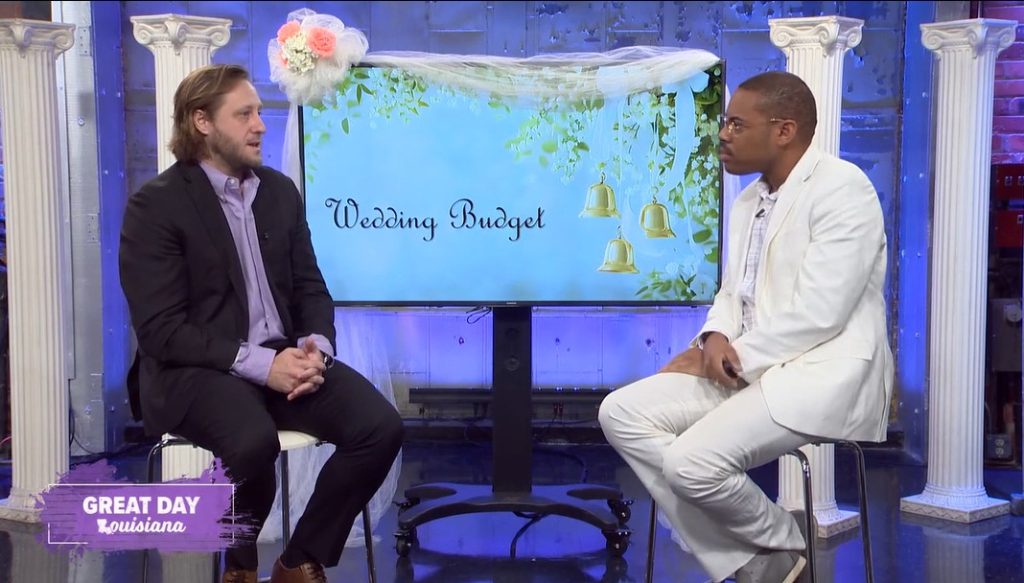
Planning a Wedding Without Losing Your Mind or Your Shirt

Wedding Budgeting for Couples: How to Plan a Wedding Without Financial Stress

For most couples, planning a wedding marks their first serious financial discussion together. It’s a major step up from playful “we don’t even need to spend money to have fun together” dates or choosing a restaurant. Add in varying family wealth levels, a saver versus spender dynamic, and a tight schedule, and it’s almost like Leo Beiderman and Sarah Hotchner getting married with a huge asteroid looming (Deep Impact reference!). Sneaky move by Leo, too –  “Marry me because it’s your only chance to survive.” Romantic! All to say, navigating this milestone together requires collaboration, trust, a shared vision, and, of course, a spreadsheet. 

Here’s how you can ensure your wedding experience is fulfilling and enriching for your soul, instead of being stressful and exhausting while trying to meet someone else’s idea of the perfect event.

Open Communication is Key

Create a Vision Board

Exchange your visions for the event and the corresponding weekend. Where are you? How many separate events are there? Are you heading straight to a honeymoon? 

Separate your vision board into three (3) columns:

  1. Non-Negotiables

  2. Nice-to-Haves

  3. Won’t Go Into Debt for

This will help organize the process of weighing trade-offs among various vendors and focus on what matters most. Our firm believes that how you live your life and celebrate important moments matters.

Therefore, we encourage you not to hold back while creating your vision board, even BEFORE discussing the money. 

Finding a Realistic Financial Starting Point for Your Wedding

Disregard Broad Data Re: Wedding Spending

“What do weddings actually cost?” A well-intentioned question, but the answer completely misses the point. There is no one-size-fits-all wedding. And while this is just one data point, I’d argue it does more harm than good. Don’t emotionally anchor how much you should spend on your wedding to the “average” cost others spent on theirs. “Oh, the average wedding cost in Louisiana is $34,000, but we *feel* like we are doing better than most, so we probably can spend twice that amount.” Disaster! 

Transparency Around Money

Without completely depleting your household’s individual savings, how much money do you have to contribute to the wedding today? This will vary depending on the household. Besides the emotional concern of how much savings you’ll dip into, it’s important to be realistic about factors such as job security, the ability to rebuild your emergency fund, and the opportunity cost of allocating this money elsewhere. Losing sleep over overextending yourself on your wedding and living paycheck-to-paycheck, or worse, accumulating debt without a realistic payoff plan, won’t help create a stress-free experience. 

When It Comes to Stakeholders, Don’t Assume!

Bizarre traditions are well, bizarre traditions. Never assume that one partner’s family will pay for the entire wedding. If you’re fortunate enough to have stakeholders, approach them candidly about what they can contribute. Understanding their financial input will help you better align their resources with a meaningful part of the weekend. More on that later! 

Establishing a Timeline

It’s not only the newly engaged who need assistance with wedding budgeting; parents may also be overwhelmed. Even if you believe your parents can cover part of the costs, their funds might not be instantly accessible. Engagements tend to happen rather abruptly. As a financial planner, I frequently see that parents need extra guidance on how much they can contribute and a pathway to making those funds liquid when needed. There’s nothing wrong with having a long engagement, especially if it gives you more time and opportunity to save for your wedding. 

Enter: The Spreadsheet

Yes, you need a spreadsheet. Fortunately, you don’t have to start from scratch. Many wedding-oriented websites offer a free one to help you get started. Here’s what I think is important to track:

  • Estimated Cost

  • Actual Cost

  • Difference (Estimated Cost – Actual Cost)

  • Vendor Name

  • Vendor Contact Details

  • Deposit Amount

  • Paid (YES/NO)

  • Final Payment Due Date

  • Amount Remaining

  • Source of Payment

Once your spreadsheet is set up, I’d recommend narrowing down your guest list. Who NEEDS to be there? The venue is the most consequential decision you have to make, so make sure you research venues that fit your mandatory guest count. Now you can start getting a feel for what venues cost, what dates are available, and what’s included in the price. You can duplicate your spreadsheet to compare different venue scenarios. Some may include everything in the price, while others only provide the bare space.  This will also allow you to experiment with your expected guest count and see how it impacts your budget. Remember, it all comes down to identifying your non-negotiables, which definitely includes guest attendance. If you can afford your “nice-to-have” items, that’s an added bonus! 

As you start pulling in quotes from vendors, it’s a great time to revisit discussions with your parents or stakeholders. Instead of giving you a check, it may be more meaningful to “sponsor” something. Whether it’s the band, a dress, or a reception dinner, this is an excellent way for them to feel more connected to the wedding. Hell, that excitement may even put a few more dollars in your pocket. 

Budget vs. Reality

There’s your original budget, and then there’s reality. CRINGE MEME, sorry Gen Z!

Wedding expenses are similar to home renovations; once you start, it’s hard to stay within your budget. Unexpected costs will arise, and you’ll find it hard to resist adding certain items. 

The more you think you thought of everything, the more surprised you’ll be that you haven’t. You should anticipate paying 1.5 to 2x your original budget.

Show Me The Money

Wedding Fund Location

You’ve set money aside, and you’re continuing to save, but where does it go? While you may be able to postpone other large purchases, like a home, if investment returns don’t align with your desired timeline, a wedding has a definitive date, and most of the money is due before it happens. Therefore, you should not be looking to *grow* this money as if it were your long-term retirement fund. Keep the wedding expense money in cash and liquid. If you’re already using a portion of your investments to fund the festivities, it can be tempting to keep it invested. But you’re taking a huge gamble that your wedding could become incredibly more expensive if you have to sell those assets at an inopportune time. 

See the illustration below, which shows that the average year sees a stock market drop of -13.5%.

It’s Okay to Pause Retirement Savings, But…

This may be an unpopular opinion, but I’m okay with you pausing your retirement savings to help absorb the cost of a wedding (if that’s something you value!). Life is for living, and it’s okay to lean into those moments. But you should really have a plan for getting back on track. Extenuating circumstances aside, a majority of families should be putting atleast 10% of their gross income toward their retirement. This also isn’t great if you’re losing your 401k match. It’s another *hidden* cost that increases the overall expense of the wedding. 

In personal finance, you either make small behavioral changes now or face the need for drastic changes later. And while the roadmap isn’t or doesn’t need to be universal, it tends to get harder, not easier, post-wedding. 

The Wedding Economy is Real… Expensive

This is just an anecdote from our wedding, but we were surprised at how costly some rental items were. Instead, we chose to *purchase* certain items and resell them afterward. My wife heroically handled ordering custom pieces from Alibaba for less than the rental cost. We then resold those items on Facebook Marketplace because, well, is there any other place to buy anything? Used is Vintage. Vintage is Beautiful! We also purchased a used Cricut, which helped us create and further customize decorations. I say *we/us* very liberally. I’m not even sure I qualified as an elf in this Santa wedding workshop my wife was running.

Debt Can Be An Ally, But It Is Not Your Friend

There are three (3) important distinctions when it comes to using debt to fund a portion of your wedding, whether it’s through credit cards, venue payment plans, or a personal loan. 

  1. Opportunity cost is in your favor. You already have the money, but you are taking advantage of a promotional opportunity that lets you keep it earning interest by shifting certain expenses to a later date. 
  2. Income is coming, but you need some extra time. You have a completely reasonable path to paying off the wedding in full from your income/wages, and you are using a 0% credit card promotional rate with some timely benefits (honeymoon!) to create extra runway. 
  3. This is a YOLO moment, and you’re taking on high-interest debt you can’t afford to pay off now or in the future without a substantial change in your financial situation. 

As mentioned earlier in this post, it’s important to be very clear about where to draw the line and what expenses aren’t worth going into debt for. Financial issues are the primary source of stress in relationships, so accumulating debt on day one is not a recipe for success. Which is my next point…

The Wedding Is The Beginning, Not The End

The beautiful thing about working with young couples is the cluster of milestones that tend to happen close together. Weddings, homes, starting a family, maybe even starting a business. Don’t lose sight of your longer-term goals. Always keep your vision of a wealthy life in mind and collaborate openly with your partner to define and live out your shared statement of financial purpose.

Frequently Asked Questions About Wedding Budgeting

Q1: How much should a couple spend on a wedding?
There is no “right” amount to spend on a wedding. Couples should base their budget on available cash, income stability, future goals, and what they value most—rather than national or state averages.
Q2: Is it okay to go into debt for a wedding?
Debt can make sense in limited situations, such as using a 0% promotional credit card with a clear payoff plan. High-interest debt without a realistic repayment strategy can create long-term financial stress early in a marriage.
Q3: Where should wedding savings be kept?
Wedding funds should be kept in cash or a high-yield savings account. Because weddings have a fixed date, investing this money exposes couples to unnecessary market risk.
Q4: Should couples pause retirement savings to pay for a wedding?
Temporarily pausing retirement contributions can be reasonable if there’s a plan to resume quickly. However, couples should account for the lost employer match and long-term opportunity cost.
Q5: How can families contribute without causing conflict?
Open conversations about expectations and boundaries are key. Allowing family members to “sponsor” specific wedding elements can help them feel involved without losing control of the overall plan.
Q6: Why do weddings almost always exceed the original budget?
Unexpected costs, upgrades, and emotional decision-making add up quickly. Couples should plan for wedding costs to be 1.5–2x their initial estimate.
Q7: What’s the biggest financial mistake couples make when planning a wedding?
Anchoring decisions to average wedding costs instead of their personal financial reality—often leading to overspending or unnecessary debt.
Fiduciary, fee-only, Certified Financial Planner, Mike Turi

Mike Turi, CFP® APMA™ is the Founder and a Lead Financial Planner at Upbeat Wealth, a fee-only firm based in New Orleans and serving clients virtually across the country. He specializes in providing straightforward financial guidance to ambitious young families as they navigate life’s many milestones.

Do you have questions about what we shared in this post, or anything else in general? Feel free to schedule a free consultation or drop us a line!

Sign up for our newsletter (at the bottom of this page) to stay up to speed on our Upbeat Insight.

Disclaimer: All content in this article is provided for educational, general information, and illustration purposes only. None of the information is intended as investment, tax, accounting, or legal advice. Nor is it a recommendation for purchase or sale of any security, or investment advisory services. We encourage you to consult with a financial planner, accountant, and/or legal professional for advice on your specific situation. Read our full disclaimer here.

Our Journey of Comingling Finances Before Getting Married

comingling finances, marriage, financial planning

What does a financial planner reflect on in the final days before getting married??? 

Finances.

Ok. Sure – a couple of other things too… But it’s up there. It’s who I am.

Money + Romance = What You Make It

We’ve all heard some version of the statistic about money being a common cause of divorce… Whatever the real percentage may be, or the specific money-related issue that tips the scale – I knew I didn’t want to be in that number. So as I count down the final hours before my wedding, I find myself thinking back on the journey my partner and I have taken to navigate the financial waters together. 

While I wouldn’t say it was the first thought that came to mind after she said “yes” (I was mostly consumed by relief that I got the answer I’d been hoping for and somehow managed to string together adequately coherent words), it wasn’t too long after our proposal that I started to think about how Christina and I would begin tackling finances together. I’ve been part of too many conversations with spouses who were already years into their marriage and still dealing with the heavy burden of misaligned thoughts on money. I’ve seen up close the strain it can have on a relationship when matters aren’t properly addressed early on. For me, it was critical to tackle this head-on in my own romantic partnership – so that the two of us were in control, rather than the other way around.

Now let’s lay some things out there before we get into it…

  • It’s not a given that finances will be a point of distress for all couples. It may naturally work for some. But it will definitely be a matter worth giving time and attention to for most.
  • People are not likely to fully change how they think about or interact with money. They will continue to have their own unique habits and mindsets that stick with them. But couples can learn how to work positively together despite such differences.
  • Before any couple can begin to work through financial matters together, they MUST first work to understand the other person’s money story… Their influential memories, their emotions, any anxieties or convictions, and so on.
  • Any level of judgment will make the conversations exponentially more difficult. Money is already a topic that requires substantial vulnerability for some individuals. It will never help to feel as though someone is looking down on how they handle or think about things.

More on Why I Felt This Was Important

It’s probably no surprise, but money stuff comes fairly easy to me – it’s what I do and talk about all day every day in my professional life. That’s not the case for my fiancée. She’s a psychiatrist who would rather think about most other things besides money. And while she’s a hell of a lot smarter than me, it’s just not something she enjoys devoting a lot of mental space to. Now I know that I’m going to spend the rest of my life with her and I hope it’s a long, happy one! But if I’m suddenly not around one day or lack the mental capacity, I would like Christina to feel confident enough to manage important financial affairs independently. 

I’ve seen a similar dynamic in plenty of other couples too. Quite often, one partner is the “chief financial officer” of the household and makes the majority of the decisions. While I’m not opposed to a spouse taking on this role, I do believe it’s highly beneficial for the other person to at least understand what’s being done and why. Further, they should be invited to provide their input – if nothing else, given the opportunity to say, “It’s up to you”.

So it was ultimately a two-part goal… 

  1. Learn how to weave healthy joint financial decision-making and expectations into our relationship early on.
  2. Ensure that both of us understand, have the chance to be a part of, and can comfortably handle the most important money matters.

Where Did Each of Us Come From?

Our socioeconomic backgrounds are quite different. I’m the son of a teacher and a carpenter, whereas she’s the daughter of a cardiologist and a mother who raised her and her five siblings full-time. I went to public school, she went to private. I carried the financial responsibility of my education and she had a college fund to take care of that. I say this simply to help illustrate that we had very unique interactions with money from a young age. As a result, we now have stark differences in how we approach financial matters as adults. I tend to stress over expenses and consider a cost for far too long while Christina generally has no issues in that department. I’m naturally more of a saver. She’s more of a spender. Neither is right, neither is wrong – we’re just different.

All that to say… if WE can figure it out, YOU can too!

What’s Our Account Setup?

Joint finances account setup for couples

Some couples go all in on doing everything jointly. Others keep it fully separate. For us, we have things that we do together and shared hopes for the future. As individuals, we have our own preferences and unique goals. Our framework is structured to allow for money movement in both arenas. 

For things we do together and use together, we’ll typically pay for those out of a shared account. For those things we do independent of the other, they come out of personal accounts. That way we can avoid any potential judgment on how the other spends their money. As long as we’re both putting the right amounts towards the things we need and want together (both for fun and necessary goals), we’re each free to spend our other personal dollars how we want.

Taking it Beyond the Accounts

The train can’t stop at simply setting up joint accounts. Opening a savings account together won’t automatically create magical money harmony. And in my mind – this is the MOST important aspect of the journey to comingle finances… It’s the process of having meaningful conversations about how to handle financial decisions together, about how you each interact with money individually, and what your future financial goals are – both those that are personal and shared. As I referenced earlier, conversations were also important to help share my financial acumen with Christina – so that she’d better understand the value of having appropriate cash savings in place, how to optimize various tax-advantaged accounts, where and why a brokerage account makes sense, even how to place trades, and so on…

I have to say, it was an especially proud partner/financial planner moment when Christina first told me she’d maxed out her Roth IRA and invested the money (without me doing it with her)!

How Did We Do This?

Money Dates! 

I hear you… it doesn’t sound all that romantic to discuss finances on a date. But here’s the thing: I believe it is much easier to talk money at an agreed-upon and preset time when both parties are expecting it, rather than randomly when one person may be caught off guard. It’s helpful to protect the time too, or it may never happen. It’s easy to put things off if they’re not on our calendars. Further, making it a date can hopefully create a more enjoyable environment. Pour a glass of wine, crack open a beer, go to your favorite dinner spot… do something to set those positive vibes. Finally, limit the time. If one or both of you aren’t all that excited to have this kind of conversation at first, knowing that it will only go on for a short chunk of time might make it more agreeable. 

Our approach? We decided to have one 30-minute Money Date one Sunday per month.

It’s worth mentioning that this was a very helpful method in our relationship. Part of why Christina doesn’t like to talk or think about money is that it can easily make her anxious to do so. Again, I have no issue talking about it. By putting these short time blocks on our calendar, she was way more receptive to the conversation – it was never a surprise and she knew it wouldn’t go longer than a half hour (we even cut the first few down to 15 minutes). 

I want to be clear: I’m not saying this has to be the ONLY time you and your partner discuss finances. But it may be the easiest and most productive way to do so while giving it the prioritization it deserves.

The Result

As with other areas of our relationship, the work is never done. Nonetheless, I’m happy to report that – after about a year and a half – I feel great about where we are. There aren’t any issues or doubts about what our shared and individual financial expectations are. Money has not been a source of contention for us. And don’t just take my word for it! I did ask Christina what her feedback on our Money Dates and overall journey has been. She expressed that, while she was very hesitant at first and really didn’t want to have “talks about money”, it’s been extremely helpful. Now she’s far more open to discussing finances rather than pushing the topic aside. 

So forget about that statistic! For us, money will be something we… 

  • Work on together
  • Have clear expectations on
  • Understand and are comfortable managing
  • Discuss openly and honestly in a healthy way
  • Agree on for big picture planning and household goals – even though we may interact with it differently in certain aspects of our lives
Fiduciary, fee-only, Certified Financial Planner, Eddy Jurgielewicz

Eddy Jurgielewicz, CFP® is a Partner and Lead Financial Planner at Upbeat Wealth, a fee-only firm based in New Orleans and serving clients virtually across the country. He specializes in providing straightforward financial guidance to ambitious young families as they navigate life’s many milestones.

Do you have questions about what we shared in this post, or anything else in general? Feel free to schedule a free consultation or drop us a line!

Sign up for our newsletter (at the bottom of this page) to stay up to speed on our Upbeat Insight.

Disclaimer: All content in this article is provided for educational, general information, and illustration purposes only. None of the information is intended as investment, tax, accounting, or legal advice. Nor is it a recommendation for purchase or sale of any security, or investment advisory services. We encourage you to consult with a financial planner, accountant, and/or legal professional for advice on your specific situation. Read our full disclaimer here.